


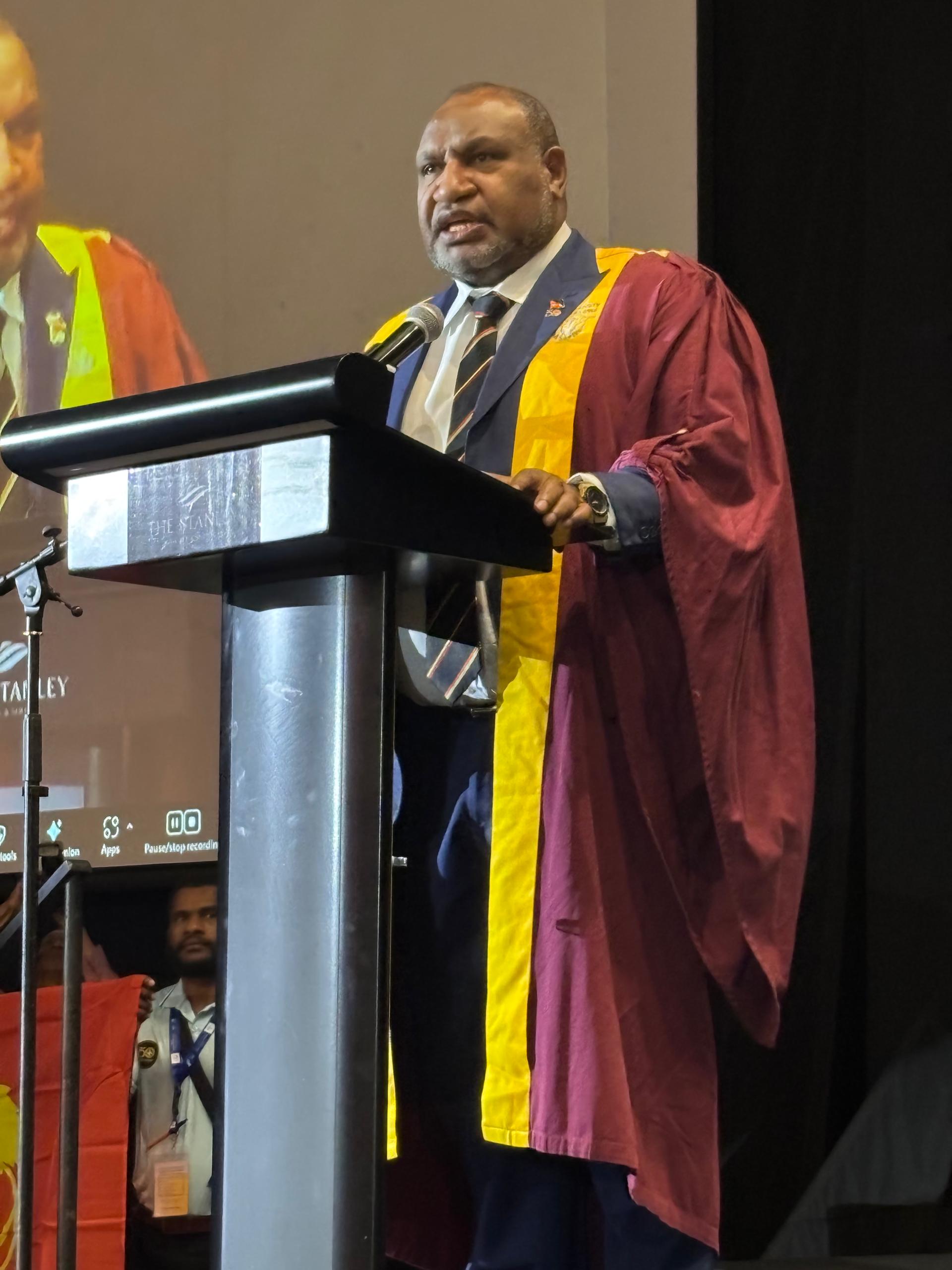
Prime Minister James Marape has urged Papua New Guinea’s health professionals and administrators to lift their game in delivering both basic and specialist healthcare as the country celebrates two historic milestones—50 years of independence and the 60th Annual Symposium of the Medical Society of PNG.
Speaking at the symposium in Port Moresby today, PM Marape reflected on the country’s journey since 1975, praising medical professionals for their contribution and resilience in the face of scarce resources and growing demands.
“If there is any one cluster of professionals that has left an indelible fingerprint in our country, it has been the medical profession,” he said.
“From community health workers in the most remote villages to surgeons in our hospitals, you have carried our country for the last 50 years.”
The Prime Minister described healthcare as a “right, not a privilege” and called for services to be available within an hour’s reach of all Papua New Guineans, whether in towns or isolated rural communities.
Mr Marape recalled his own childhood in rural PNG, where he witnessed families lose children due to lack of basic healthcare.
“As a child, I saw my parents, especially my mother, weep for the loss of her children because basic healthcare was not available,” he said. “That experience drives me today to ensure that no Papua New Guinean is left behind.”
While reaffirming his government’s commitment to strengthening basic healthcare, PM Marape also highlighted recent breakthroughs in specialist medical services, including Papua New Guinea’s first successful kidney transplant and heart bypass operation.
He stressed that these achievements were made possible by teamwork between doctors, anaesthetists, nurses, researchers, and technicians.
“Healthcare is not a one-man operation. It is a collective effort, governed by policy, process and ethics,” he said.
PM Marape acknowledged the high cost of delivering world-class healthcare, especially in a country with competing priorities in education, infrastructure, and law and order.
“Since 1975, money has never been enough to meet all our needs,” he said. “That is why I am calling for prudent, transparent, and ethical management of resources at all levels of the public service.”
He also committed the government to lifting national health standards to best international benchmarks, pointing to Australia’s system as a model.
PM Marape said the long-term solution to sustaining healthcare lies in expanding PNG’s economy.
“When I took office in 2019, I set the target of growing our economy to K200 billion. A bigger economy will give us the capacity to sustain health, education, and law and order,” he said.
The Prime Minister paused during his address to honor the late Professor Michael Alpers, describing him as one of the great contributors to PNG’s medical research, and called for a moment of silence in respect.
He also acknowledged the lifelong service of senior medical leaders including Professor Sir Isi Kevau, Professor Tefuarani, and many others.
As the nation enters its next 50 years, PM Marape said medical education, research, and rural outreach will remain priorities.
He reaffirmed the government’s support for the newly established University of Medicine and Health Sciences, which will focus on producing world-class professionals trained within PNG.
He concluded by urging administrators and policymakers to act with urgency and not delay critical reforms.
“What needs to be done, we must do. Let us not compromise basic healthcare, but at the same time provide specialist care. Together, let us secure a functioning health system for the 10 million people of Papua New Guinea.”