


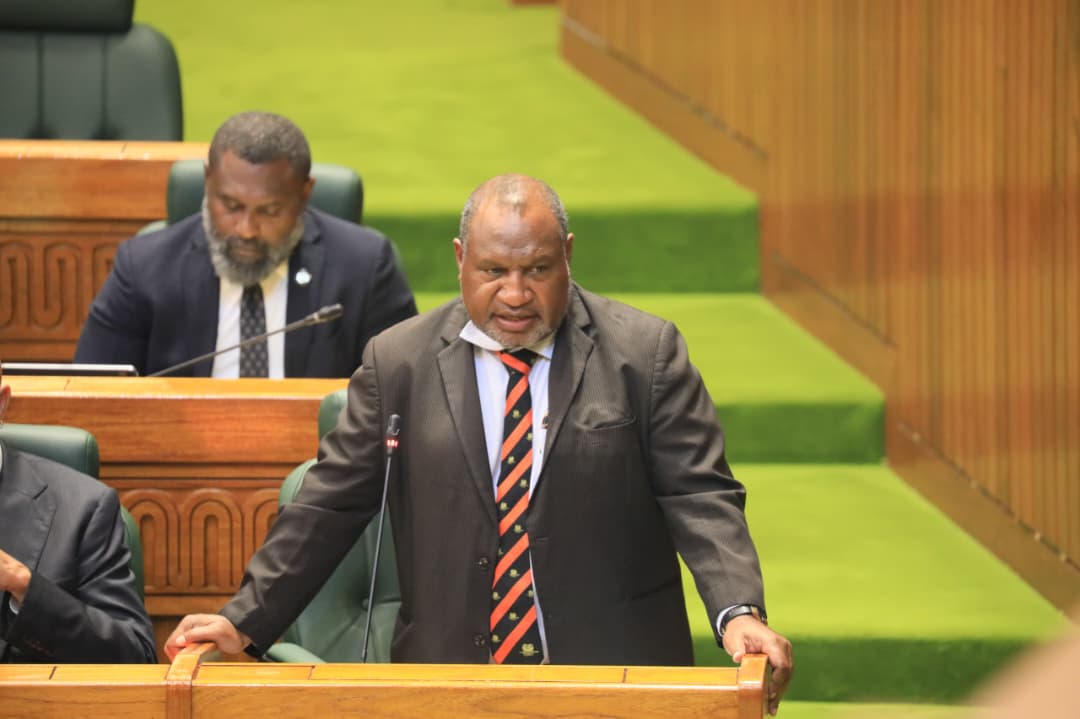
PORT MORESBY – Prime Minister Hon. James Marape has welcomed the IBS University Bill 2026, describing it as a timely step towards expanding higher education opportunities for Papua New Guinea’s rapidly growing number of school leavers. The bill was passed by Parliament 93-0.
Speaking in Parliament in support of the bill, Prime Minister Marape said the legislation would help address the increasing demand for tertiary education spaces as more students complete Grade 12 each year.
“Today our country is producing close to 30,000 Grade 12 graduates every year, and that number is steadily increasing towards 40,000 graduates annually,” Prime Minister Marape said. “When we took office in 2019, there were fewer than 15,000 tertiary spaces available in the country. That gap clearly demonstrates the urgent need to expand both our secondary and tertiary education systems.”
Prime Minister Marape said the Government had already begun addressing the issue by expanding existing universities and increasing capacity across the higher education sector.
“Over the past seven years, our government has already created an additional 6,000 university spaces in existing institutions,” he said. “The elevation of IBS to university status will now create around 1,000 additional spaces for our students, which is very important for our growing population of young people completing Grade 12.”
Prime Minister Marape also paid tribute to IBS founder Sir Mick Nades, acknowledging his lifelong commitment to education and his contribution to national development.
“Sir Mick Nades belongs to a group of people who chose Papua New Guinea as their home,” Prime Minister Marape said.“For more than 50 years, he has served this country with dedication. Through the Institute of Business Studies, close to 30,000 students have been trained over the past four decades.”
The Prime Minister noted that IBS had built strong academic partnerships with reputable international universities, including Southern Cross University in Australia, providing students with internationally recognised qualifications.
Prime Minister Marape also commended the founder’s decision to place the future governance of the institution under a trust rather than family ownership, ensuring the university’s long-term sustainability.
“He has structured the institution so that it will not remain a family-owned entity but instead be governed by a trust with reputable trustees for the benefit of Papua New Guinea,” the Prime Minister said.The Prime Minister reaffirmed the Government’s broader commitment to education, including a K11 billion programme to expand education infrastructure between 2026 and 2035, aimed at ensuring every child has the opportunity to complete Grade 12 and pursue further studies.
“Our vision is clear: every child who enters our education system must have the opportunity to complete school and access further education or training,” he said. “We want our young people not only to look for jobs but to become entrepreneurs, innovators and business leaders who contribute to the country’s economic growth.”
Prime Minister Marape also emphasised that while the Government supports the growth of private universities, education standards must remain high.
“Our degrees must meet international benchmarks similar to Australian standards, so that Papua New Guinea qualifications are recognised both at home and internationally,” he said.
The Prime Minister urged Members of Parliament to support the bill after debate, noting that it would strengthen the country’s higher education system while supporting the Government’s vision for a more entrepreneurial and skilled workforce.
“This is a worthy bill. It will expand university spaces, strengthen business and commerce education, and complement our government’s drive to produce more entrepreneurs and business leaders,” he said. “I encourage all Members of Parliament to support this legislation for the benefit of our young people and the future of our country.”
Background
The IBS University Bill 2026 was introduced in Parliament by the Minister for Higher Education, Research, Science, Technology and Sports, Hon. Kinoka Feo, who described the legislation as a milestone for Papua New Guinea’s higher education sector.
Minister Feo said the bill would provide a clear statutory foundation for IBS University, consolidating the legal standing of an institution that has served Papua New Guinea for more than three decades.
“Education is the most powerful weapon which you can use to change the world,” Minister Feo said, quoting the late Nelson Mandela while introducing the bill.
He noted that the institution traces its origins to 1987, when its founder Sir Mick Nades identified a shortage of professionally qualified accountants in Papua New Guinea, at a time when the country had fewer than 10 nationally certified accountants.
The Institute of Business Studies was formally established in 1989 and gradually expanded its programmes to include business management, information technology and postgraduate education.
Following national audits and quality assurance processes, the institution was elevated to IBS University under National Executive Council Decision No. 314 of 2016, and formally gazetted in January 2017.
IBS University currently serves a growing student population with enrolments exceeding 1,400 students in 2024, offering programmes in accounting and finance, business and management, economics and development studies, and information technology.The university also delivers degree programmes in partnership with Southern Cross University, while maintaining academic and professional collaborations with organisations including Oracle Academy, Cisco Academy, Red Hat Academy, Pearson VUE, and the All-India Management Association.
Minister Feo said the institution currently employs 102 full-time academic and professional staff, along with 70 personnel engaged in campus development and facilities management at its campus near the foot of Mount Eriama in Port Moresby.
Future plans include the introduction of new programmes such as a Bachelor of Education in Digital and Blended Learning and a Master of Leadership and Strategic Management, as well as infrastructure developments including an innovation centre and a School of Health Sciences.
Minister Feo said the passage of the bill would strengthen governance arrangements and provide long-term institutional certainty for IBS University.
“This legislation is not merely institutional reform,” he said.
“It is an investment in our people and in our future.”