


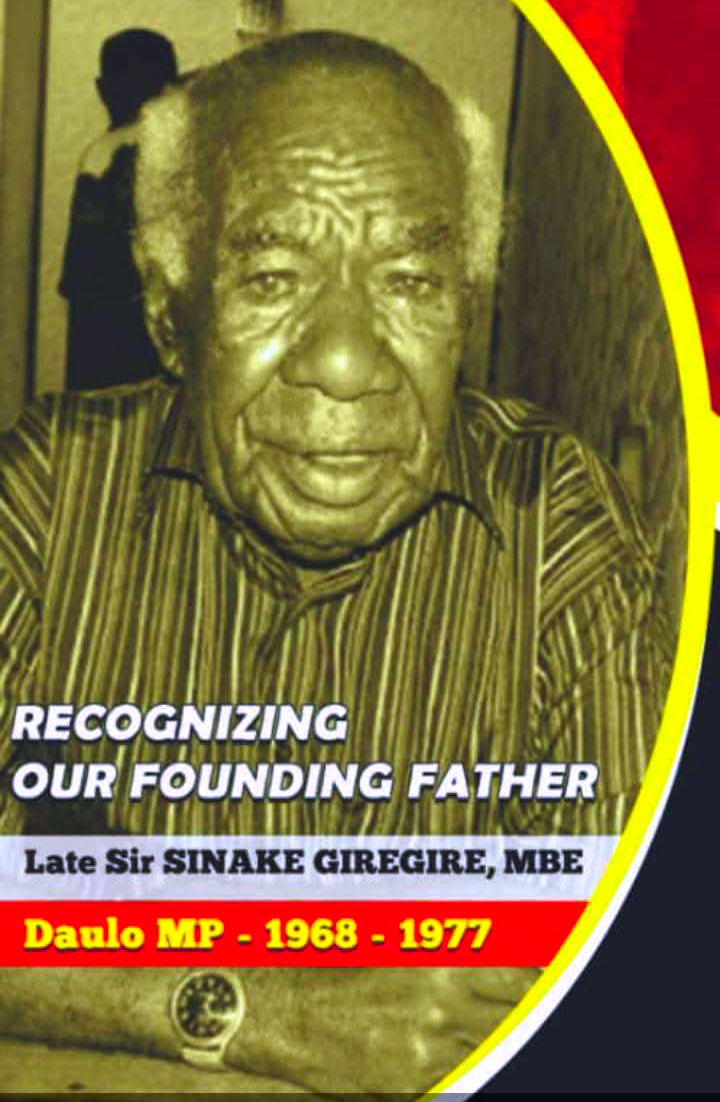
Country Party – Coffee – First Millionaire (Author Source: Wilson Thompson)
As we celebrate 50th Independence Anniversary , and reflect on the event, it is a long journey that started before 1975. Sir Sinake started with many expatriates in sawmill, mining and tea, coffee, poultry, cattle etc. He promoted agriculture including establishment of Grains Board, connected world to PNG.
Sinake Giregire is known for his promotion of agriculture and business and for politics. We have many Prime Minister and senior persons associated with the foundation of PNG and the Constitution, Giregire would be best known as the only PNG who served on all Constitutional Development and Planning Committee from 1964 to 1975 and wanted to be the first Governor General and aspired to be Prime Minister.
As we consider the moment, Giregire is also founder of now United and the Country Party, where these two political parties former and current members did contribute in this journey.
Take time to read the Country Party story in this journey…
The existence of PNG Country Party is the result of earlier political developments prior to the Independence of Papua New Guinea. There were attempts in 1964 to 1968 in formation of political parties. A meeting was held in Port Moresby and a Territory Country Party, organized along the Australian Country Party was formed in 1967.
However, this Party never entered into any election nor its leadership progressed. The connection between Australian Country Party and political parties in PNG was through the Compass Party (later United Party). Despite talks and media release, the Compass Party was formed in Minj; WHP in 1967 by certain expatriate and indigenous Members of the House of Assembly led by Sinake Giregire, who were aligned with the farmers and planters association, the Highlands Farmers & Settlers Association Incorporated (HFSA). Members of HFSA in Parliament were Ian Downs, Highlands Special (President of HFSA), John Watts (WH Regional), Mike Casey (Kainantu), Sinake Giregire (Goroka) (first indigenous member of HFSA). The prominent national being Giregire and Members from Simbu and EHP.
Sinake Giregire was born before the first Lutheran missionaries established Asaroka Mission in 1933. He witnessed the Second World War as the Japanese bombed the Asaroka Airstrip and the Mission Station. He did his schooling at the Station and been one of the brightest was sent to Heldsbach School in Finschhafen. He returned to teach in Goroka. He left in early 1950s to venture into what the expatriates were doing in well established Kainantu District. He learnt about alluvial mining, timber milling and coffee. From proceeds from mining he sawed timbers which build houses and administration buildings in Kainantu. He also found his gold nugget and within few years took that knowledge and got coffee seedlings to start his life in Goroka
He started the Yanowa Coffee Plantation and was into farming and was the first national to be admitted into the expatriate only Farmers and Settlers Association. By 1964, Giregire was an icon in coffee, vegetable and livestock farming and in establishing the Highlands Commodity Exchange Ltd and had achieved his fame as the first indigenous millionaire. We leave the exploits in business and get to the political history of PNG.
In 1958 Sinake Giregire was elected Councillor and first President of the Asaro Watabung Local Government Council. Whilst there, he contested the first 1964 Election and elected as Member of House of Assembly for Goroka Open, which comprised Goroka, Unggai Bena and Asaro Watabung Districts
Giregire appointed to then First Cabinet as Minister responsible for Services that includes Communication, Housing, Works and Supply, Electricity and appointed to the first Constitutional Development Committee.
In 1967 the Territory Country Party was established as Branch of the Australian Country Party, now National Party of Australia. However, with expatriates and himself the Compass Party was formed in Minj; WHP in 1967 with Giregire as Leader. Expatriate and indigenous Members of the House of Assembly led by Sinake Giregire, renamed the Compass Party to United Party and Giregire relinquished Leadership to Tei Abal and Deputy Leader to Paul Langro.
After its formation, Tei Abal (Wabag) was appointed its Leader with Giregire as Deputy. The United went into 1968 Elections and returned as a force against the pro independence, Pangu Party. As the Party was conservative, most of its Members were appointed Ministers and Vice Ministers. The Party went again to the polls in 1972 and returned and with the self government in 1973. Tei Abal and Sinake Giregire and Paul Langro were on appointed to the Constitutional Planning Committee.
In 1968, Giregire was elected into 2nd House of Assembly and was appointed Minister for Agriculture, Stock Fisheries and Forestry. He was appointed to the second Constitutional Development Committee
Giregire negotiated the funding of teaching facilities with the UNESCO for the Goroka Teachers College, now University of Goroka.
As Minister, he Introduced sugarcane and oil palm planting from Kuching , Malaysia and sourced funding for the establishment of Agriculture Training College for Sepik, Highlands , Popondetta and Vudal. He was then appointed Minister for Post and Telegraphs (Communication). He visited the World Bank and sourced the first World Bank funding for communication infrastructure that saw the Repeater stations rollout, Post Office or PTC office building and upgrades across the country. The SeaCom cable from USA through Guam to PNG was connected to Madang that saw PNG getting telephone calls directly than operator assistance such as in Australia.
In 1972 he was elected Member for Daulo in the third House of Assembly and appointed to the third Constitutional Planning Committee that toured the country and selected countries to adopt a government system and constitution for the Independent State of PNG.
In March 1974 Michael Pondros, Member for Manus formally announced that Country Party is established in PNG, independently of the Australian Party and announced the Ten (10) Point Policy. Some interesting Country Party highlights includes election of Mathias Yaliwan for Yangoru seat and the Peli movement. He resigned and his protégé Linus Hepau was elected.
During the Constituent Assembly debates of the Constitution, Giregire formed the Nationalist Pressure Group comprising Mataungan, Melanesian Alliance, PPP and Country Party to push for and adopt the Constitution as it was to oppose the Pangu majority where United Party at times sided with Somare to remove certain provisions in the proposed Constitution such as removal of provincial governments, citizenship issues and separation of powers.
The third Party was the Peoples Progress Party under Julius Chan (Namatanai). At this time, the Australian Country Party sent an officer to PNG to work on establishment of a party. This was going on in Goroka and there were talks of a Country Party. The Country Party was formally recognized on the floor of Parliament in March 1974 under the leadership of Sir Sinake Giregire (MP for Goroka and later Daulo) and Michael Pondros (Manus).It�s policy was focused on the Eight Point Plan of the PNG Government with its emphasis on development of agriculture, sustainable use of resource, rural development and economic growth with urban centers as service centers.
In September 1975 Giregire was nominated for the first Governor General but lost to Sir John Guise. In 1977 he nominated Tore Lokoloko of Country Party as Governor General to succeed Sir John Guise who resigned to contest elections. In 1982 he nnounced that Country Party will form Government but founders Sir Sinake Giregire and Michael Pondros lost election and Members like Suinavi Otio and others joined PPP. In 1983 – Sinake Giregire, President of Country Party was awarded MBE for services to politics
In 1987 – Peter Kuman, Member for Simbu Regional was the Party Leader and took to 1992 Elections to suffer defeat In 1997 National Elections, no Members elected s with Non Parliamentary Leader – Dekot Koki. However, the former Country Party MP for Goroka (1977-1982) and later National Party member, Sir Silas Atopare was elected 7th Governor General and second from Country Party
In 1997, Silas Atopare was elected Governor General of PNG. He was a Country Party Member for the Goroka Open from 1977 to 1982. This brought some interest towards the re-organization of the Party. In 1998, some University of PNG students wanted to resurrect the ailing and historical party. They realized that despite being recognized on floor of Parliament and by the Electoral Commission, it did not have an administrative and operational capacity and was involved only in Parliament. A formalized institution with its Constitution and Objectives was formally incorporated with Registrar of Associations to become PNG Country Party.
In 1998 – Sinake Giregire awarded Companion of Star of Melanesia (CSM) for services to agriculture and business In 2002 – Dickson Maki elected Member for Kompiam Ambum under Country Party.
In 2001, the enactment of the Organic Law on Integrity of Political Parties and Candidates provided the opportunity as it did to other political parties to give formal and operational capacity. It was formally registered with the Commission for Integrity of Political Parties and Candidates. In 2002, it went again into the National Elections under the Leadership of Sir Sinake Giregire. He came third in his former seat of Daulo and the new MP in Parliament was Hon. Dickson Maki, (Kompiam Ambum, Enga). In 2005, Hon. Jamie Maxtone-Graham was elected in By-Election for Angalimp South Waghi, WHP and joined the Party.
On 30th Independence Anniversary in 2005, Prime Minister Grand Chief Somare called all members of Constitutional Planning Committee and congratulated them and hosted function which includes John Momis , Sir John Kaputin, Matiabe Yuwi, John Numi, Angmai Bilas
Somare announced the Knighthood for Sir Sinake Giregire and Sir Matiabe Yuwi. In the same year with By-election, Jamie Maxtone Graham was elected MP for Angalimp South Waghi and 2006 Jim Nomane elected Member for Chuave under Country Party
In 2006, the Country Party pushed for the launching of the National Agriculture Development Plan and Minister for DAL, Mathew Siune sacked DAL Secretary and top management which saw the NADP launching in Lae In the ensuing 2007 Elections, – Hon, Jamie Maxtone-Graham, MBE and returned with Hon. Jim Nomane, (Chuave, Simbu) and Niuro Toko Sapia (Rai Coast, Madang). The PNG Country Party was a minor Coalition partner in the National Alliance Party led Government..
In 2008, the Country Party moved Motion for the Inquiry into the Finance Department, which saw the establishment of Commission of Inquiry, the Report has been gagged from debate by Court proceedings. In the ensuing change of government on the 2nd August 2011, Hon Peter O’Neill, MP, Prime Minister rewarded Country Party with two Ministries, Hon Thompson Haroqkave, MP for Goroka and Minister for Environment & Conservation and Hon. Jamie Maxtone Graham, Minister for Health.
In 2012 National Elections, the Party returned with three but one still listed as Independent being, Hon Richard Mendani, MP (Kerema) and Hon. Jeffrey Kuave, MP (Lufa). The Country Party voted with O�Neill as signatory to Alotau Accord. However, the Party was mot rewarded with Ministry, Vice or Parliamentary Committee. Hence, Hon. Kuave was appointed Shadow Minister for Community Development, Sports and Pacific Games.
In 2017 the Country Party goes into election to win MPs again but returned with Hon Henry Ame, Member for Goroka and Vice Minister for Agriculture and Livestock and Hon Chris Haiveta, Governor of Gulf Province and its Leader.
The Country Party contributed to development of the government system and Constitution with Sir Sinake being the only Papua New Guinean who sat on all 3 Committees until Independence. Also, Country Party had more contribution to Agriculture, Livestock and Forestry and Fisheries sector and also Communication and Rural Development in PNG.
The role of Country Party featured prominently in the Constituent Assembly when it was took the lead in the Nationalist Pressure Group (Momis, Kaputin and Giregire) who wanted to present the CPC Report as it is to become the Constitution and on one hand Somare and Pangu who wanted amendments such as dropping the Provincial Government system.