


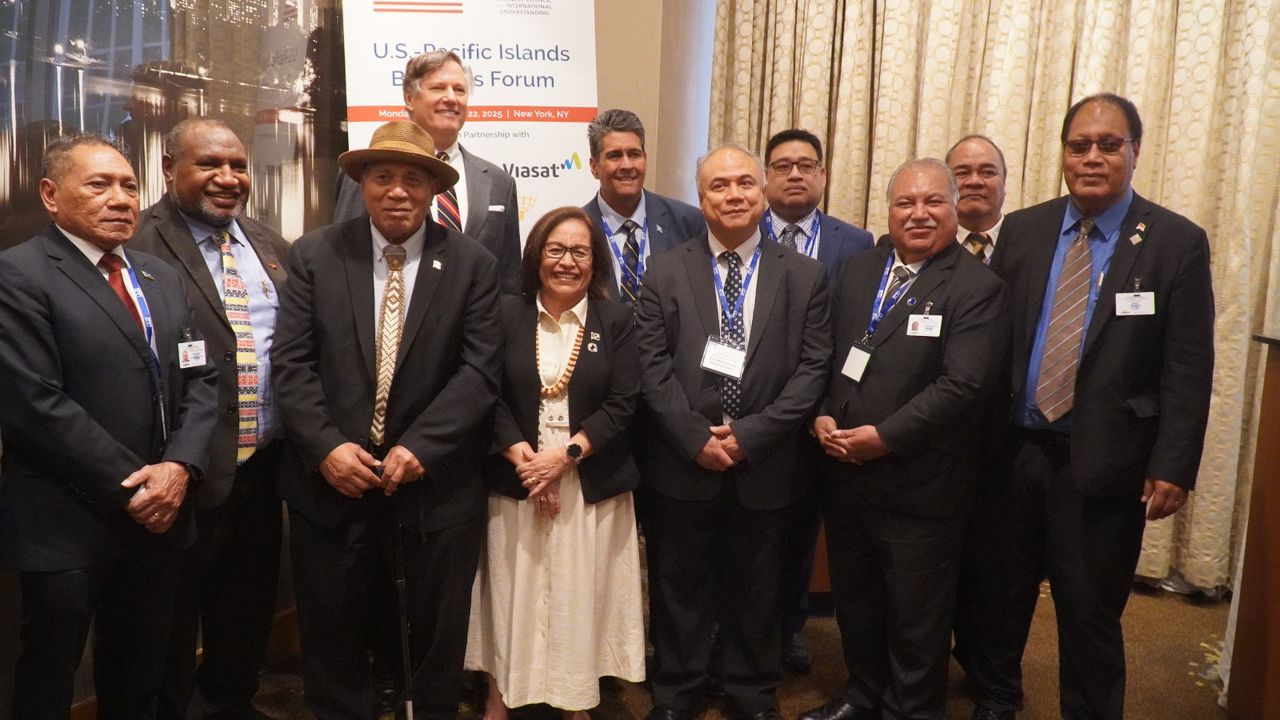
Prime Minister James Marape has called on the United States and its business community to deepen trade and investment ties with the Pacific, stressing that the region should be seen as a hub of opportunity rather than a recipient of aid.
Speaking at the US–Pacific Islands Business Forum on the sidelines of the United Nations General Assembly (UNGA), hosted by the Business Council for International Understanding (BCIU) in partnership with Newmont, Viasat, and Atlas Air, PM Marape said Pacific Island countries were re-defining themselves as “big ocean nations” with resources and opportunities second to none.
“We may be called small island states, but we are in fact big ocean nations,” Mr Marape said. “Our seas, our airspace, our forests, and our human capital are immense. The Pacific holds more than $3 billion worth of tuna and fisheries resources every year, yet our citizens remain among the lowest per capita earners in the world. This must change.”
The Prime Minister expressed gratitude for the recognition of Papua New Guinea’s 50th Independence Anniversary and highlighted the shared values between the Pacific and the United States.
“We are all democratic nations, we are all free market economies, and we are largely Christian nations,” he said. “These are the same values that the United States embodies and leads with globally. We congratulate the U.S. on its upcoming 250th anniversary of independence—a true testimony to the miracle of democracy and free market economy.”
Mr Marape urged the US to pivot from aid and grants towards sustainable partnerships based on fair trade and private sector investment.
“Aid and grant relationships are subservient; trade relationships elevate human dignity,” he said. “We welcome U.S. companies to invest in fisheries, green energy, tourism, downstream processing, and infrastructure. The Pacific must become a hub of prosperity, not dependency.”
The Prime Minister acknowledged major American companies already operating in PNG, including ExxonMobil, Newmont, Hilton, and Marriott, and invited more US firms to expand into the region.
He pointed to ExxonMobil’s PNG LNG Project, which represents the single largest foreign direct investment in PNG since independence, as evidence that the country could host and sustain long-term ventures.
Closing his remarks, Mr Marape described the Pacific as a critical partner for global prosperity and environmental stewardship.
“Our Blue Continent is more than a collection of islands—it is the world’s largest carbon sink, with oceans and forests that help sustain the planet,” he said. “Together with US companies and global partners, we can build a Pacific that is prosperous, dignified, and respected.”