


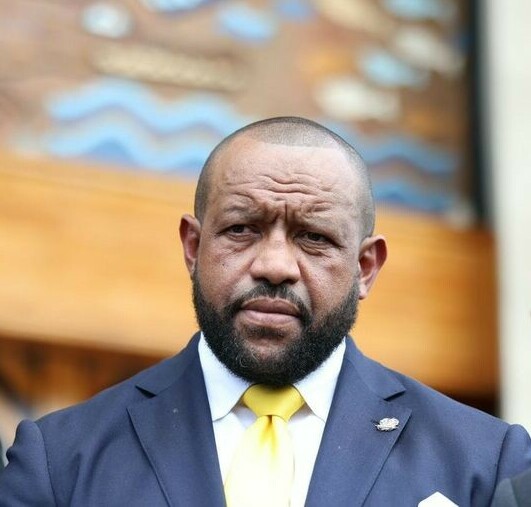
Opposition Leader James Nomane has warned that Papua New Guinea faces a “national emergency” if it is placed on the Financial Action Task Force (FATF) grey list, cautioning that any attempt to downplay the risks would be dangerous for the country’s economy and international standing.
In a strong-worded statement, the Chuave MP criticized recent comments suggesting that grey listing is common and has little impact on foreign investment, saying such views are misleading and ignore global evidence.
“Grey listing is not a routine administrative label. It is a global warning sign that a country’s financial system is vulnerable to corruption, money laundering and criminal abuse,” Mr Nomane said.
He explained that once a country is grey-listed, international banks and financial institutions respond immediately by imposing stricter compliance checks, slowing transactions and increasing the cost of doing business.
According to Mr Nomane, this has been the documented experience of every country placed on the FATF grey list.
Citing independent studies by the International Monetary Fund and the World Bank, the Opposition Leader said grey-listed countries typically suffer a 7–10 per cent decline in foreign direct investment, face higher borrowing costs and experience reduced access to correspondent banking services.
“These effects are real, measurable and unavoidable,” he said. “To suggest otherwise is to mislead our people.”
Mr Nomane said PNG was particularly vulnerable due to its narrow economic base, pressure on the kina—which he described as the weakest it has ever been—and heavy reliance on foreign correspondent banks.
He warned that PNG lacked the economic buffers enjoyed by larger or more diversified economies.
“The consequences here would be deeper, sharper and longer lasting,” he said.
He also rejected claims that grey listing would be temporary, stressing that removal from the list depends on strong and credible reforms.
“It is not the duration of grey listing that matters, but the damage done while a nation struggles to climb out of this self-created economic hole,” Mr Nomane said.
According to the Opposition Leader, PNG’s risk of grey listing stems from years of weak enforcement, poor supervision and a lack of political will to address corruption and illicit financial flows. He said FATF assessments show that while PNG has laws in place, they are not being effectively implemented.
“That is a failure of leadership, not a failure of technical staff,” he said.
Mr Nomane called for honesty, urgency and disciplined coordination across government institutions, describing the issue as one of national economic security.
He urged the Government to move beyond meetings and statements and demonstrate real, verifiable results through stronger enforcement, improved transparency and better supervision of high-risk sectors.
“The Opposition stands ready to support genuine reforms that protect our financial system and safeguard our economic future,” he said. “But we will not allow complacency or misinformation to put our country at risk.”
Mr Nomane concluded by stressing that grey listing is harmful and not normal, warning that Papua New Guinea cannot afford to be placed on the FATF grey list.