


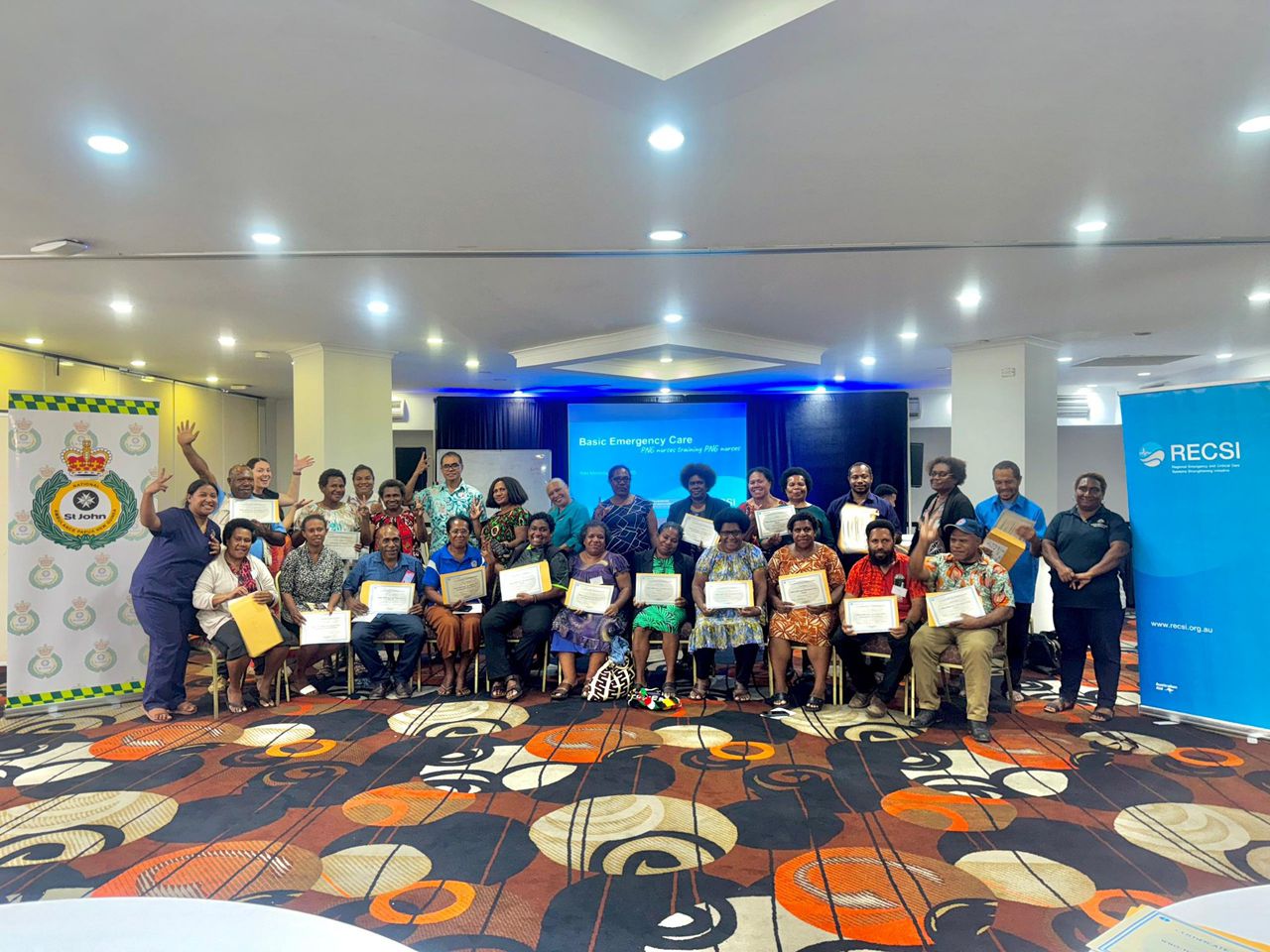
Papua New Guinea has marked a new chapter in Basic Emergency Care (BEC) training, with the successful delivery of the first BEC provider and training-of-trainers courses for nurses in Port Moresby last week (August 18-22).
The courses were taught by nurses and led by local facilitators from Port Moresby General Hospital, National St John Ambulance PNG, and ANGAU Memorial Provincial Hospital in Lae.
For the first time, an all-nursing team of BEC trainers led the delivery of the courses, showcasing the capability and leadership of PNG’s nursing workforce and equipping nursing leaders from 14 provinces with essential, life-saving skills in emergency assessment and management.
The 18 participants included representatives from nursing schools across PNG as well as the National Department of Health (NDOH), ensuring broad national representation and alignment with health system priorities.
PNG’s first BEC master trainer Sr Wilma Sebby, who is the Nurse Unit Manager with the Emergency Department at ANGAU Memorial Provincial Hospital, said: “For nurses to teach nurses, it’s a good thing. We’re speaking the same language, and we know that nurses are the frontliners for any healthcare system. When a nurse is teaching, they will better understand us. We’re kind of using the same language.”
BEC course coordinator with Port Moresby General Hospital, Sr Marcia Willie said: “Basic Emergency Care training is very important for PNG nurses because it improves our everyday practice as care givers whether in the pre-hospital setting or in the health facility to follow a systematic approach when dealing with life threatening conditions.”
“It also helps us to do proper handover and transfers between facilities or from pre-hospital care to the health facility so that the patient care is effectively carried out or continued.”
“As a master trainer, having this opportunity to teach BEC to my fellow nursing colleagues from around the country enables us to speak the same language and gives us the confidence to continue to reach out to as many nurses as we can and to train them so that they can become BEC providers.”
The BEC course was developed by the World Health Organization (WHO) in collaboration with the International Committee of the Red Cross (ICRC) and the International Federation for Emergency Medicine (IFEM).
It is designed for first contact providers of emergency care in resource-constrained settings, and provides a safe and structured approach to managing acutely ill and injured patients.
These courses are being delivered as a partnership between the Regional Emergency and Critical Care Systems Strengthening Initiative (RECSI), the World Health Organization Collaborating Centre for Nursing, Midwifery and Health Development at the University of Technology Sydney (WHO CCNM UTS), and the NDOH.
RECSI and WHO CCNM UTS are both supported by the Australian government through the “Partnerships for a Healthy Region” initiative. Course delivery has been facilitated by RECSI’s implementing partner National St John Ambulance PNG.
As nursing leaders, participants are now positioned to impart these skills to colleagues in their provinces and institutions. The training will also boost the numbers healthcare workers from the existing 135 who have completed BEC training.