


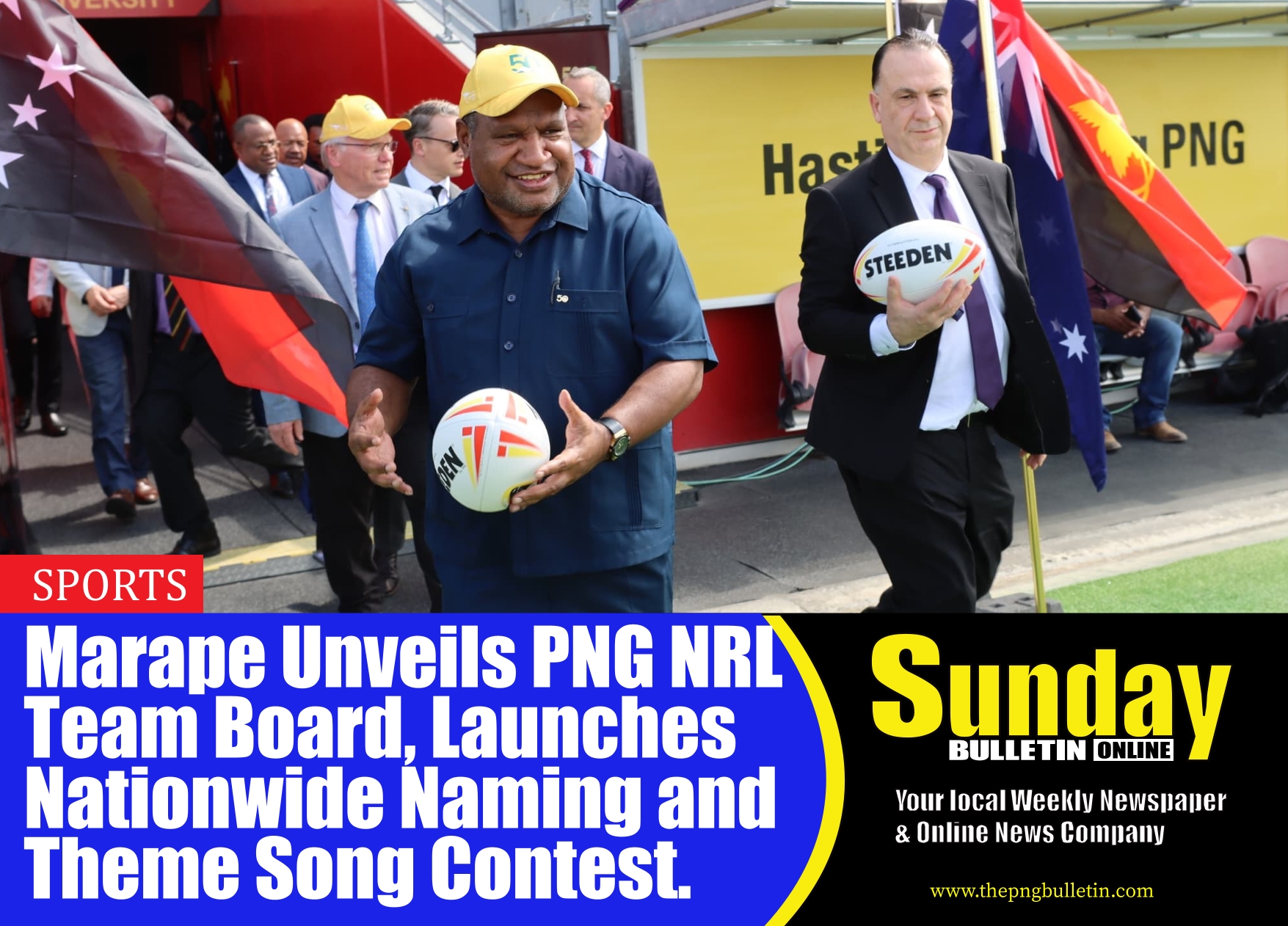
PRIME Minister James Marape has officially announced the board for Papua New Guinea’s inaugural National Rugby League (NRL) team and launched a nationwide competition to name the team and compose its theme song, describing the occasion as “a historic moment for sport and nation.”
Speaking at a packed press conference at the Santos National Football Stadium today, Tuesday June 24 2025, Marape said the franchise represents far more than sport—it’s a symbol of unity and national pride.
“This is more than just sport—it’s our national unification project,” said the Prime Minister, drawing applause. “One team, one people, one nation—that is the vision behind our NRL team.”
Australia’s Minister for the Pacific, Hon. Pat Conroy, was present for the announcement, praising the initiative as “visionary” and likening it to the iconic 1975 partnership between PNG’s Grand Chief Sir Michael Somare and Australia’s former Prime Minister Gough Whitlam.
“This team has been talked about for decades,” said Minister Conroy. “But it’s through the leadership of Prime Minister Marape, with the strong support of Prime Minister Albanese, that it’s now a reality. This is about jobs, tourism, unity and pride—it will go down in history.”
Prime Minister Marape unveiled the seven-member board, highlighting their depth of experience in sport, business, and national leadership:
- Mr Ray Dib – Chairman; former Canterbury-Bankstown Bulldogs chairman and respected rugby league administrator.
- Ms Lorna McPherson – Veteran rugby league official and community leader.
- Mr Stan Joyce – Former SP Brewery Managing Director and rugby supporter.
- Mr Richard Pegum – Financial expert and Chairman of Mayur Resources.
- Mr Ian Tarutia – Influential voice in PNG’s private sector.
- Mr Wapu Sonk – Managing Director of Kumul Petroleum and Chair of the PNG NRL Bid Team.
- Mr Marcus Bai – Former PNG Kumuls captain and one of the country’s most celebrated rugby league figures.
“The two governments will support from the sidelines, but will not interfere,” Marape emphasised. “This is a sports business—it must be run professionally.”
He credited the efforts of the bid team and reaffirmed their continued involvement as the franchise transitions into competition mode.
In a rousing call for public participation, Prime Minister Marape launched a national competition inviting citizens to propose a name and compose a theme song for the new team.
“The name must unite us, tell our story, and reflect our past, present, and future,” he said. “It should also resonate with our Australian friends—it must become every Aussie’s second team.”
Ms McPherson was tasked with leading the public engagement campaign through social media and community outreach.
“We are a democracy. The name must be supported by 60 to 70 percent of our people,” Marape stated.
Reflecting on PNG’s bond with Australia, Prime Minister Marape recalled a personal moment during a 2024 trek along the Kokoda Trail with Prime Minister Anthony Albanese. At Isurava, a local chief shared why his people supported Australian forces during WWII:
“He told me, ‘We had no choice but to defend our territory.’ That story remains with me—it reminds us of where we come from, and why we must build a future together.”
Minister Conroy confirmed that the Australian Government will invest over A$600 million over the next decade in PNG rugby league, infrastructure, and franchise development.
“This is not just sport—it’s economic development and nation building,” said Conroy. “More than 5,000 Papua New Guineans will be employed directly—from stadium upgrades to team operations.”
He added that the team will boost tourism, strengthen people-to-people ties, and transform PNG into a rugby league powerhouse.
“This team will not just compete. It will dominate. It’ll make Penrith look like minnows,” Conroy joked to loud applause.
Prime Minister Marape also announced that road upgrades are being planned from the Highlands, Morobe, and Alotau to Port Moresby to facilitate game-day travel.
“By 2028, fans will drive in, watch the game, and return home. We are building not just a team—but a nation.”
The Santos National Football Stadium will host the team’s early matches, with the Sir Hubert Murray Stadium to become its permanent home.