


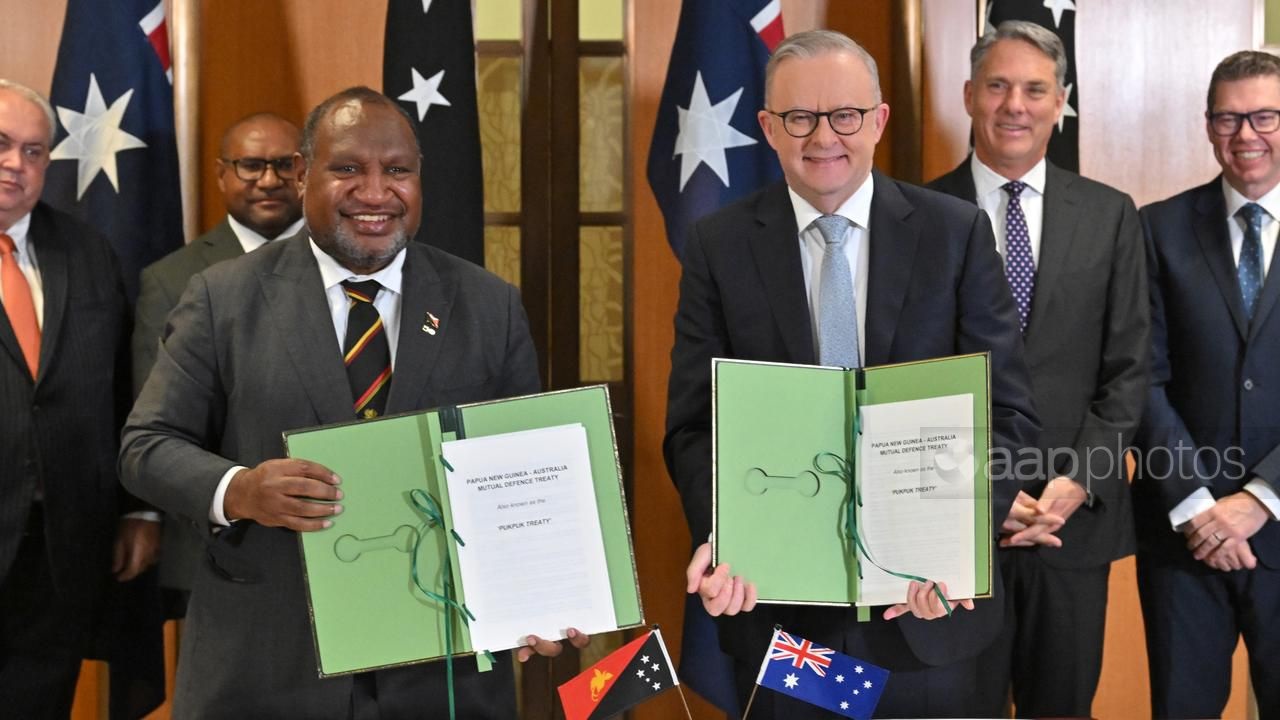
The Government of Papua New Guinea today entered into the PukPuk Treaty with Australia — a landmark bilateral defence agreement designed to protect and strengthen Papua New Guinea’s sovereignty, independence, and territorial integrity through mutual defence cooperation, modernisation of the PNG Defence Force (PNGDF), and significant socio-economic benefits for the people of Papua New Guinea.
The signing took place in Canberra in the presence of Prime Minister Hon. James Marape and Australian Prime Minister Hon. Anthony Albanese.
Remarks by Hon. Dr Billy Joseph, Minister for Defence:
“Prime Minister Hon James Marape, I congratulate you on signing this critical mutual defence treaty today in Canberra. It is the correct, forward-thinking decision taken at exactly the right time,” said Minister for Defence Hon. Dr Billy Joseph.
Dr Joseph emphasised that this treaty reflects maturity in bilateral relations and a shared vision for regional stability.
“We must not dwell in the past, especially on past decisions by either government. As we mark our 50th Independence Anniversary and look to construct the next 50 years, national security must be at the core of that construct. The PukPuk Treaty is the foundation of that outcome.”
Legal and Constitutional Safeguards
Minister Joseph reaffirmed that the treaty is fully compliant with the Constitution of Papua New Guinea and does not require any constitutional amendment for its implementation.
All provisions are consistent with existing legal frameworks, including:
• Section 117 – Treaties
• Section 202 – Mandate of the Defence Force
• Section 206 – Visiting Forces
• Sections 189 & 201 – Control and Command of the PNGDF
Under the treaty:
• PNG citizens recruited into the Australian Defence Force (ADF) will not be members of the PNGDF.
• They will hold dual citizenship and may attain Australian citizenship within nine weeks of recruitment.
• A similar opportunity will apply to Australian citizens wishing to serve in the PNGDF.
While PNGDF and ADF personnel will train and operate together to improve interoperability, the Commander of the PNGDF retains full command and control of his forces within PNG’s jurisdiction. Likewise, the Commander of the ADF maintains authority over Australian troops.
“This ensures that the mandate of the PNGDF under Section 202 remains fully protected,” said Minister Joseph.
ADF members will not enjoy blanket immunity in Papua New Guinea. Any ADF personnel who commit offences while off duty will be prosecuted under PNG law, while operational offences will be investigated and prosecuted under military law in cooperation with the Royal Papua New Guinea Constabulary (RPNGC).
Implementation will occur within designated military facilities in both countries.
Strategic and Economic Benefits
The PukPuk Treaty delivers significant benefits to PNG across multiple areas:
1. Strategic Deterrence:
Provides a legal framework for mutual defence, ensuring PNG’s protection from conventional and non-conventional threats. All deployments abroad will remain subject to PNG Cabinet and Parliamentary approval.
2. Building PNGDF Capability:
Australia will invest in PNGDF land, air, maritime, and cyber capabilities — including training, infrastructure, and technical support — raising the PNGDF to international standards.
3. Socio-Economic Opportunities:
Over 10,000 Papua New Guineans will be recruited into the ADF, gaining world-class military experience and contributing income and remittances to the PNG economy.
4. UN and Regional Engagement:
The treaty strengthens PNGDF’s qualifications for UN peacekeeping missions, fulfilling its international obligations under Section 202.
“This treaty gives PNGDF the higher platform to participate in UN missions. It is not intended to be used against any third party, but if we are attacked, it is our responsibility as a government to defend our people and sovereignty,” Minister Joseph said.
5. Foreign Policy Leverage:
The treaty enhances PNG’s diplomatic position on security matters, giving greater weight in engagements with regional partners, including our neighbours.
“When we ask for respect for our sovereignty, it has weight,” the Minister added. “This treaty strengthens our ability to stand firm.”
6. Balanced Global Engagement:
“We must stop pushing China into the conversation every time we talk about PNG’s security. China has its own security and economic interests — and so must we. Australia is China’s largest trading partner, yet they balance those interests. PNG will do the same — we will choose our security partners based on our national interests while maintaining open relations with all nations,” Dr Joseph said.
7. Peace and Stability in the Pacific:
As the two largest countries in the South Pacific, PNG and Australia share a duty to maintain peace and stability. The PukPuk Treaty provides a platform for cooperation, preventing geopolitical competition and strengthening regional unity.
8. Mutual Respect and Flexibility:
The treaty can be amended or terminated by either party with twelve (12) months’ notice. This ensures sovereignty and flexibility while upholding mutual respect and shared values.
“The PukPuk Treaty is not about dependence — it is about empowerment. It ensures Papua New Guinea stands stronger, safer, and more confident in defending its sovereignty in an increasingly complex regional environment,” Dr Joseph said.