


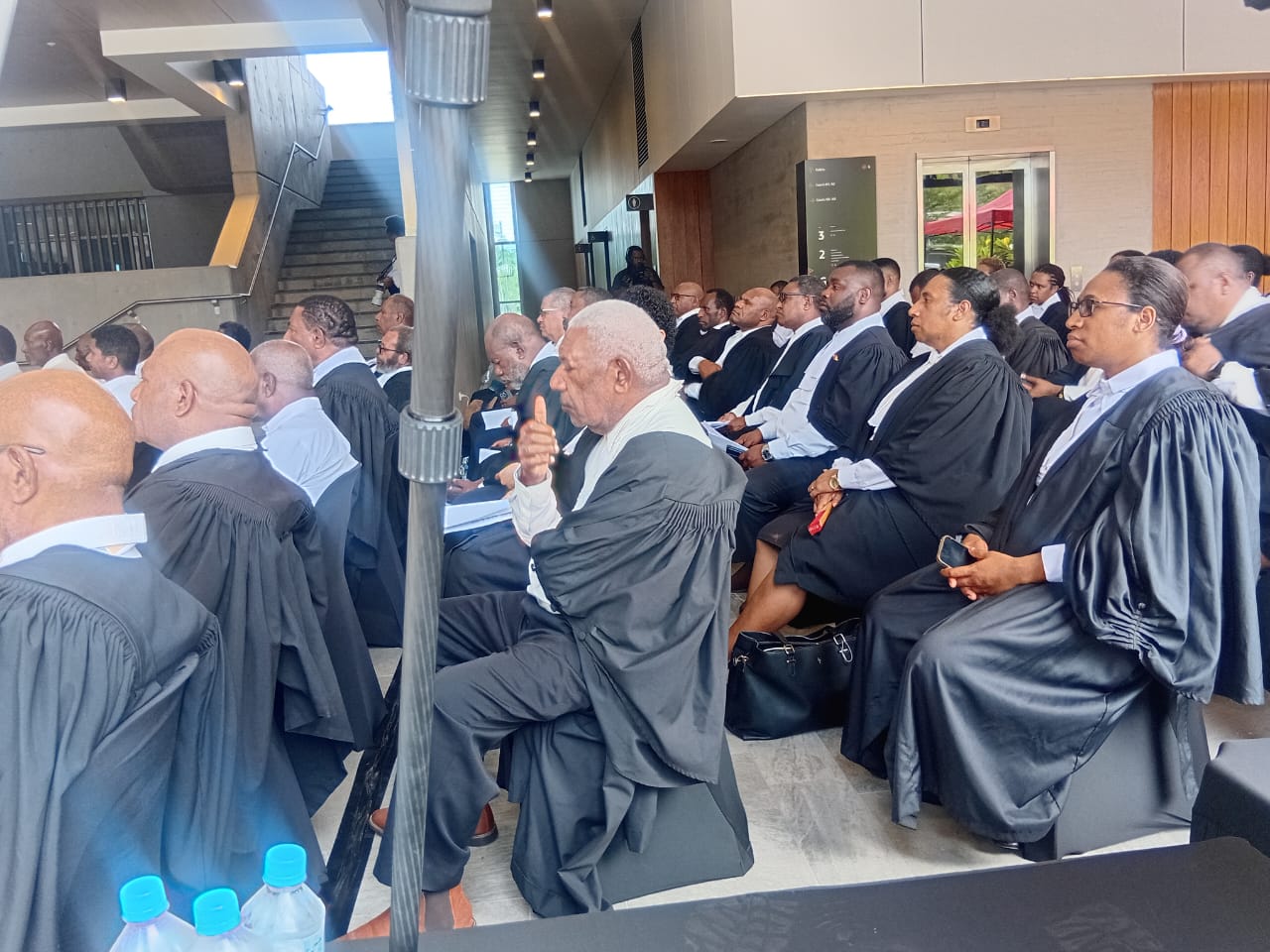
President of the Papua New Guinea Law Society, Hubert Namani, has called for a renewed national commitment to the rule of law, judicial independence, ethical legal practice, and accountability, during his address at the 2026 Legal Year Opening ceremony in Port Moresby today.
Speaking before the Chief Justice, members of the Judiciary, Government leaders, and the legal profession, Mr Namani welcomed the opening of the 2026 Legal Year and acknowledged the importance of improved justice infrastructure, while stressing that justice is not guaranteed by buildings alone.
“A court house does not guarantee justice. A building is only a structure. Justice is a system.
Justice is a culture. Justice is a discipline,” Mr Namani said.
Mr Namani said Papua New Guinea has entered a critical phase beyond its first 50 years of independence and must now confront hard questions about whether the Constitution remains the highest authority and whether citizens still believe in the courts.
“The Rule of Law is not an academic concept. It is the difference between safety and lawlessness, prosperity and poverty, order and chaos,” he said.
Mr Namani warned that criminal impunity has become a national emergency, stating that PNG cannot progress where corruption, fraud and violence go unpunished.
“The Rule of Law is not proven by speeches. It is proven by convictions,” he said.
“If the State cannot investigate, prosecute, and convict serious offenders, then the law becomes merely a suggestion.”
Mr Namani highlighted the national economic risks arising from weak enforcement under global anti-money laundering standards, warning that PNG faces increased scrutiny and potential “grey listing” consequences.
“Strengthen prosecution capacity. Strengthen investigation capacity. Strengthen conviction outcomes. This is not optional. It is national survival,” he said.
Mr Namani raised concerns about delays in court processes, particularly delayed delivery of judgments, noting the real human and commercial cost of prolonged litigation.
“Some of our clients die while waiting for reserved judgments. That is not just unfortunate.
That is tragic. That is injustice,” he said.
He called for stronger case management and improved judicial administration to ensure the new court infrastructure delivers timely justice.
Mr Namani also encouraged robust jurisprudence and intellectual independence within the superior courts, noting that dissenting judgments strengthen the law.
“Dissent is not disrespect. Dissent is intellectual honesty,” he said.
Mr Namani reaffirmed the Law Society’s commitment to strengthening disciplinary processes, trust account compliance, and professional integrity.
“There is no Rule of Law without ethical lawyers,” he said.
He announced that the PNG Law Society will introduce Compulsory Continuing Legal Education (CLE) from 2027, requiring lawyers to accumulate approved CLE points as part of practising certificate requirements.
Mr Namani confirmed that the Law Society’s annual Rule of Law March will take place on Friday, 27 March 2026.
He advised that further details will be officially released before the end of February.
Mr Namani cautioned members of the profession about the ethical use of Artificial Intelligence (AI), noting that lawyers in other jurisdictions have already faced disciplinary action for filing false materials and fabricated citations generated by AI tools.
“Technology can assist us, but it does not replace professional judgment,” he said.
Mr Namani concluded by stating that the new courthouse must represent a national covenant for justice and accountability, not merely a physical structure.
“Let it be a covenant that judgments will be timely, courts will be courageous, corruption will be confronted, and justice will not be reserved only for the powerful,” he said.