


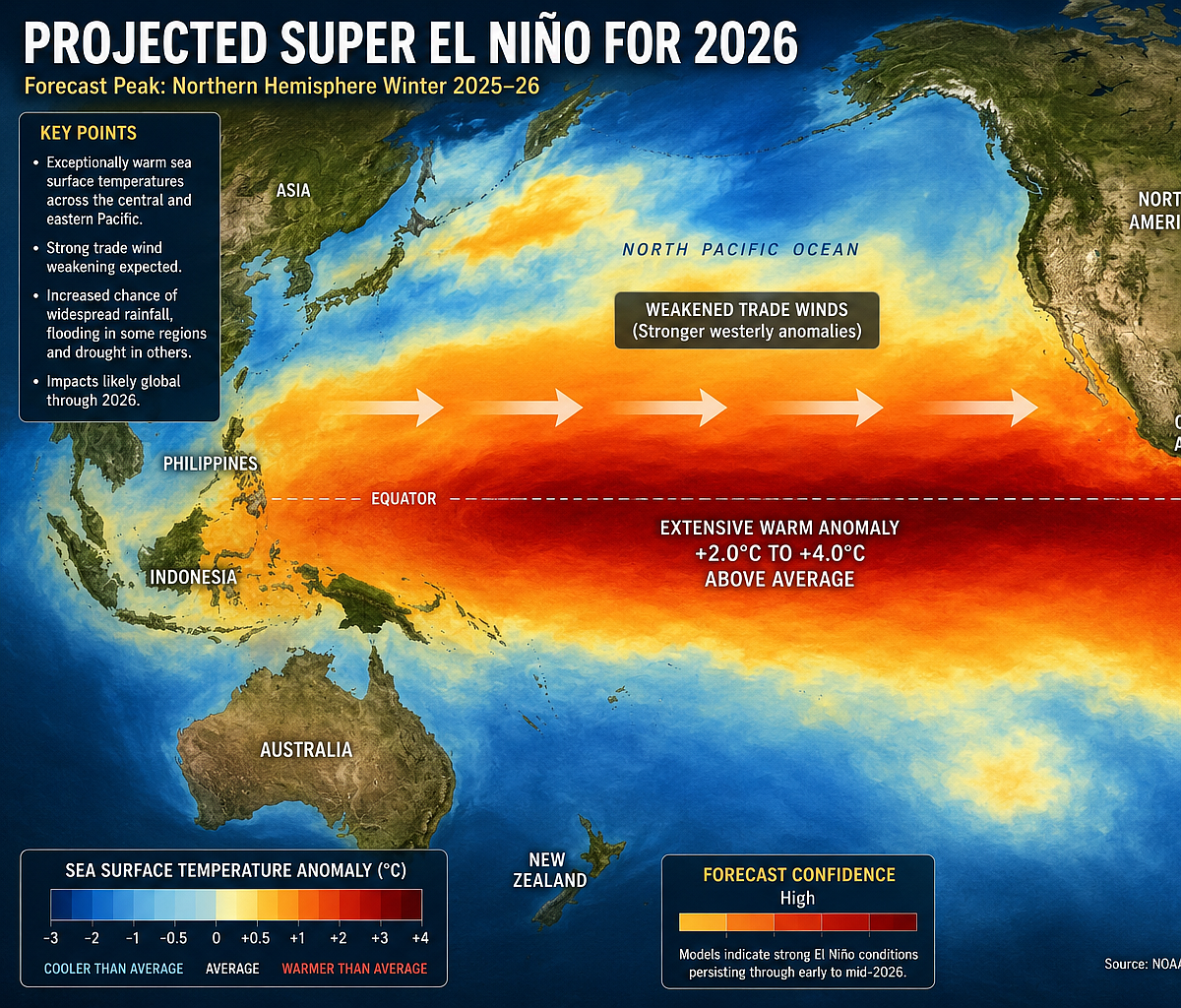
THE Papua New Guinea National Weather Service has officially declared the development of El Niño conditions in the tropical Pacific Ocean, following three consecutive months of monitored coupling between oceanic and atmospheric systems.
In a media statement released on 16 June 2026, Director of National Weather Service Jimmy Gomoga confirmed that the conditions, first flagged in an earlier advisory on 1 May 2026, have now become fully established and are expected to influence weather patterns across the country for the rest of the year.
The Papua New Guinea National Weather Service said sea surface temperatures in the central tropical Pacific, along with atmospheric circulation patterns and international climate model guidance, all indicate a developing El Niño event that is likely to persist until at least late 2026.
Forecasts suggest the event could become strong to very strong, potentially comparable to the 1997/98 or 2015/16 El Niño events.
El Niño is a climate phenomenon linked to warmer-than-average sea surface temperatures in the central and eastern Pacific Ocean and is associated in many regions with reduced rainfall and prolonged dry conditions.
For Papua New Guinea, the weather service warns that the Highlands, southern coastal areas, and other drought-prone regions may face below-average rainfall, rising temperatures, and increasing moisture stress in the coming months. These conditions could affect water availability, agriculture and food production, public health and sanitation, hydropower generation, and transport services.
The agency is urging national and provincial authorities, district administrators, development partners, and communities to strengthen preparedness measures.
Recommended actions include monitoring water supplies, promoting water conservation, supporting drought planning, advising farmers on climate-resilient agricultural practices, and improving coordination across government agencies responsible for disaster risk management.
The National Disaster Centre is working alongside the weather service and other partners to support early warning dissemination and preparedness planning.
Authorities have encouraged the public to rely on official updates as monitoring continues, noting that early action remains critical in reducing the impacts of potential drought conditions linked to the evolving El Niño event.
From my observation & knowing very well the fact of El Niño & its impacts which would perhaps have on the life’s of people. I, as an Highland, would like to appeal to the national government to take precautionary measures actions as quick as possible before it gets from bad to worse. The government for PNG must not wait but they must act quickly & ASAP to save the life’s of the citizens before we start loosing the lives of people of hunger etc
Comments are closed.