


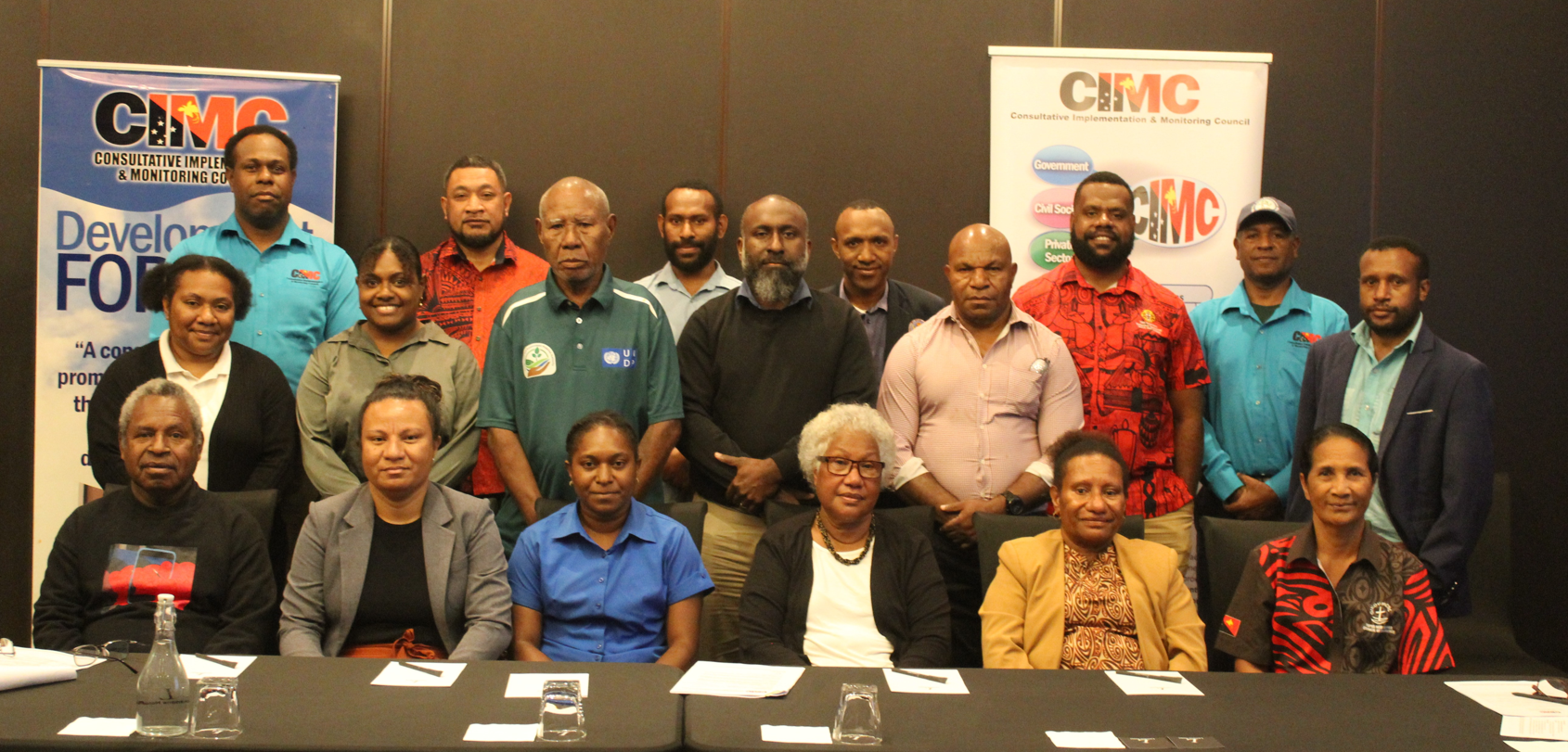
THE Consultative Implementation and Monitoring Council’s (CIMC) Natural Resources Sectoral Committee (NRSC) has held its fourth sectoral meeting since its revival in 2025, with stakeholders calling for stronger coordination and renewed action on key natural resource issues.
The meeting was held on Tuesday, July 21, 2026, at the Lamana Hotel in Port Moresby and brought together representatives from government agencies, development partners, civil society and the natural resources sector.
The meeting focused on reviewing outstanding action items from previous meetings and determining whether they should be amended or reprioritised in response to changing sector priorities and emerging challenges.
CIMC Executive Officer Wallis Yakam said the meeting provided an important opportunity to assess progress since the committee was re-established and address long-standing coordination gaps.
“This meeting allows us to critically review our progress since the Committee’s re-establishment, amend our strategies where necessary, and bridge long-standing coordination gaps,” Yakam said.
She said the NRSC provided a vital platform for stakeholders to align their priorities, review action items and address operational issues affecting the natural resources sector.
“By strengthening collaboration across government, industry, and civil society, we can modernize our laws and deliver balanced economic, environmental, and social outcomes for our country,” she said.
Key sector issues discussed
Among the major issues discussed was the proposed round log export ban, which aims to phase out raw log exports over five years to encourage greater domestic processing.
Stakeholders raised concerns about the potential loss of tax revenue, governance gaps and competing interests involving economic zones as the country considers the transition.
The committee also discussed customary land policy, including proposed changes that would restrict customary landowners to leasing or selling land exclusively to the State. Stakeholders noted that progress on the policy has stalled amid differing parliamentary recommendations.
Another major concern was the existence of cross-sector regulatory gaps, including weak enforcement, political interference and instances of unauthorised activities across industries, such as mining companies becoming involved in logging activities.
Stakeholders agreed that stronger national policy alignment was needed to improve regulation and coordination across the natural resource sectors.
Committee revises Terms of Reference
The meeting also reviewed the committee’s governing framework and amended its Terms of Reference (TOR).
Members agreed to remove language referring to “voluntary participation” and expand the committee’s membership to include the Provincial and Local-Level Government Affairs (PLGA), the Constitutional and Law Reform Commission (CLRC), and other relevant agencies where necessary.
The committee also agreed to reactivate its Land Administration Sub-Committee following concerns over stalled progress on land policy and governance.
In a shift towards more direct engagement, the Secretariat was instructed to issue formal correspondence on several unresolved matters, including ensuring stakeholder participation in the transition associated with the round log export ban and seeking updates on customary land policy.
The committee also called for greater emphasis on building local capacity through development programs.
UNDP was specifically encouraged to prioritise the recruitment of local and national personnel rather than relying heavily on external consultants for its approximately US$70 million sustainable community development program.
Stakeholder presentations
The meeting featured presentations from the Climate Change and Development Authority (CCDA) on REDD+ development and climate finance in Papua New Guinea.
The PNG Environmental Alliance (PNGEA) provided a progress update, while the United Nations Development Programme (UNDP) presented on its work to accelerate sustainable community development in PNG.
CIMC said the active participation of stakeholders was critical to strengthening the work of the NRSC and ensuring that key natural resource issues continue to receive coordinated attention.
Stakeholders attending the meeting included the Association of Forests in PNG (AFPNG), CCDA, CLRC, PNG Council of Churches, PNGEA, Research Conservation Foundation, UNDP, Centre for Environmental Law and Community Rights (CELCOR), Department of Lands and Physical Planning, Embassy of Japan and PNG Forest Governance.
The July 21 meeting marks the fourth sectoral meeting since the NRSC was revived in 2025, as the committee continues efforts to improve coordination, policy implementation and
governance across Papua New Guinea’s natural resources sector.