


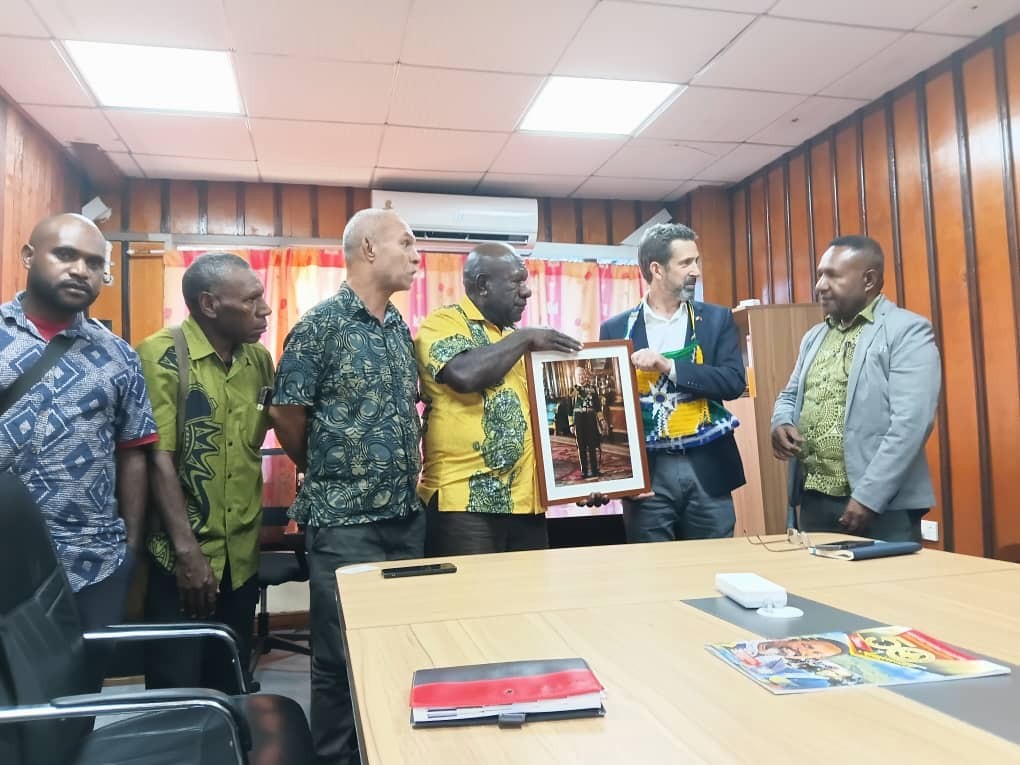
His Excellency Paul Eastwood, the United Kingdom High Commissioner to Papua New Guinea, formally presented a portrait of His Majesty King Charles III to Deputy Governor, Andrew Tera of Morobe Province this afternoon, in a ceremony that underscored the two nations’ converging interests in environmental conservation and renewable energy.
Mr Eastwood described the portrait as a tribute to a monarch whose long-standing advocacy for the environment he holds in particular esteem, including spending time in the country during his young days. “Here is a portrait of someone I truly admire, and because of the things he stands for, like the conservation of the environment and renewable energy,” he said.
The High Commissioner noted that Morobe Province, under the leadership of Governor Rainbo Paita, has itself been pursuing an ambitious renewable energy agenda, principally through the development of the Mongi Burum Kuat hydroelectric facility and the Wawin and Wagang solar project.
The remark drew an implicit parallel between the Province’s programme and the environmental causes long associated with the British monarch and the emerging trends around the world.
Deputy Governor Tera adorned the High Commissioner with a string bilum woven in the colours of the Morobe provincial emblem and flag.
He was joined for the occasion by the Provincial Executive Council Portolio Chairman, the Honourable Johna Epemu, who holds the transport portfolio, and the Honourable Samuel Honnie, responsible for primary education, as well as by Provincial Administrator Max Bruten and Wilson Thompson, Chief of Staff in the Office of the Governor.
Mr Eastwood was accompanied by his political officer, Theo Shing, who is originally from the Finschhafen district of Morobe Province.
The presentation followed a working visit by the High Commissioner to the Papua New Guinea University of Technology, where he inspected facilities and reviewed a course of study in energy and conservation that receives support from the United Kingdom.
During the visit, Mr Eastwood was briefed on the state of the energy sector in Morobe Province, including the considerable geographic and economic challenges attending the development and implementation of power infrastructure across the region. He raised particular questions concerning the relationship between electricity provision and conservation practice.
There was discussion on the mechanisms by which solar-generated power might be extended to benefit villagers in rural areas of the Province, a subject he indicated was of considerable in the context of the United Kingdom’s continuing engagement with Papua New Guinea on energy policy.