


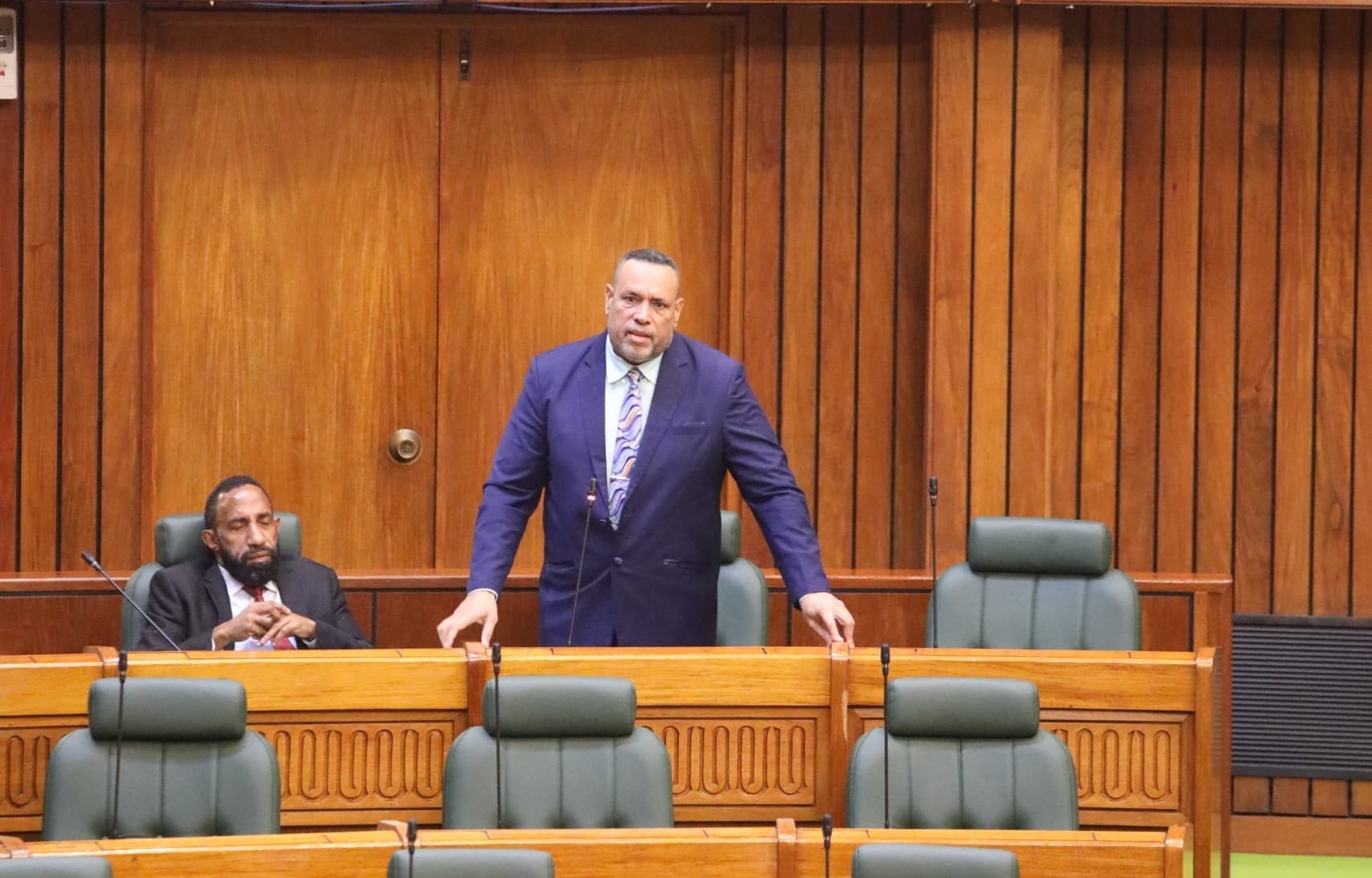
By ESWIN PLESIO
East Sepik Governor Allan Bird has questioned Prime Minister James Marape over the government’s recent changes to the Treasury and Finance portfolios, arguing that the reforms could reverse measures introduced after Papua New Guinea’s 1999 financial crisis.
During Question Time in Parliament, Bird asked whether the government had considered the reasons behind the reforms introduced by the late former Prime Minister Sir Mekere Morauta before making the latest changes.
“My supplementary is in relation to these changes to Treasury and Finance,” Mr Bird said.
“My first question to the Prime Minister is, is he aware that these were part of the reforms that the Mekere government brought in after the 1999 financial crisis that the country went through? The reforms were aimed at achieving stability.”
Mr Bird also raised concerns about what he described as the government’s approach to the independence of key financial institutions.
“I note also that this government has worked around the independence of the Central Bank, and now you’ve done the same to the separation between Treasury and Finance,” he said.
He further asked whether Cabinet had revisited the 2002 reform report before deciding to restructure the portfolios.
“Did Cabinet revisit the 2002 report, part of the reforms that the Mekere government implemented, to understand why it had to do the things it did to restore the financial system of the country?”
Mr Bird said if the government’s intention was to reverse the Morauta reforms, it could simply merge the Treasury and Finance portfolios under one minister.
“If the Prime Minister and the Cabinet wanted to undo the Mekere reforms, the easiest thing to do would be to amalgamate Treasury and Finance so you can have one minister in charge of both, like we did prior to 2002,” he said.
Responding, Prime Minister James Marape rejected suggestions that the government’s reforms had weakened the independence of the Bank of Papua New Guinea.
“That is far from the truth,” Mr Marape said.
“We have rather entrenched and augmented the independence of the Central Bank. The Treasury has no unilateral power, neither does the Prime Minister have unilateral power to impinge on the operation of the Central Bank or direct its monetary policy.”
Mr Marape said the government had strengthened governance by establishing an independent board to oversee the Central Bank.
“What we’ve done is set up a board of eminent Papua New Guineans to work with the Central Bank, making sure there is an additional layer of oversight instead of one person operating alone,” he said.
“So, far from eroding the Central Bank’s independence, we’ve actually strengthened it.”
On the separation of the Treasury and Finance portfolios, Mr Marape said the country’s growth since 2002 had significantly increased the workload across government.
“When Sir Mekere made those reforms, the economy was under K17 billion. Today we have 96 districts, 21 provinces, an autonomous region, many more government agencies and a population of more than 10 million,” he said.
“You cannot congest one minister with so many functions.”
Mr Marape explained that under the new arrangement, Treasury would focus on macroeconomic policy and revenue, Finance would manage government expenditure, while Planning would oversee long-term development priorities.
“We’re streamlining responsibilities so everyone knows their role and government programs are delivered more efficiently,” he said.
He also said the reforms were developed through the government’s Reset 50 agenda and were informed by experienced public servants.
“I want to assure the country this is not James Marape concluding this from somewhere else,” he said.
“The Reset 50 team includes people with deep institutional knowledge of this country, and these reforms are intended to improve the way government works, not weaken it.”