


By GEORGINA MICHAEL
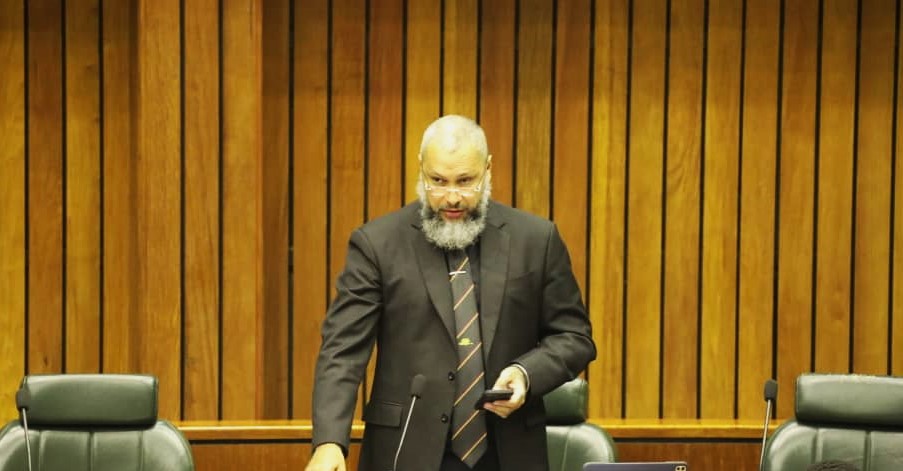
Oro Governor Hon. Gary Juffa today raised concerns over the looming El Niño, seeking clear answers on funding, food supplies, water security, and support for vulnerable communities, as climate agencies warn there is an 82 per cent chance Papua New Guinea will face a “super” drought this year and into early 2027.
During question time, Juffa said meteorological and climate monitoring agencies are predicting a highly significant El Niño event will begin this year. He reminded Parliament of PNG’s experience during the 2015–2016 El Niño, which resulted in severe drought, crop failures, dried-up rivers, and public health crises that hit rural and remote communities the hardest.
“The National Disaster Centre has activated early preparedness measures and I commend the Government for reacting promptly,” Juffa said.
He then directed four key questions to Minister for National Emergency Services, Hon. Billy Joseph.
Juffa asked for details on the total funding allocated by the National Government for El Niño preparedness and response, including how much has already been released or committed to provincial administrations and Provincial Disaster Committees.
He sought information on the Government’s operational plan and timelines for the procurement, transportation and pre-positioning of emergency food supplies, drought-resistant planting materials, and water storage and purification facilities in vulnerable districts and communities.
Juffa also questioned how government agencies would coordinate logistics, given PNG’s challenging geography, to ensure emergency resources reach isolated communities on time.
He further asked how agencies would work with the Health Department to address health issues expected to increase during the drought.
He questioned whether provincial risk assessments had been completed and which provinces and districts had been identified for immediate intervention and support as being highly vulnerable to the expected El Niño event.
Minister Joseph acknowledged the questions and thanked Governor Juffa for his close collaboration with the National Disaster Centre during previous disasters.
He said PNG’s disaster response framework is guided by the Disaster Management Act 1984, which establishes the committee structure responsible for managing disasters nationwide.
“Following the presentation I made last week, scientists worldwide are saying there is an 82 per cent chance that we will have a super El Niño,” Joseph told Parliament.
“As a Government and as a country, we have to be prepared. Disaster management is a cycle: mitigation, preparedness, response and recovery. One leads to the next.”
He revealed that an inter-agency team comprising technical officers from the National Weather Service, the United Nations Development Programme (UNDP), the National Disaster Centre, and the International Organization for Migration (IOM) has already been deployed to conduct early assessments in provinces currently under El Niño watch.
“These are the seven Highlands provinces — Eastern Highlands, Simbu, Jiwaka, Western Highlands, Enga, Hela and Southern Highlands. That does not mean other provinces are not vulnerable,” the Minister said.
Joseph said that once the assessment reports are received, he will prepare a National Executive Council (NEC) information paper for Cabinet to determine the full Government response.