


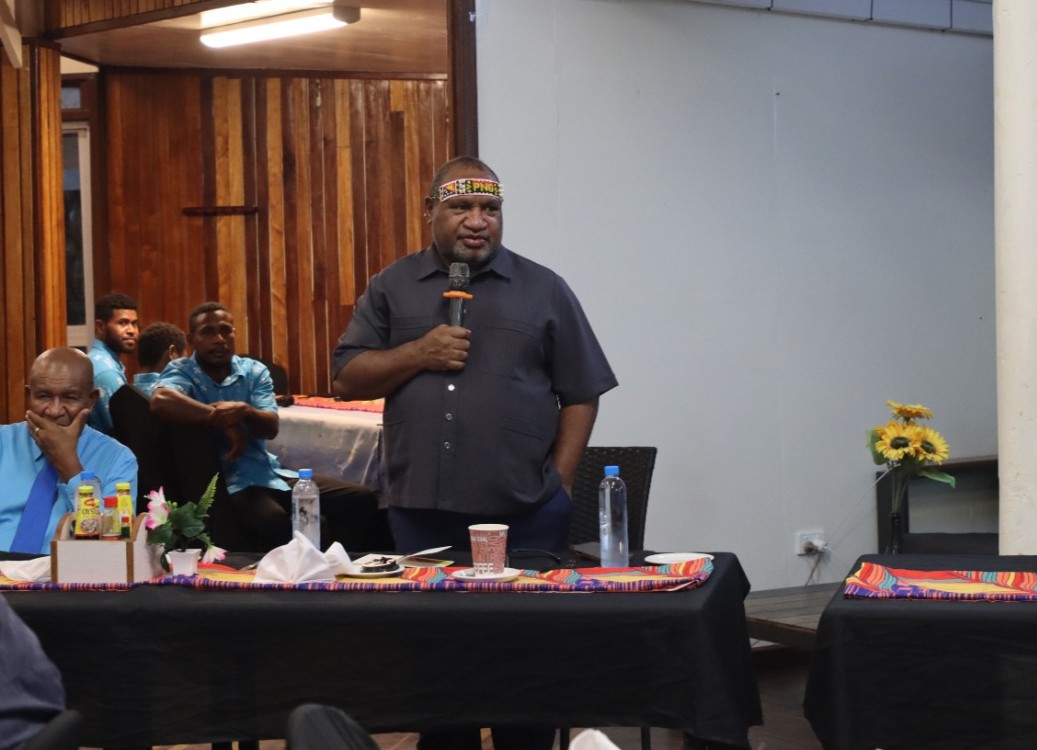
Prime Minister Hon. James Marape has urged Papua New Guineans to look at facts, figures and the Government’s actual work in growing the economy, instead of being misled by negativity and misinformation on social media.
Prime Minister Marape made the remarks during a Dinner Event in Lorengau, Manus Province, attended by Manus Governor Hon. Charlie Benjamin, Minister responsible for Disaster Response Hon. Dr Billy Joseph, Provincial leaders, senior public servants, community representatives and other stakeholders. Using a PowerPoint presentation with graphs and economic data, the Prime Minister explained the Government’s management of national affairs, including economic recovery, revenue growth, tax compliance, resource sector reforms, infrastructure development, and the country’s pathway beyond the 50th Independence Anniversary. He said he wanted leaders, public servants and citizens to understand clearly where the country had come from, where it is now, and where it is heading. “We must not allow social media negativity to mislead our people,” Prime Minister Marape said.
“We must look at the facts, the numbers, the graphs and the real work being done. Leadership is about explaining clearly where we have come from, where we are now, and where we are going.”
The Prime Minister said Papua New Guinea had always operated under resource constraints, with great needs across all provinces, districts and communities, but limited resources available at any one time. “Whilst you may like Government to do plenty work, we are working within resource constraints,” he said. “Our country, for the last 50 years, has been working with resource constraints.
The needs are big, and resources have been limited.” He said this was why his Government had focused on growing the economy, improving revenue collection, ensuring resource companies pay their fair share, and investing in infrastructure, education, health, law and order, churches, SMEs, provinces and districts.
Prime Minister Marape told Manus leaders that Papua New Guinea’s journey since Independence had not been easy, but the country had remained united despite enormous challenges. “In 1975, only less than 1,000 Papua New Guineans were in high school, and less than 100 were in universities and colleges. That was our starting point,” he said. “For us to hold together as one people, one nation, one country, 50 years on, is an amazing miracle. We give credit to the Somare generation and all those who held this country together.”
The Prime Minister said PNG had experienced difficult economic periods in the past, including high debt levels, depleted foreign exchange, political instability and weak revenue performance. He said his Government had been working since 2019 to restore confidence, grow the economy and strengthen the country’s fiscal position. “When we came in 2019, we started rebuilding the economy to get back up,” Prime Minister Marape said. He said the economy had grown significantly from around K79 billion in 2019 to around K140 billion today, with the Government targeting further growth towards K200 billion, K300 billion and eventually K500 billion in the years ahead. “If we stick on this path, including mobilising resources from fisheries, forestry, agriculture, mining and petroleum, then we are certainly on track to hit the K200 billion target,” Prime Minister Marape said. He said growing the economy was not about figures alone, but about ensuring more money was available for provinces, districts, health authorities, schools, roads, law and justice, Churches, SMEs and families. “The reason why we want to increase the size of the economy is simple,” he said.
“When the economy grows, Government has more ability to support provinces, districts, health services, schools, infrastructure and
our people.”
Prime Minister Marape also highlighted improved internal revenue collection, saying the Internal Revenue Commission had lifted collections through better compliance, stronger enforcement and reforms that ensure those who should pay tax do so. He said Government revenue collection had grown strongly in recent years, even while the Government removed Personal Income Tax for low-income earners making under K20,000 per year. “We removed Tax from those earning under K20,000 so that low-income workers — including security guards, hotel workers, community health workers, elementary teachers and others — can take home
more money,” Prime Minister Marape said. “Despite removing Tax from many low-income earners, our revenue has continued to grow because we are improving efficiency and compliance in other areas.”
The Prime Minister said the Government was also making sure that companies operating in the mining, petroleum, fisheries, forestry
and other resource sectors contribute fairly to the country. “We are trying our absolute best in tough times to make sure those who
are supposed to pay their fair share of tax, pay their tax,” he said. He cited Porgera as an example of the Government’s resource
reforms, saying the mine is now making tax contributions after new arrangements were secured. “Porgera paid K800 million in Taxes
last year. Before, Porgera was not paying Tax in the way it should. Government policy is now working, and we are starting to collect
more from our own resources,” Prime Minister Marape said.
He said these Reforms were part of the Government’s broader commitment to “Take Back PNG” by ensuring the country earns more from its natural resources and invests those returns back into the people. Prime Minister Marape said the Government’s economic growth agenda is directly linked to service delivery and provincial development, including support for infrastructure, health, education, law and order, district development, disaster response and local economic opportunities.
He said Manus, like all Provinces, would benefit from a stronger national economy and improved revenue base. The Prime Minister said Manus has strong potential in fisheries, maritime opportunities, tourism, agriculture, infrastructure development and possible special economic zone arrangements, and the National Government would continue working with the Manus Provincial Government to unlock these opportunities. “Manus is important to Papua New Guinea,” Prime Minister Marape said. “This Province has contributed leaders, public servants, professionals, Church workers and ordinary citizens who have helped build our country. Manus will not be left behind.”