


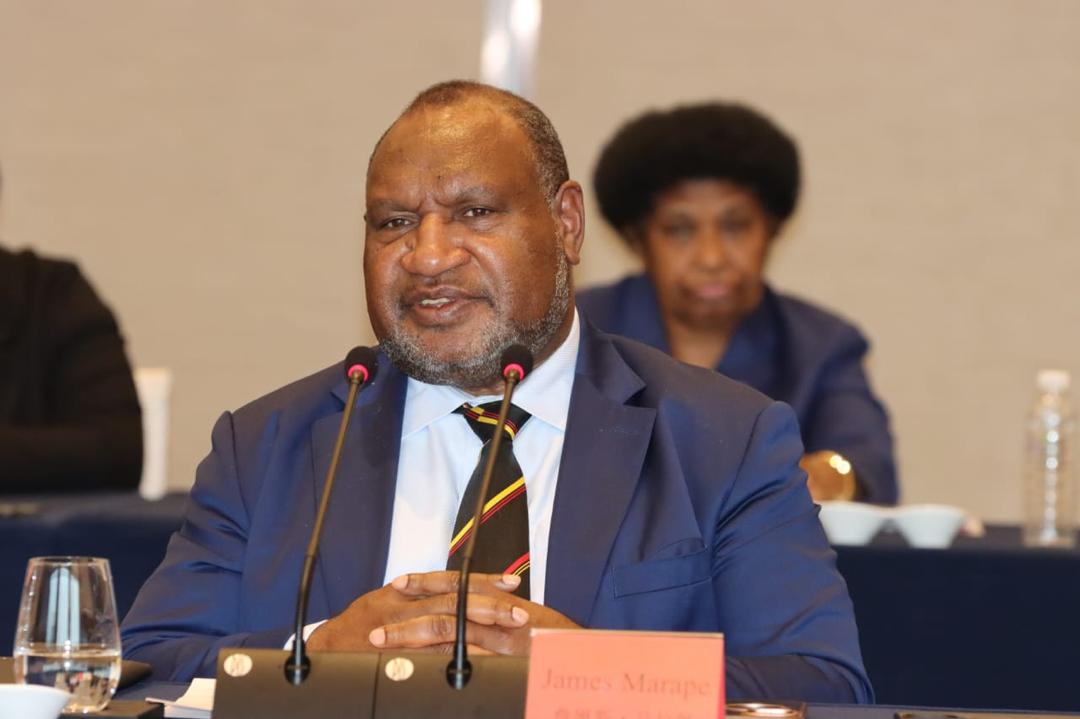
PRIME Minister James Marape has reinforced Papua New Guinea’s longstanding One China Policy while inviting deeper trade, investment, industrial development, and strategic partnerships with Guangdong Province during high-level talks yesterday (28April).
Mr. Marape met with a senior Guangdong delegation led by Governor Meng Fanli, where both sides discussed strengthening economic ties, improving connectivity, advancing clean energy cooperation, promoting downstream processing, and creating long-term commercial opportunities between PNG and one of China’s most powerful economic provinces.
The Prime Minister described Guangdong as a natural gateway between PNG and China, noting the province’s deep historical, commercial, and people-to-people links with PNG.
Speaking during the meeting, Mr Marape said PNG’s relationship with China had been built on five decades of diplomatic trust since Independence, but the connection between the peoples of both countries stretched back generations.
He said PNG was among the earliest countries to recognise the One China policy following Independence in 1975, and that this position remained clear, consistent, and unchanged.
“Fifty years on, I am here to strengthen that philosophy, that worldview, and that policy,” Mr. Marape said.
“Our government’s position is clear and timeless.”
“The One China policy remains the central pillar of relations between our two nations, and it will continue to guide our friendship into the future.”
Prime Minister Marape said many Papua New Guineans of Chinese heritage traced their ancestry to Guangdong, making the province especially significant in bilateral relations.
“This province is not just an economic powerhouse of China—it is an important bridge between Papua New Guinea and China,” he said.
Mr. Marape also highlighted growing direct air connectivity between Guangzhou and Port Moresby, which has expanded from one weekly service to three weekly services.
The Prime Minister thanked China’s President Xi Jinping for the respect and friendship consistently shown to PNG, including previous bilateral meetings in Beijing and China’s senior-level representation during PNG’s 50th Independence anniversary celebrations last year.
He also praised China’s remarkable national development journey, particularly the lifting of hundreds of millions of people out of poverty and the rapid transformation of Chinese cities, industries, and infrastructure.
“That is an achievement unmatched in modern history,” Mr. Marape said.
“From the perspective of developing nations, China’s progress gives hope that transformation is possible through planning, discipline, investment, and leadership.”
The Prime Minister used the meeting to position PNG as a secure, strategic, and resource-rich destination for Guangdong investors seeking growth opportunities in the Pacific and wider Indo-Pacific region.
He proposed the establishment of a dedicated special economic zone for Guangdong enterprises in PNG, supported by land access, competitive incentives, reliable energy, and export-oriented industrial planning.
“Papua New Guinea can be a safe production base for Chinese enterprise,” he said.
“Products manufactured in Papua New Guinea can access markets across the Pacific, ASEAN, APEC, the Commonwealth, and beyond.”
Prime Minister Marape said PNG’s geographic location gave investors access not only to Pacific markets, but also to Southeast Asia, Australia, New Zealand, and other partner economies.
He emphasised that PNG was friendly to all nations and open to investment partnerships based on mutual benefit.
“We are friends to all and enemies to none,” he said.
The Prime Minister said Papua New Guinea’s vast clean energy resources made it ideal for industrial expansion and value-added manufacturing.
He pointed to the country’s enormous potential in hydropower, biomass, gas-to-power, solar, and waste-to energy generation.
During his China programme, Mr. Marape held discussions with Shenzhen Energy Group regarding possible partnerships in hydroelectricity, waste-to-energy systems, and other clean energy technologies.
“If Chinese companies help us generate affordable and reliable energy, industries can follow,” he said.
“That can support downstream processing in agriculture, forestry, fisheries, mining, and manufacturing sectors.”
Prime Minister Marape said affordable electricity was essential if Papua New Guinea was to industrialise, create jobs, and move beyond raw commodity exports.
The Prime Minister also updated Guangdong leaders on several major Chinese-linked investments already progressing in Papua New Guinea.
These include the proposed Frieda River Copper and Gold Project, expansion plans for the Ramu Nickel Mine, and broader cooperation in agriculture through Juncao technology pioneered by Professor Lin Zhanxi.
Prime Minister Marape said agricultural cooperation with China remained especially important as Papua New Guinea seeks to modernise farming, create rural incomes, and expand exports in coffee, cocoa, palm oil, fisheries, vanilla, spices, and other commodities.
He said technologies such as Juncao could help transform livestock feed, mushroom production, land productivity, and rural enterprise opportunities.
Mr. Marape reaffirmed that PNG remained committed to being a reliable long-term host for investors.
He noted that century-old foreign companies continued to operate successfully in PNG, demonstrating the country’s long history of supporting enduring business partnerships.
“Our country welcomes serious investors who come to grow with us, employ our people, transfer skills, and build industries,” he said.
Looking ahead, Mr. Marape said he would address more than 300 business leaders and investors at a major Guangdong investment forum, where he would further promote PNG as a destination for trade, tourism, manufacturing, agriculture, mining, fisheries, and clean energy.
“We want business ties that produce jobs, factories, exports, skills transfer, and lasting prosperity for our people,” he said.
Mr. Marape said the relationship between PNG and Guangdong had the potential to become one of the strongest provincial-to-national partnerships in the Asia-Pacific region.
“Papua New Guinea will forever be a bridge between China, the Pacific, and the wider world,” Prime Minister Marape said.