


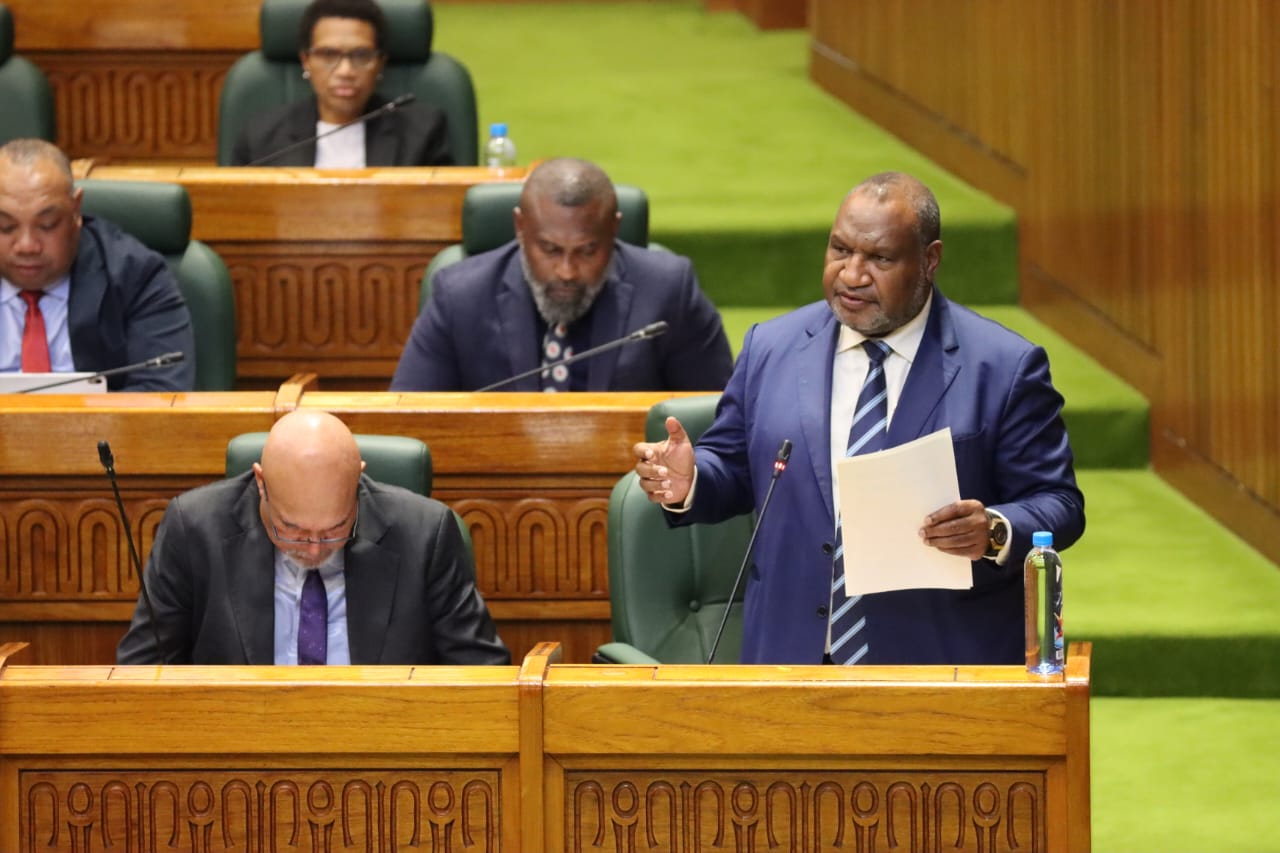
Prime Minister Hon. James Marape has called on the National Parliament to deal with the 2019 Bougainville Referendum result with maturity, respect, responsibility and full appreciation of the historic significance of the Bougainville peace process.
Prime Minister Marape made the statement in Parliament today as the Government moved to establish the formal parliamentary process for the referendum result to be tabled and considered by the House.
He said the matter before Parliament was one of the most sensitive and consequential issues in Papua New Guinea’s history, touching on national identity, constitutional order, peace, unity, and the future of generations to come.
“This is a historic moment, a huge moment,” Prime Minister Marape said.
“The issue before us is sensitive and consequential to our nation’s future, but it is something we cannot ignore. Time is of the essence.”
Prime Minister Marape said the 2019 Bougainville Referendum was not optional but was constitutionally mandated under the Bougainville Peace Agreement and Part XIV of the National Constitution.
He said the referendum was conducted peacefully, with international observers, including the United Nations, recognising the process as free, fair and credible.
“The people of Bougainville participated peacefully, with overwhelming turnout, and expressed their views with clarity and dignity,” Prime Minister Marape said.
“Today, we know the result stands at 97.7 per cent in affirmation of the view that they must be politically independent. They chose political independence over the maintenance of autonomy as it is at present.”
Prime Minister Marape paid tribute to all leaders who have contributed to the Bougainville peace process since the signing of the Bougainville Peace Agreement on 30 August 2001.
He acknowledged current Minister for Bougainville Affairs Hon. Manasseh Makiba, former ministers who served in the portfolio, and past national leaders, including the late Hon. William Samb, former Member for Goilala and Minister responsible for Bougainville matters.
He also paid special tribute to Bougainville leaders, including the late President Joseph Kabui, the late Francis Ona, the late Peter Tsiamalili Sr, and others who sat at the table of peace and helped construct the Bougainville Peace Agreement.
“Without thanking the Bougainville leaders, our thanks to national leaders would be in vain,” Prime Minister Marape said.
“All who have contributed to the peace process thus far must be acknowledged.”
Prime Minister Marape also acknowledged the role of past Prime Ministers who carried the burden of the Bougainville issue during difficult periods of the nation’s history, including Sir Rabbie Namaliu, Paias Wingti, Sir Julius Chan, Sir William Skate, Sir Mekere Morauta and Grand Chief Sir Michael Somare.
He said each leader acted within the difficult circumstances of their time and made contributions that helped bring the country from conflict to peace.
Prime Minister Marape said the Bougainville Peace Agreement had given Papua New Guinea a clear constitutional pathway to follow, and Parliament now had a duty to respect that process.
He said Section 342 of the Constitution required consultation after the referendum and required the National
Parliament to make a decision.
“The National Parliament must make a decision,” he said.
“This law has stood for the last 25 years. The National Parliament must make the decision.”
“The referendum result will stand,” he said.
Prime Minister Marape assured the people of Bougainville that the 97.7 per cent referendum result would remain on record forever, regardless of how Parliament eventually votes.
“At one time in history, the people of Bougainville voted, and they voted not for autonomy, but for full political
independence.”
Prime Minister Marape said his Government had worked to transfer substantial powers and functions to the Autonomous Bougainville Government, including state land, fisheries powers, and control over Panguna resources.
He said many powers already existed under the Constitution for drawdown to Bougainville, while the National Government had indicated that only key national powers such as foreign affairs, defence, currency and the Supreme Court would remain subject to the wider process.
“My Government stands ready to give every power that enables Bougainville to operate an economy, a government and a community,” he said.
Prime Minister Marape said the issue must be considered carefully by all Members of Parliament, taking into account both Bougainville’s long-standing aspirations and the wider responsibility of preserving national unity and stability.
“As we think from Bougainville’s perspective, I ask Bougainville to also think from our perspective,” he said.
“This is an emotional matter, but we must make rational choices collectively going forward.”
Prime Minister Marape said whatever the final decision of Parliament, Papua New Guinea and Bougainville
would continue to share deep historical, cultural, Melanesian and human ties.
“If it is yes, we will continue. If it is no, we will continue,” he said.
He said Papua New Guinea was one of the most diverse nations on earth, brought together in 1975 as one country, one people and one Constitution.
“Our work as two peoples, or as one people in the Melanesian family, will always continue into the future.”
Prime Minister Marape urged all Members of Parliament to consult their provinces, districts and people before the final vote is taken.
He said no leader could run away from the issue, and every Member of Parliament would have to make a decision based on what they believed was best for Bougainville and for the collective future of Papua New Guinea.
“There is no hiding from the scrutiny,” Prime Minister Marape said.
“Each of us must decide on what is good for Bougainville and our collective future.”
Parliament today adopted a sessional order to allow the Minister for Bougainville Affairs to table the return of writ containing the Bougainville Referendum result, make a statement, and allow debate to proceed until the question is put.
The motion on whether Parliament accepts the Bougainville Referendum result will require a three-quarter absolute majority.