


By CYRIL GARE
THE National Government under Prime Minister, James Marape is very keen on providing Biosecurity cover for Papua New Guinea and not just in National Security for the nation.
National security involves the safety of a nation against threats such as terrorism, war, or espionage.
Biosecurity on the other hand also involves safety of a nation but usually that refers to measures aimed at preventing the introduction and or spread of harmful organisms to animals and plants in order to minimize the risk of transmission of infectious disease.
Because man depends on animals and plants for food, biosecurity requires national cohesion for survival as a nation. Without food, a population starves and perishes.
From national security to biosecurity the Marape-Rosso Government has you covered.
Next week Tuesday, Jul 11 – Friday, July 14, 2023 in Lae, Morobe province the Government in the National Agriculture Quarantine and Inspection Authority (NAQIA) will host a four day workshop where stakeholders from Government, private sector and donor government and agencies will congregate to finalize the framework and construction of the country’s first-ever Biosecurity Bill, first since decolonization.
“It will be a historical event signifying another leap turn in our journey since Independence,” says NAQIA managing director, Mr. Joel Alu.
Agriculture Minister and Goroka MP, Hon. Aiye Tambua will open the work shop on Tuesday. He is determine to bring the bill to Parliament for enactment sooner rather than later.
The business of biosecurity in PNG lies primarily and is a mandated function of NAQIA by law.
The new biosecurity legislation will premise on but not limited to these goals: establish legally enforceable mechanisms and principles to prevent the risk of introduction and spread of pests and diseases and protect the health of humans, animals and plants and natural resources generally; enable the country to meet its legal commitments under international agreements and harmonize its biosecurity measures with international standards and best practices and captures and compliments biosecurity issues within the framework of Papua New Guinea and Australia proposed Bilateral Security Treaty (BST), pursuant to the 2020 Comprehensive Strategic and Economic Partnership (CSEP). The proposed BST has been delayed due to Waigani’s fears the proposed wording encroached on the nation’s sovereignty; implement domestic policy; define an institutional framework for implementation and enforcement; captures the development aspirations in PNG Vision 2050 plan – National Security – section 1.17.8.2.2 – Ensure that the Customs Office and the National Agriculture Quarantine and Inspection Authority provide 100 percent quality assurance of all inbound imports and outbound exports; and create a robust and transparent environment for trade, investment and business as well as agricultural activities; among others.
In April, 2020 Prime Minister, James Marape tasked NAQIA to undertake and develop a biosecurity policy for the country taking into consideration “our socio-economic development agenda as well as take advantage of PNG’s terrestrial and marine biodiversity including unique flora and fauna, that is at risk of becoming infected or extinct”.
Under the leadership of Mr. Alu and backed by a highly qualified and technically skilled and experienced management team at NAQIA, a Biosecurity Policy Stakeholders Consultation conference was held at the Forest Research Institute in Lae between 7-8th September, 2021 where over 200 participants from the Northern and Highlands regions comprising reps from both government and private sectors as well as reps from donor governments and international agencies congregated and laid the framework for the biosecurity policy.
Similar Consultation Conferences were later held for the Southern and New Guinea Islands regions respectively that year.
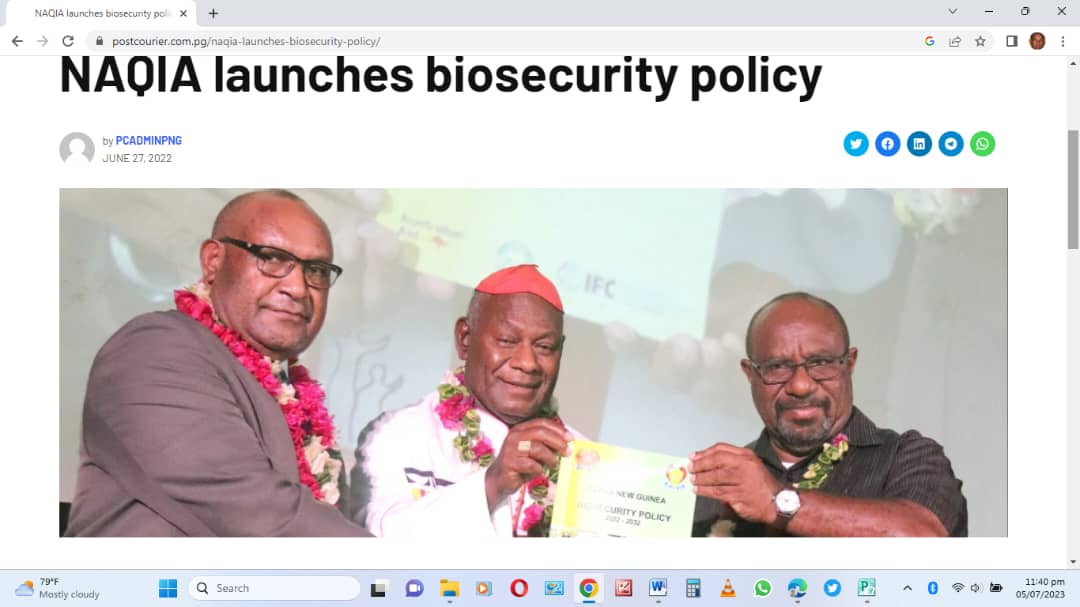
Within a short nine (9) months period, Mr. Alu and his NAQIA team were able to officially launch the country’s first-ever Biosecurity Policy 2022-2032 in Port Moresby on June 26, 2022, a very hectic period when the country was going through the 11th National General Elections but which did not hinder the then DAL Minister, Hon. John Simon to find time and presided over the ceremony.
Twelve (12) months on and this biosecurity policy is now set to be finalized in Lae into the construct of a Biosecurity Bill (legislation) to go before Parliament for enactment.
Since taking office on May 30, 2019, Prime Minister James Marape’s government has successfully passed more legislations than any of his predecessors, in fact a total of 150 amendments and legislations were passed in Parliament under his belt. These legislations are key enablers to not only resuscitating the economy but sustaining its growth at the same time.
This anticipated Biosecurity Act will add on the tally.