


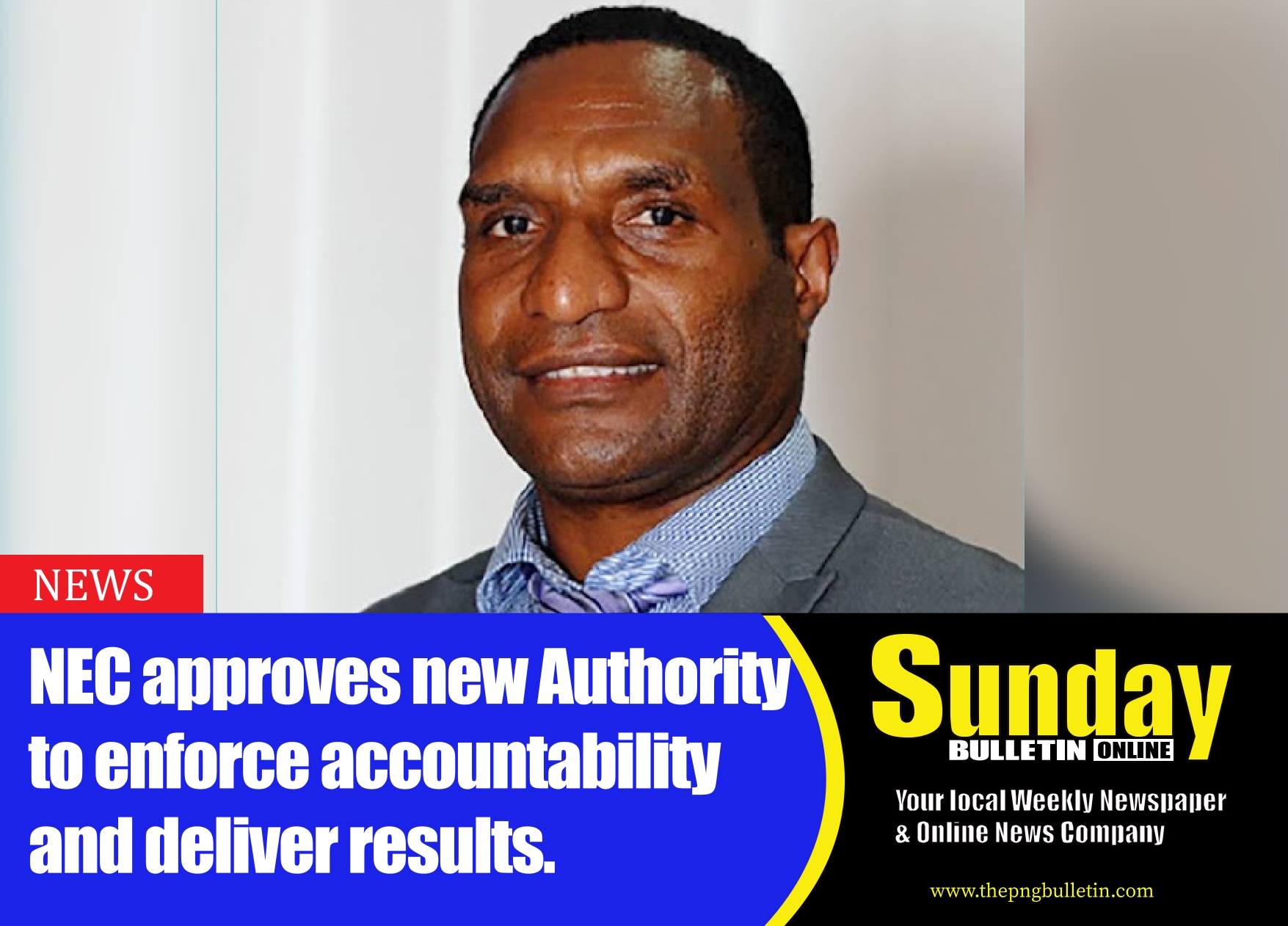
IN a bold move to strengthen whole-of-government performance and accountability, the National Executive Council (NEC) has approved the creation of the National Monitoring and Coordination Authority (NMCA).
The NMCA will serve as the government’s central coordinating agency to eliminate fragmentation, drive policy implementation, and ensure the effective delivery of programs across all levels of government.
In a statement yesterday, Prime Minister James Marape described the NEC decision as a major reform aimed at improving efficiency, coordination, and results within the public sector.
“For too long, government monitoring and coordination have been scattered across departments, resulting in inefficiency, duplication, and weak implementation. That ends now,” PM Marape declared.
Initially housed within the Department of Prime Minister & NEC, the NMCA will be led by a Chief Executive Officer under the delegated authority of the Chief Secretary, reporting directly to the Prime Minister.
Upon full establishment, the Authority will operate independently under its own legislative mandate.
The Government has appointed Mr. David Wereh, former Secretary for Works and Highways and architect of the Connect PNG initiative, as Interim CEO.
Mr. Wereh brings extensive experience in delivering large-scale national programs and leading cross-government reforms.
“His appointment reflects our confidence in his ability to align agencies and mobilise public service machinery to deliver with urgency and cohesion,” said the Prime Minister.
The NMCA will absorb monitoring and coordination staff currently spread across multiple departments and consolidate them into a single, focused authority.
It will act as the Government’s principal mechanism for monitoring, evaluating, and coordinating the implementation of policies, programs, and projects at the national, provincial, district (DDA), and agency levels.
The Authority will also engage independent industry experts—including accounting, engineering, auditing, and architectural firms—alongside institutions like the National Research Institute and key State agencies, to ensure all government-funded work meets standards of quality, compliance, and value for money.
“From now on, every toea spent and every directive issued must lead to measurable outcomes,” said Prime Minister Marape.
“Public servants must take note: failure to deliver will no longer be tolerated. The era of excuses and inefficiency is over.”
The NMCA will be governed by a Council reporting directly to the Prime Minister. The State Solicitor and First Legislative Counsel have been tasked with drafting enabling legislation for presentation to Parliament.
An interim operational team is already being assembled from existing departmental resources to commence groundwork.
“Every review and audit in the last decade has pointed to the same problem—poor coordination, weak implementation, and zero accountability. Billions have been spent with little to show. This ends now,” PM Marape emphasised.
“The NMCA is our structural solution. From now on, budgets must align with the Medium-Term Development Plan (MTDP), and the plan must be executed as intended. No more loose ends.”
“We must lift our game. The NMCA will ensure the public service is disciplined, organised, and results-driven. This is how we rebuild trust, deliver impact, and make government work again.”