


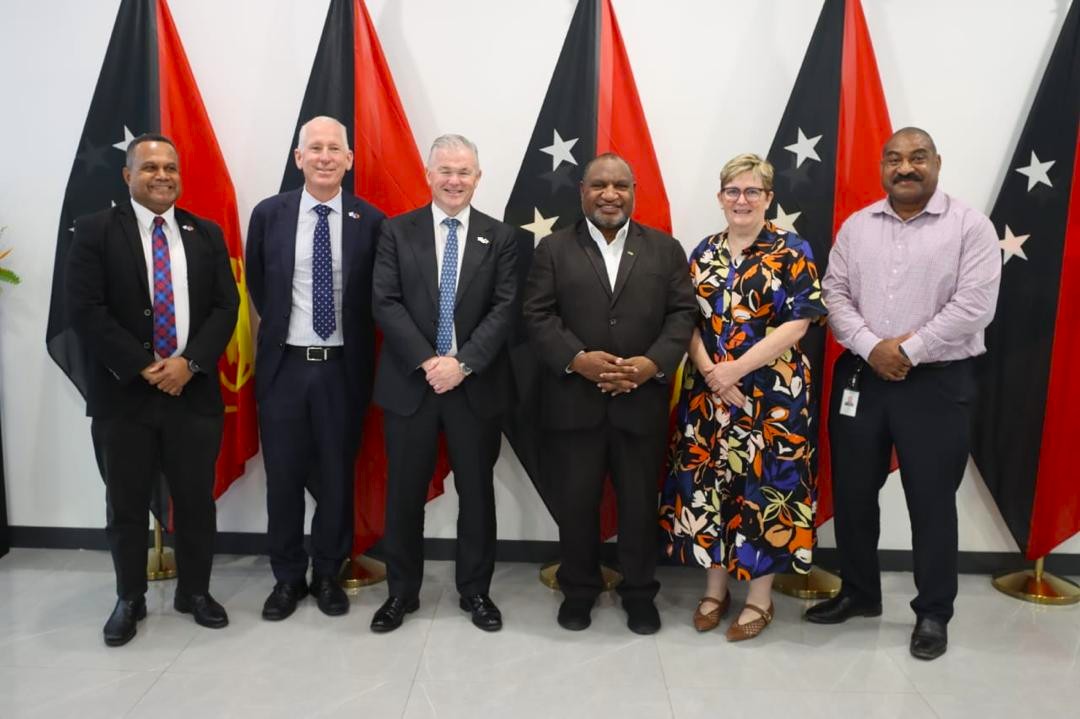
Prime Minister Hon. James Marape has welcomed Santos Managing Director and Chief Executive Officer Mr. Kevin Gallagher and his senior executive team following their Meeting at Melanesian Haus on Monday, 2 March 2026, reaffirming Papua New Guinea’s position as a safe, credible and long-term energy producer in the Asia-Pacific region.
Santos Ltd, one of Australia’s largest energy companies and a major investor in Papua New Guinea, remains a key partner in the country’s Hydrocarbon sector, including its longstanding involvement in the PNG LNG Project.
Prime Minister Marape thanked Mr. Gallagher and his delegation for their courtesy visit and ongoing commitment to Papua New Guinea. “Santos remains one of the biggest Oil and Gas energy companies operating in Australia and Papua New Guinea. They are a welcomed corporate citizen of our country,” Prime Minister Marape said.
The Prime Minister noted that several years ago, upon assuming office, he encouraged Santos to intensify exploration activities, particularly along Papua New Guinea’s prospective Southern Fold Belt corridor stretching from Southern Highlands to Western Province. “A few years back, when Santos was going through restructuring, I asked them to step up further explorations and prop up reserves in our present oil fields,” he said. Prime Minister Marape confirmed that Santos has now significantly increased exploration efforts. “Last night, Santos indicated that they are ramping up their work on explorations to prop up additional Oil and Gas. Their work has not slowed down — in fact, they are doing more explorations,” he stated.
He revealed that Santos signalled plans for over a billion dollars in exploration and resource development activities in Papua New Guinea. “They indicated to me that close to over a billion dollars’ worth of work will take place as far as exploration, affirmation of resources, and extraction are concerned. The fact that they are spending money on exploration is commendable,” Prime Minister Marape said. The Prime Minister described the developments as strong signals of confidence in Papua New Guinea’s geological potential and regulatory stability.
PNG’s Energy Credibility and Track Record
Prime Minister Marape highlighted Papua New Guinea’s global credibility in delivering complex energy projects, referencing the successful development and performance of the PNG LNG Project. “Our first Gas project, PNG LNG, was secured against the backdrop of the 2008 global financial crisis. Seventy percent of its cost — over US$16 billion — was bank-financed by 19 international banks. Six months earlier than scheduled, the debt was totally repaid. That is PNG’s credibility,” he said.
He further noted Papua New Guinea’s environmental credentials. “PNG is a carbon-neutral or carbon-negative country, bearing our substantial forest resources. We tick all the boxes as a safe place for investing in Oil and Gas,” he added.
He emphasised that Papua New Guinea remains firmly positioned in the Hydrocarbon space for the next two to three decades, while also preparing for global energy transition trends. “We remain in the Hydrocarbon space. PNG will continue to be a safe Oil and Gas producing nation for the next 20 to 30 years as the world transitions toward cleaner energy. Gas remains a better energy option than coal,” Prime Minister Marape said. He further noted Papua New Guinea’s environmental credentials. “PNG is a carbon-neutral or carbon-negative country, bearing our substantial forest resources. We tick all the boxes as a safe place for investing in Oil and Gas,” he added.
Sequencing Projects for the Next 20 Years
Prime Minister Marape outlined the Government’s long-term sequencing strategy across multiple Oil and Gas prospects, including Papua LNG, P’nyang, Juha, Pasca, Pandora, Stanley, Wildebeest and offshore exploration in the Gulf Province. “In all, close to ten (10) Resource Areas we want to sequence over the next 20 years. The southern side of our country is shaping up to be Oil and Gas powerhouse territory,” he said.
He stressed that his Government’s approach remains firm but balanced. “My Government is known to negotiate hard and fair. Investors must win. The State must also win. We always strive for a win-win outcome — not where investors win alone, but where both investors and the State benefit,” Prime Minister Marape said.
Broader Resource Sector Momentum
The Prime Minister also indicated that strong momentum continues in the Minerals sector, including progress on WafiGolpu and other major projects under regulatory review. “The work on Wafi-Golpu is going as we speak. Once the Peer Review is completed, Cabinet will make a final decision on how the Project is progressed. We want to give support to the Project to run its course, but the terms must be fair — not just for today, but for the entire 40-year mine life,” he said. He added that Papua New Guinea currently has close to ten (10) Mining projects at various stages of regulatory processing, reinforcing the country’s long-term Resource pipeline.
A Premium Location for Energy Investment
Prime Minister Marape concluded by emphasising Papua New Guinea’s strategic geographic advantage. “Our easy access to North Asia and the broader Asian marketplace gives us a Premium location for Oil and Gas business. In a world facing energy insecurity and geopolitical tensions, PNG offers stability, reliability and partnership,” he said.
The Prime Minister affirmed that the Marape-Rosso Government remains committed to supporting responsible investment, strengthening State participation through Kumul Petroleum Holdings Ltd, and ensuring that resource wealth delivers long-term benefits to landowners, provinces and the nation.
“PNG stands ready to work with credible partners like Santos to unlock our energy potential responsibly and sustainably for the benefit of current and future generations.”