


By GEORGINA MICHAEL
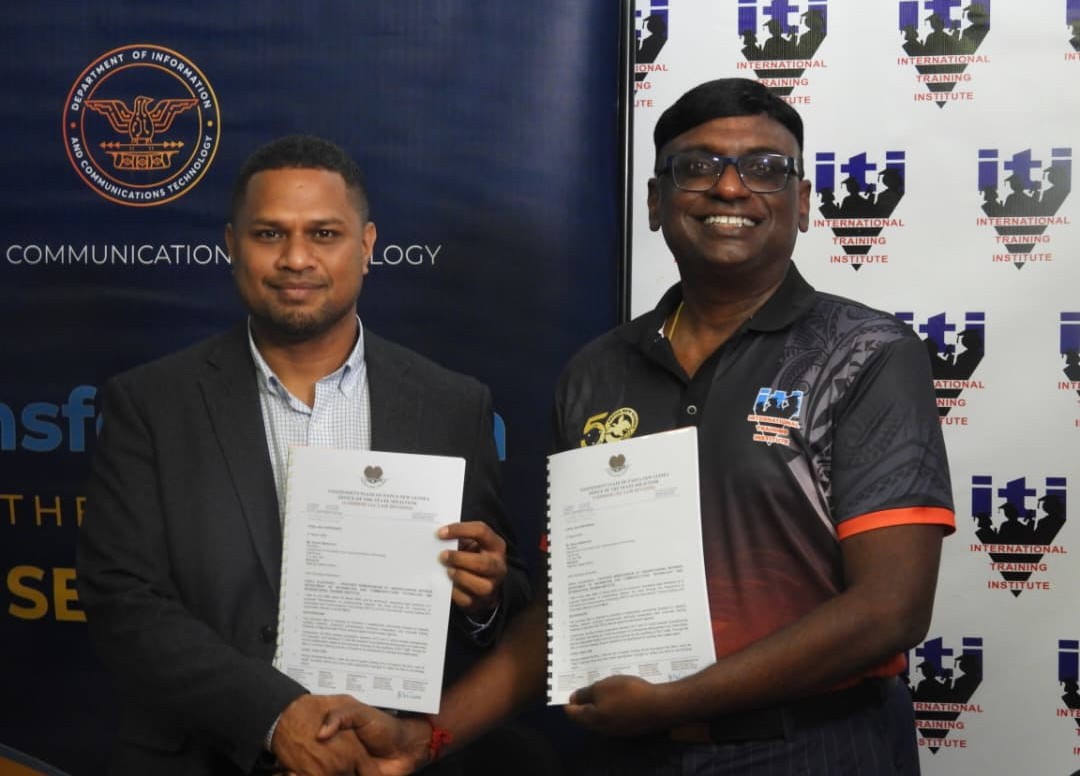
The International Training Institute (ITI) has signed a five-year Memorandum of Understanding (MoU) with the Department of Information and Communication Technology (DICT), marking a strategic partnership to drive Papua New Guinea’s digital transformation.
With PNG at a critical juncture in its digital journey, both parties emphasized that the choices and collaborations made today will determine whether citizens become participants or leaders in the global digital economy.
DICT, as the lead agency for ICT policy and transformation, acknowledged that government alone cannot build the workforce the nation requires. Collaboration with industry, communities, and institutions such as ITI is essential.
The MoU sets out a framework for cooperation in ICT capacity building, curriculum development, research and technical collaboration, and executive training.
ITI Chairman and Co-founder Kumuran Sentheyvel thanked DICT for finalizing the agreement. “ITI is moving into IT and AI, and this is something we want to partner on. We’re also working together on our summits—the DICT Summit and the AI Summit—knowing we are heading in the same direction. As an institution focused on training and digitalization, we are proud to contribute to a better digital future for Papua New Guinea,” he said.
DICT Secretary Steven Matainaho congratulated ITI’s leadership and staff, describing the institute as a “development partner” for providing training opportunities to many Papua New Guineans. He said ITI’s vision from its recent summit on using AI ethically, with good governance, and leveraging AI across workplaces, government, corporates, and especially SMEs.
“SMEs are a big part of any developing nation. You want to grow new markets and enable SMEs to access them and do business with ease. What better way than to leverage AI,” Matainaho said, noting ITI’s collaboration with the SME Corporation and other partners.
The partnership aligns with DICT’s Digital Government and Digital Economy priorities, its draft Government AI Adoption Framework, and its AI Strategy. A key focus is partnering with local institutions to roll out AI adoption.
“AI alone has no value, but AI with a use case has value. This partnership is about exploring and incubating those ideas and use cases—and what better way than through higher education institutions like ITI,” Matainaho added.
With ITI already embedding AI across its programs, DICT is keen to deepen collaboration at the upcoming Digital Transformation Summit from July 20–24.
Mr. Matainaho said this was the first MoU DICT signed with a higher education institution specifically on AI, and the government looks forward to working with ITI to achieve national development goals.