


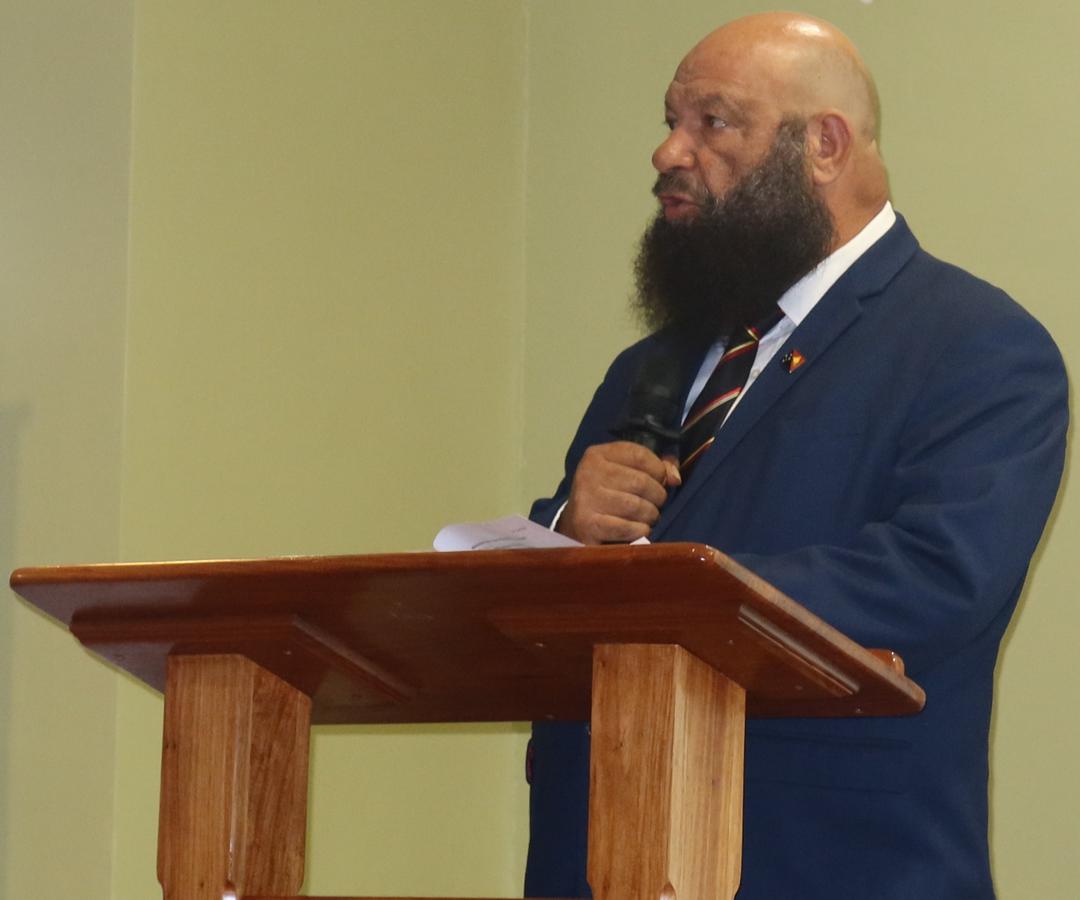
Agriculture Minister Hon. John Boito today launched the National Agriculture Research System (NARS) Policy Framework 2026, a landmark blueprint aimed at modernising agricultural research, strengthening coordination across the sector and delivering practical benefits to farmers throughout the country.
The framework was launched at the NARS Policy Forum at the Lae International Hotel, bringing together government leaders, researchers, development partners, provincial representatives, commodity boards, universities, the private sector and farmers.
The forum also marked the release of the World Bank report, Agri-Food System Transformation in Papua New Guinea, an evidence-based roadmap to guide the country’s agricultural transformation. Minister Boito received the report from World Bank Division Director for Papua New Guinea, Solomon Islands and Vanuatu, Mr Hans Fraeters.
Opening the forum, Minister Boito described agriculture as the foundation of Papua New Guinea’s economy and the livelihood of the overwhelming majority of its people.
“Agriculture is Papua New Guinea,” he said.
“It is the livelihood of the overwhelming majority of our people, the foundation of our rural communities, our food security and our cultural identity.”
Despite the country’s rich natural resources and resilient farming communities, Minister Boito said agriculture continued to operate well below its potential.
“Our farmers are resilient and our land is extraordinary. But too many still farm without access to improved technologies, quality inputs, reliable extension services or markets that reward their effort,” he said.
“This is a challenge we must confront honestly and urgently.”
Mr Boito said the Government’s National Agriculture Sector Plan 2024-2033 sets out a vision for a modern, productive, resilient and market-oriented agricultural sector capable of creating jobs, improving food security and driving rural economic growth.
“But vision without delivery is just words,” he said.
He said achieving that vision required stronger coordination among institutions, increased investment in agricultural research and extension, and research programmes that directly addressed the needs of farmers.
The Minister outlined the progress already made in building the National Agriculture Research System.
Three technical working groups established in 2025 focused on rebuilding research capacity, strengthening extension services and improving commercialisation and market access. Their recommendations now form the foundation of the NARS Policy Framework.
He said chief executives of key agricultural institutions endorsed the draft framework during a meeting at Loloata Island in September 2025 before formalising their commitment through a Memorandum of Agreement signed in Port Moresby three months later.
Earlier this year, the Agricultural Research and Development Coordination Facility was established within the National Agricultural Research Institute (NARI) to oversee implementation.
“This framework is no longer simply an idea,” Minister Boito said.
“It has been built through consultation, collaboration and collective action.”
A central component of the framework is the US$250 million AgriConnect Programme, which aims to bring together government agencies, research institutions, provincial governments, universities, farmers, the private sector and development partners under a coordinated national approach.
Minister Boito said AgriConnect would strengthen the link between research and commercial agriculture by translating scientific findings into practical farming solutions, expanding digital extension services, improving market access and encouraging greater private sector investment.
“In short, AgriConnect connects farmers to markets, research to commercialisation, provinces to national priorities and our people to better livelihoods,” he said.
He called on every institution represented at the forum to commit fully to the programme, saying its success would depend on genuine collaboration.
The Minister also stressed the importance of greater government investment in agricultural research, saying Papua New Guinea could no longer depend primarily on donor funding.
“We cannot rely solely on external funders,” he said.
“We must build our own capacity, our own resilience and our own future.”
Minister Boito thanked the World Bank for its continued support of Papua New Guinea’s agricultural transformation agenda and acknowledged the contributions of AgriConnect, the Department of Agriculture and Livestock, NARI, commodity boards, universities, provincial governments and other stakeholders.
He said the true success of the policy would be measured not by today’s discussions but by improvements in the lives of ordinary Papua New Guineans.
“The success of this forum will be measured by what changes in the months and years ahead,” he said.
“By whether our farmers become more productive, our young people find opportunities in agriculture, and our rural communities become more prosperous.”
Minister Boito reaffirmed the Government’s commitment to transforming agriculture into a major driver of economic growth and rural development.
“Today, let us transform agriculture from a sector of untapped potential into a sector of realised opportunity,” he said.
“Together, let us transform Papua New Guinea’s future.”