


By ESWIN PLESIO
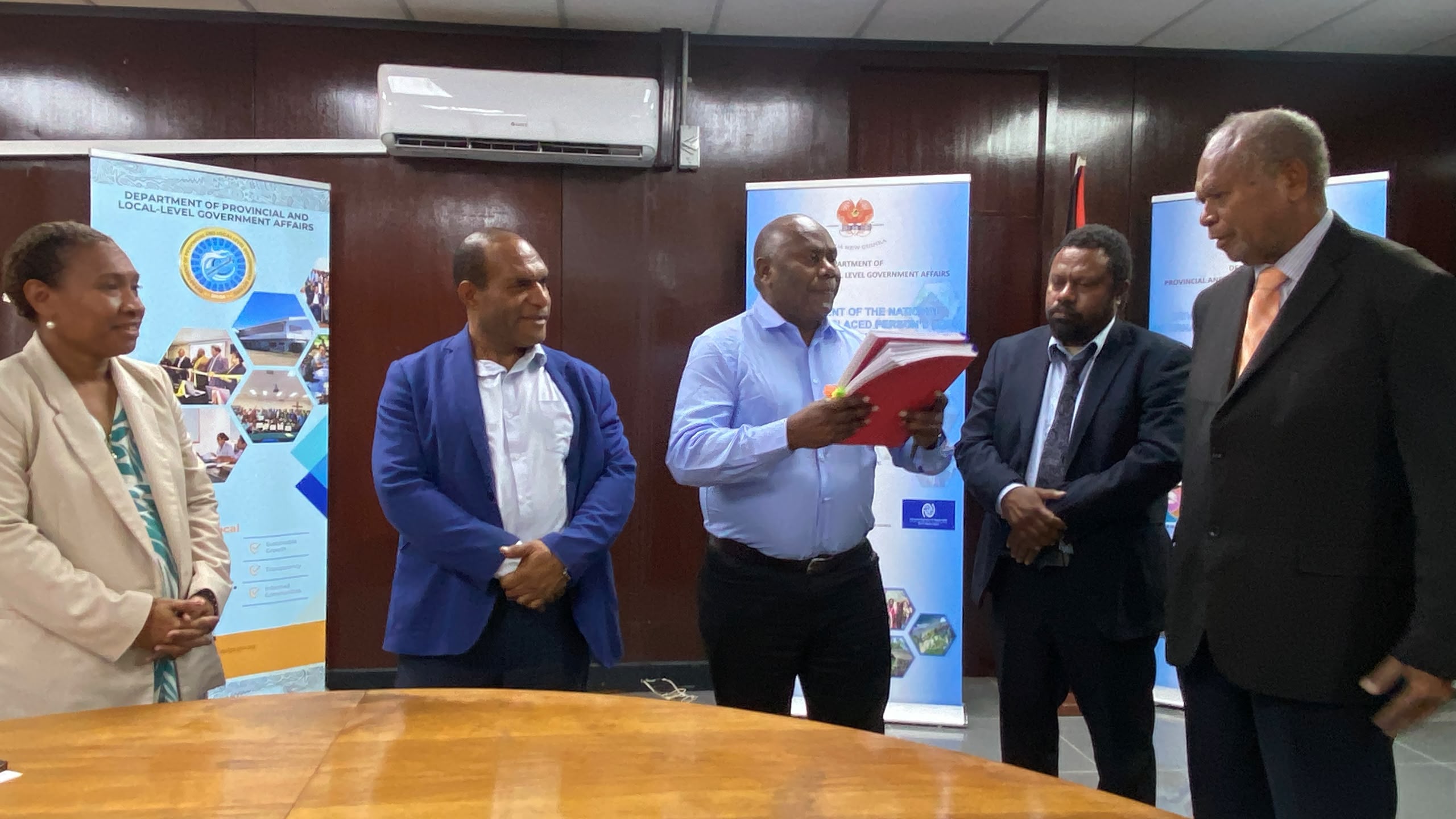
The East New Britain Provincial Administration has taken a significant step towards strengthening local governance by presenting a total of 43 Local Level Government (LLG) by-laws to the Department of Provincial and Local Level Government Affairs (DPLGA) in Port Moresby.
The presentation took place on Wednesday in Port Moresby and was attended by officials from the DPLGA, the East New Britain Provincial Administration and Rabaul MP, Dr Allan Marat.
The by-laws consist of 25 urban LLG by-laws and 18 rural LLG by-laws, all developed to provide a stronger legal framework for local governments to better manage their communities, improve service delivery and maintain peace and order.
Deputy Director of the Department of Provincial and Local Level Government Affairs, Larsel Thomas, said the initiative comes at a time when the department is reviewing legislation to restore and strengthen the role of local-level governments throughout the country.
He said that since the introduction of the Organic Law on Provincial Governments and Local-Level Governments nearly three decades ago, many of the powers originally intended for LLGs have gradually shifted to provincial governments and District Development Authorities (DDAs).
Mr Thomas said the department is now working on legislative reforms that will clearly define the responsibilities of the national government, provincial governments, DDAs and LLGs, ensuring each level of government performs its intended role.
He also announced that funding mechanisms, including the Local Level Government Service Improvement Program (LLG-SIP), have now been given legal recognition alongside PSIP, DSIP and WSIP. He expressed confidence that LLG-SIP funding will begin reaching local governments from next year.
Describing East New Britain as a model province, Mr Thomas praised the provincial government for taking the lead in preparing the by-laws.
He said good governance starts with good laws and, while enforcement remains a challenge, having proper legislation gives local leaders the authority they need to govern their communities effectively.
He encouraged the province to complete the remaining legal processes so the by-laws can be certified, gazetted and enforced.
“Our goal is to empower LLGs to run their own affairs, provide effective leadership, improve service delivery and be more accountable to the people,” Mr Thomas said.
Rabaul MP Dr Allan Marat said the by-laws reflect the aspirations of the people of East New Britain to build safer, more peaceful and well-managed communities.
He said the province had taken the matter seriously and invested time and effort into developing legislation that gives legal backing to community rules that were once enforced informally at the ward level.
“The people of East New Britain want a peaceful society where meaningful development can take place,” Dr Marat said.
He said the province has submitted all 43 by-laws. 25 for urban LLGs and 18 for rural LLGs for legal review, with the hope that they will soon be approved and enforced across the province.
Among the proposed by-laws are provisions aimed at addressing issues such as excessive noise late at night and other behaviours that disrupt peace within communities.
While welcoming the progress made, Dr Marat acknowledged that challenges still lie ahead, particularly in ensuring the by-laws are properly implemented and enforced at the community level.
He said the focus now is to ensure the legislation carries the full force of law so that local leaders have the authority to uphold order and strengthen governance throughout East New Britain.