


By FREDRICK JEJERI
WHILE communities across Papua New Guinea continue to call for larger government funding, a small rural community in Markham District has demonstrated that honest and accountable management of public money can deliver lasting development.
The achievement has earned national recognition, with Parliament Clerk Kala Aufa describing Ward 20 of Leron-Wantoat Local Level Government – LLG as a model for how public funds should be utilized.
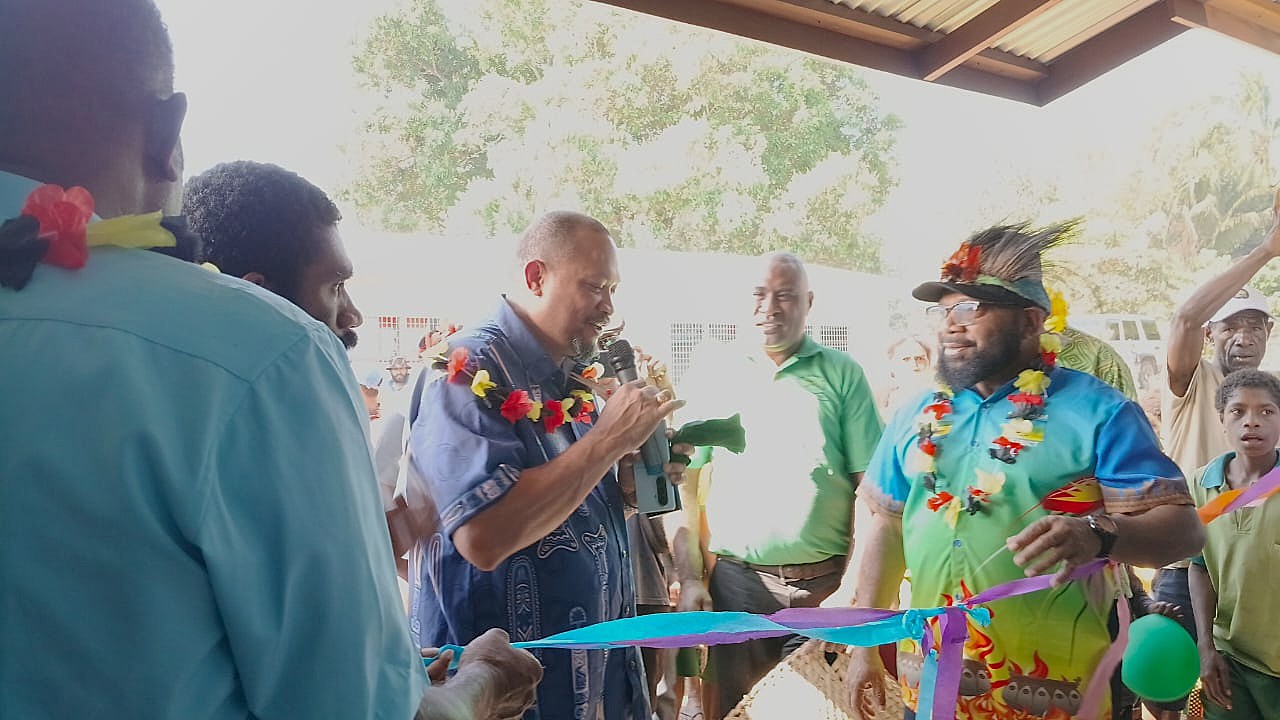
Mr Aufa made the remarks on Friday while opening two teachers’ houses and a double classroom at Nariawang Primary School.
The buildings were completed through a K100,000 allocation from the Markham District Development Authority under the leadership of Markham MP and Deputy Speaker Hon. Koni Iguan.
Standing before the newly completed buildings, Mr Aufa said the project signifies powerful message that development is determined not by the size of the budget but by the integrity of the people entrusted to manage it.
“Most communities continue to ask for more funding, yet what I have witnessed here proves that accountability and community ownership can achieve remarkable results,” he said.
“This is how public money should be managed. Nariawang has set a benchmark for other communities to follow.”
He said the project reflected a partnership where local people took responsibility for protecting public funds and ensuring every kina was invested in services that would benefit future generations.
Mr Iguan congratulated the community for earning national recognition through its commitment to accountability and prudent management of development funds.
“If every community in our district managed public funds with the same honesty and commitment, more schools, health facilities and other essential services would already be serving our people,” he said.
He urged community leaders to see public funds as a trust placed in them by the people, saying every kina must produce visible and lasting improvements in villages.
The parliamentary delegation also witnessed the groundbreaking ceremony for a new two-man aid post, with construction scheduled to begin next month.
The facility is expected to provide much needed primary healthcare for surrounding communities.
School headmaster John Robert said the project succeeded because the community supplied local labour and worked together instead of demanding for money.
He said enrolment at the school had increased from 317 to 645 students, placing enormous pressure on existing classrooms and teachers’ accommodation.
“The community understood that such investments are good for their children’s future,” Mr Robert said.
He added that the school was continuing to expand its infrastructure as it worked towards meeting the requirements for elevation to high school status.
For Nariawang, the new buildings are more than classrooms and staff houses. These are signs of what can be achieved when communities place accountability ahead of personal interests and treat public funds as a shared responsibility