


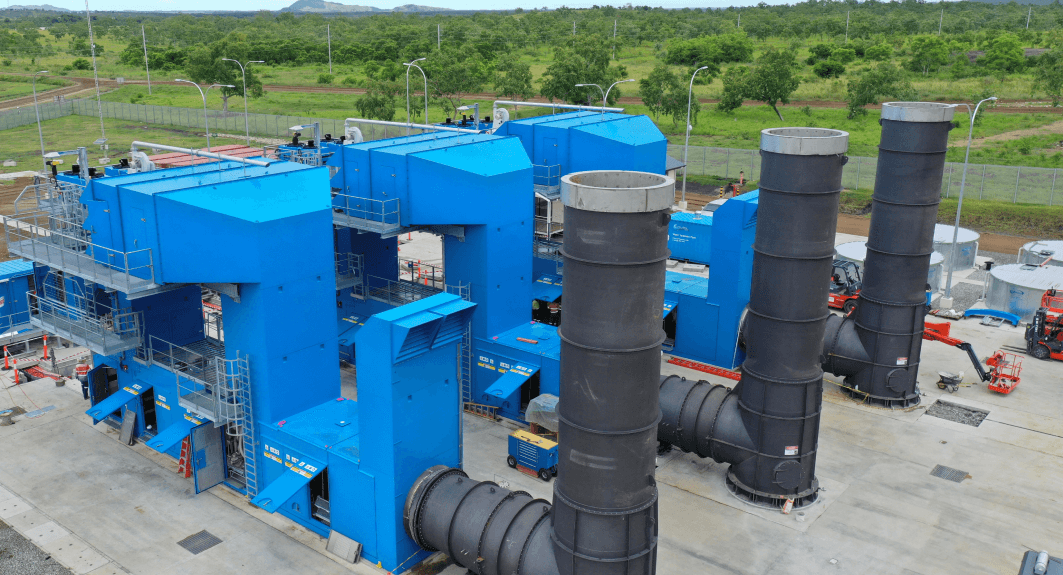
DIRIO Gas & Power Company Limited has rejected allegations by Minister for International Trade and Investment and Minister looking after PNG Power Limited (PPL) Richard Maru that its Power Purchase Agreement (PPA) with PNG Power Limited (PPL) is unfair, saying the agreement was lawfully approved and that PPL’s financial losses are largely the result of its own operational decisions.
The statement from Dirio follows Minister Maru’s clarification on Thursday (30/07/26) that the Government is not opposed to all Independent Power Producers (IPPs), but is specifically targeting the PPAs between PPL and Dirio Gas and Power Limited and Daewoo Posco Limited (Munum).
“I am very grateful to the IPPs that have good commercial deals with PPL. We will honour the Power Purchase Agreements with those IPPs,” Maru said.
“The war is not against the Independent Power Producers of Papua New Guinea and the IPPs that PPL is making money from. We are specifically targeting the PPAs that PPL has with Dirio Gas and Power Limited and Daewoo Posco Limited (Munum),” he said.
Maru alleged that the two agreements were “bleeding PPL” and contributing directly to the utility’s financial difficulties.
He questioned why the pricing formula used in PPL’s agreement with NiuPower was not adopted in Dirio’s agreement, despite the Dirio PPA being signed four years later.
“The PPA between Dirio and PPL was signed four years after NiuPower. How is it that the same template and pricing formula for NiuPower was not used for Dirio? Why the difference? We will get down to the bottom of this,” Maru said.
The Minister also indicated that the Government was considering legal action to overturn the agreements.
“We must get PPL out of these deals and renegotiate better terms. I am looking at going to court to nullify these Agreements,” he said.
In response, Dirio categorically rejected any suggestion that its PPA was illegal, fraudulent, unfair or improperly obtained, describing the allegations as “wrong,” “damaging,” and unsupported by the facts.
The company said the agreement was negotiated over more than a year and received all required approvals from PNG Power, Kumul Consolidated Holdings, the National Executive Council and the Independent Consumer and Competition Commission.
“Every required approval was obtained,” Dirio said, arguing that any allegation of fraud or impropriety effectively challenged the decisions of the State institutions that approved the agreement.”
Dirio also disputed claims that it was responsible for PPL’s financial losses, instead pointing to high technical losses,
electricity theft, rising operating costs and regulated retail tariffs as the key factors affecting the utility’s financial position.
The company said PPL itself had under-dispatched the Dirio gas-fired power station, operating it at only around 30 per cent of its average dispatch capacity during 2025.
According to Dirio, the reduced utilisation significantly increased the unit cost of electricity because the plant’s fixed costs had to be recovered over a smaller volume of energy than it was designed to produce.
Dirio also said it purchases gas without applying any mark-up and that fuel costs, which are linked to global oil prices, typically account for between 40 and 60 per cent of the cost of generating electricity.
The company maintained that it should not be grouped with higher-cost diesel generators or blamed for losses arising from PPL’s tariff structure, dispatch decisions, system losses and operating costs.
Dirio further warned that attempts to renegotiate or nullify lawfully approved commercial agreements could undermine investor confidence in Papua New Guinea.
It also noted that the National Court had previously upheld the validity of the PPA and ruled in its favour regarding monies owed by PPL.
Despite the dispute, Dirio said it remained committed to supplying reliable electricity and was willing to engage constructively with the Government on addressing the challenges facing PPL, provided discussions were based on facts and respect for legally binding agreements.
The exchange marks an escalation in the public dispute over PPL’s power purchase agreements as the Government pursues reforms aimed at improving the financial position of the state-owned electricity utility.
The contract is no problem, however, the price per unit cost is still high as compared to other independent suppliers. I strongly advise the company to work with the minister responsible to make sure this does not affect their long term partnership. The government of the day as represented by the minister responsible can change its terms and conditions if it feels that something is not right. If pushed to a corner, the contract can be easily terminated and that would be a big loss to Dirio Power. Do not forget that the government will have the money to pay off any breach of contract regardless.