


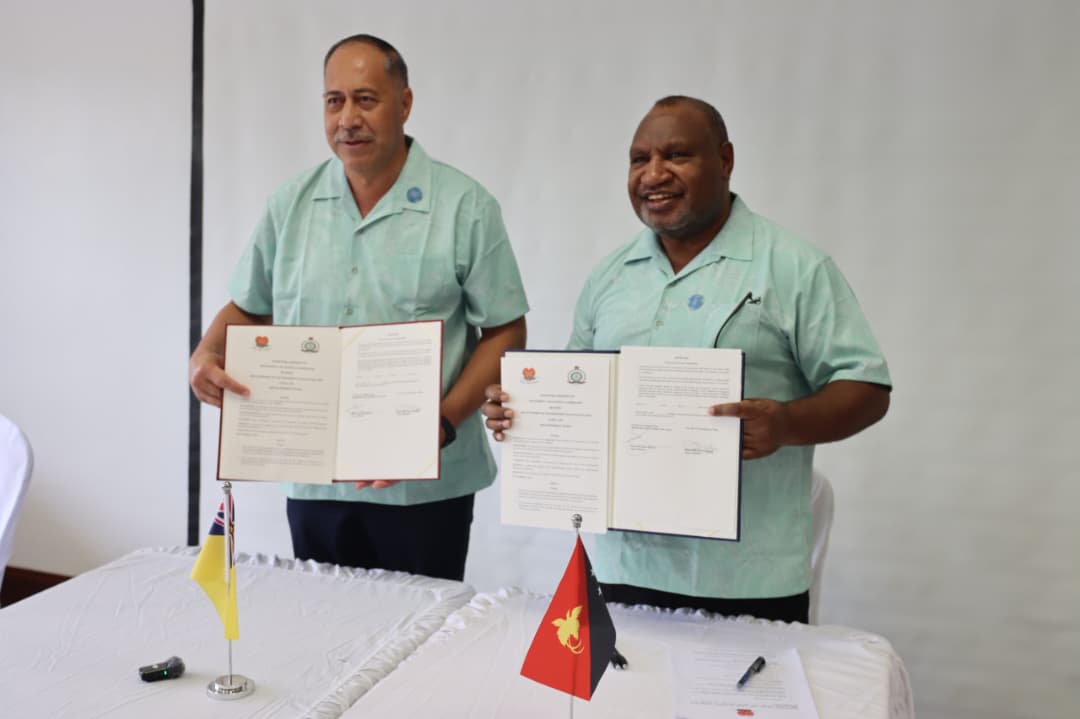
PRIME Minister Hon. James Marape and Niue Prime Minister Hon. Dalton Tagelagi today signed a Framework Agreement on Development and Technical Cooperation, strengthening bilateral relations between Papua New Guinea and Niue and opening the way for greater cooperation across a wide range of development sectors.
The agreement was signed in Koror, Palau, on the sidelines of the 55th Pacific Islands Forum Leaders’ Meeting.
Prime Minister Marape said the agreement reflected Papua New Guinea’s commitment to strengthening cooperation within the Pacific family and sharing knowledge, expertise and resources for mutual benefit.
“This agreement is about Pacific countries working together and supporting each other in practical areas that improve the lives of our people,” Prime Minister Marape said.
“Papua New Guinea values its relationship with Niue, and we want to build on that relationship through
stronger economic, technical and people-to-people cooperation.”
The Framework Agreement provides an overarching mechanism through which the two countries can develop specific subsidiary agreements and programmes according to their respective economic and social development priorities.
It identifies a broad range of areas for cooperation, including:
* Trade, investment, tourism and economic cooperation;
* Education, skills and labour mobility;
* Health, sports and social development;
* Agriculture, food security and sustainable development;
* Climate resilience, environmental protection and natural resource management;
* Infrastructure, digital development and connectivity;
* Fisheries and marine resources management;
* Cultural, arts, religious and people-to-people exchanges;
* Renewable energy and green technology;
* Public sector governance and institutional strengthening; and
* Sister-city arrangements.
Prime Minister Marape said the breadth of the agreement provided both governments with considerable scope to translate their close Pacific relationship into practical programmes.
“As Pacific nations, we have much that we can share with each other. Whether it is education and skills, agriculture, fisheries, climate resilience, renewable energy, tourism or digital connectivity, there are opportunities for Papua New Guinea and Niue to cooperate more closely,” he said.
“The important thing now is to turn this framework into practical initiatives that deliver tangible benefits to our people.”
Under the agreement, the two countries can cooperate through the exchange of information, technical knowledge and skills, the deployment or secondment of experts, short-term technical training, consultancy services, feasibility studies and joint projects.
Papua New Guinea’s Department of Foreign Affairs and Niue’s Office of Foreign Affairs will serve as the respective implementing authorities, working with relevant agencies and institutions to develop subsidiary arrangements.
Prime Minister Marape said the agreement was consistent with Papua New Guinea’s wider commitment to Pacific regionalism and the principle that Pacific countries should increasingly draw upon their own collective strengths and capabilities.
“We are one Pacific family. We may differ in population, geography and economic size, but we share the same ocean and many of the same challenges and aspirations,” he said.
“Papua New Guinea, as the largest Pacific Island nation, has a responsibility to work constructively with our
Pacific neighbours. We also have much to learn from countries such as Niue, particularly in areas where they have developed valuable experience and expertise.
“This is cooperation based on mutual respect and mutual benefit.”
Prime Minister Marape said the agreement also complemented the broader objectives of the 2050 Strategy for the Blue Pacific Continent by strengthening partnerships between Pacific Island countries and building greater regional resilience and self-reliance.
The Framework Agreement takes effect from the date of signing and will remain in force unless either country gives six months’ written notice of its intention to terminate it.