


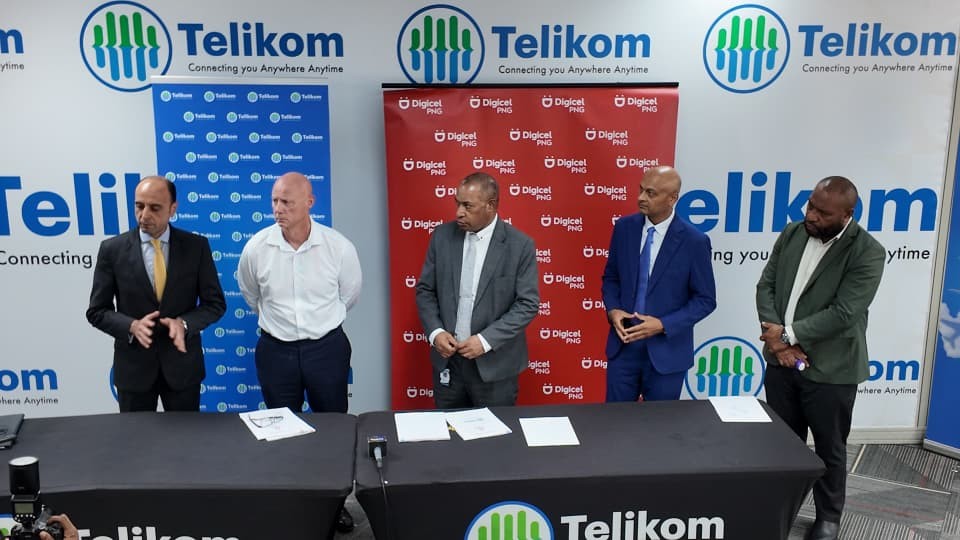
Telikom PNG Limited and Digicel PNG have entered into a major telecommunications infrastructure-sharing agreement aimed at expanding network coverage, reducing infrastructure costs and improving mobile and broadband connectivity across Papua New Guinea.
Telikom Limited Chief Executive Officer Amos Tepi, described the agreement as an important milestone that would allow both telecommunications operators to share existing towers instead of constructing separate infrastructure in the same locations.
Speaking during the signing of the Telikom–Digicel Tower Licence Agreement in Port Moresby today, October 15, Tepi said the arrangement would enable both companies to extend their networks more efficiently, particularly into rural and remote communities where telecommunications infrastructure remains expensive to establish.
“Today Telikom and Digicel PNG sign a Tower Licence Agreement. Put simply, it is an agreement to share towers. Where one of us already has a structure standing, the other can use it, rather than build a second one beside it,” Tepi said.
He explained that the agreement would initially run for five years, with provisions for an extension of up to 15 more years.
Under the reciprocal arrangement, either company can install telecommunications equipment on suitable tower sites owned by the other, subject to technical, operational, safety and commercial requirements.
Tepi stressed that the agreement would not affect competition between the two telecommunications operators, as both companies would continue operating independently and competing for customers.
“What it does not do is blur the line between us. Digicel and Telikom remain competitors. We will compete on service and on price. We will simply stop competing on steel,” he said.
He said Papua New Guinea’s difficult geographical conditions, including mountainous terrain, isolated communities and limited road access, have made telecommunications infrastructure development extremely challenging and costly.
“Papua New Guinea is one of the hardest countries in the world to build a network in. Every tower sits at the end of a road, a boat trip or a helicopter flight,” Tepi said.
He pointed out that constructing separate telecommunications towers in the same geographical areas resulted in unnecessary duplication of investment, with customers and communities ultimately missing out on expanded services.
“When two operators build in the same valley, the country pays twice for one outcome and the second tower is often the one that never gets built,” he said.
Tepi said the new agreement would change that situation by allowing both operators to maximise existing infrastructure and accelerate network expansion into communities currently without reliable telecommunications services.
“This agreement changes that arithmetic. Coverage reaches communities sooner. Telikom’s tower portfolio becomes a revenue-earning asset, and every new site costs us less to deploy,” he said.
He added that the partnership would give practical effect to the infrastructure-sharing principles under the National Information and Communications Technology Act through cooperation between competing operators.
Digicel PNG Interim Chief Executive Officer Brett Goschen also welcomed the partnership, describing it as an important step towards improving telecommunications connectivity and supporting Papua New Guinea’s growing digital economy.
“Connectivity is critical to Papua New Guinea’s economic and digital future. Through closer collaboration and shared infrastructure, we can extend network coverage more efficiently, reduce costs and accelerate access to reliable services for more communities,” Goschen said.
He said the partnership would help both companies strengthen their networks while extending the benefits of telecommunications services to more people throughout the country.
Goschen added that improved access to reliable telecommunications services would encourage greater participation in the digital economy and contribute to Papua New Guinea’s long-term economic growth and development.
The agreement is expected to improve operational efficiency, reduce infrastructure duplication and create opportunities for both operators to expand mobile and broadband services into underserved areas.
It will also allow Telikom and Digicel PNG to concentrate more investment on improving network quality, customer services and expanding coverage rather than duplicating costly tower infrastructure.
Tepi acknowledged the technical and legal teams from both companies, particularly Telikom’s Shivneet Nair and Digicel’s Abdallah Nassar, for their work in developing the agreement.
He said the real success of the partnership would be measured not by the signing ceremony but by the number of communities that eventually benefit from improved telecommunications connectivity.
“The real measure of today will not be the signatures on this page. It will be the first site that goes live under it, and every one after that,” Tepi said.
The partnership marks another important development in Papua New Guinea’s telecommunications industry as the country continues efforts to improve digital connectivity, strengthen communication infrastructure and bridge the digital divide between urban and rural communities.
Telikom Limited is a 100 per cent nationally owned telecommunications company providing fixed-line, mobile, broadband and satellite connectivity services, while Digicel PNG remains one of the country’s major mobile telecommunications and digital service providers.
Both companies have reaffirmed their commitment to working together on infrastructure sharing while maintaining independent commercial operations and competition in the telecommunications market.