


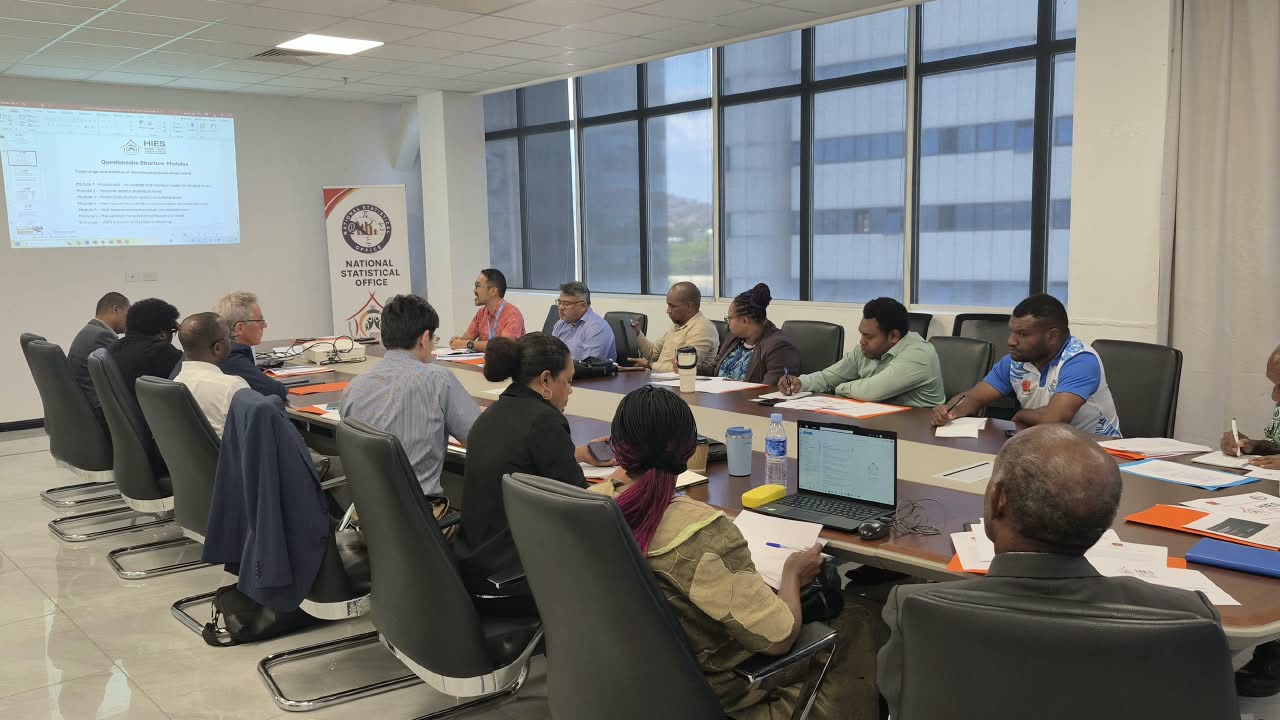
THE National Statistical Office (NSO) today convened a Development Partners and Donor Consultation in Port Moresby to strengthen partnerships and mobilise technical and financial support for three priority national statistical programmes.
The consultation brought together representatives of the World Bank, International Monetary Fund (IMF), Asian Development Bank (ADB), Department of Foreign Affairs and Trade (DFAT), United Nations agencies, USAID, Japan International Cooperation Agency (JICA), New Zealand Aid and other development partners, together with the NSO Senior Management Team and technical officers.
Opening the consultation, National Statistician Mr Alfred Mokae said the engagement was an important opportunity to strengthen collaboration and establish a coordinated approach to supporting Papua New Guinea’s National Statistical System.
He said the consultation aligned with the NSO’s institutional Transformation and Modernisation Agenda, which aims to strengthen institutional capacity and improve the production of timely, reliable, accurate and internationally comparable official statistics.
The discussions focused on three major national statistical programmes:
- 2027 Household Income and Expenditure Survey (HIES)
The HIES will provide updated information on household income, expenditure, consumption, poverty and living standards. It will also support the updating of the Consumer Price Index and strengthening of the national accounts.
- 2028 Demographic and Health Survey (DHS)
The DHS will generate essential information on fertility, maternal and child health, nutrition, family planning and other key health indicators to support evidence-based health policies and national development planning.
- 2030 National Population and Housing Census
Building on the experience and lessons of the 2024 Census, the NSO will commence early preparations to strengthen census methodology, institutional capacity, technology, data collection systems and logistics.
The Census remains fundamental to national planning, resource allocation, electoral planning and the effective delivery of public services.
Mr Mokae acknowledged that implementing these programmes would require substantial financial resources, specialised technical expertise, appropriate technology and sustained institutional support.
“These are important national statistical programmes that cannot be delivered by the NSO alone. We need strong partnerships, predictable financing and coordinated technical assistance to ensure their successful implementation,” he said.
He called on development partners to explore opportunities for financial assistance, technical cooperation, capacity development, technology transfer and joint programme oversight.
He also emphasised the need for a coordinated support framework that aligns development assistance with national priorities, avoids duplication and strengthens national ownership and institutional capacity.
The consultation provided an opportunity for NSO technical teams to present programme priorities, implementation challenges and resource requirements, while engaging development partners on potential areas of assistance.
The expected outcomes include a common understanding of the three programmes, identification of potential technical and financial support opportunities, and agreement on practical follow-up actions to mobilise the necessary resources and expertise.
Mr Mokae reaffirmed the NSO’s commitment to institutional reform, professional integrity, transparency and accountability under its Transformation and Modernisation Agenda.
He emphasised that investment in the national statistical system was fundamental to good governance, informed policymaking, public accountability and sustainable national development.
“Quality statistics are more than numbers. They are essential instruments for understanding our people, measuring development progress and making informed decisions about the future of our country,” he said.
The NSO looks forward to strengthening its partnerships with development partners and government agencies to advance these priority national statistical programmes and build a stronger National Statistical System for Papua New Guinea.