


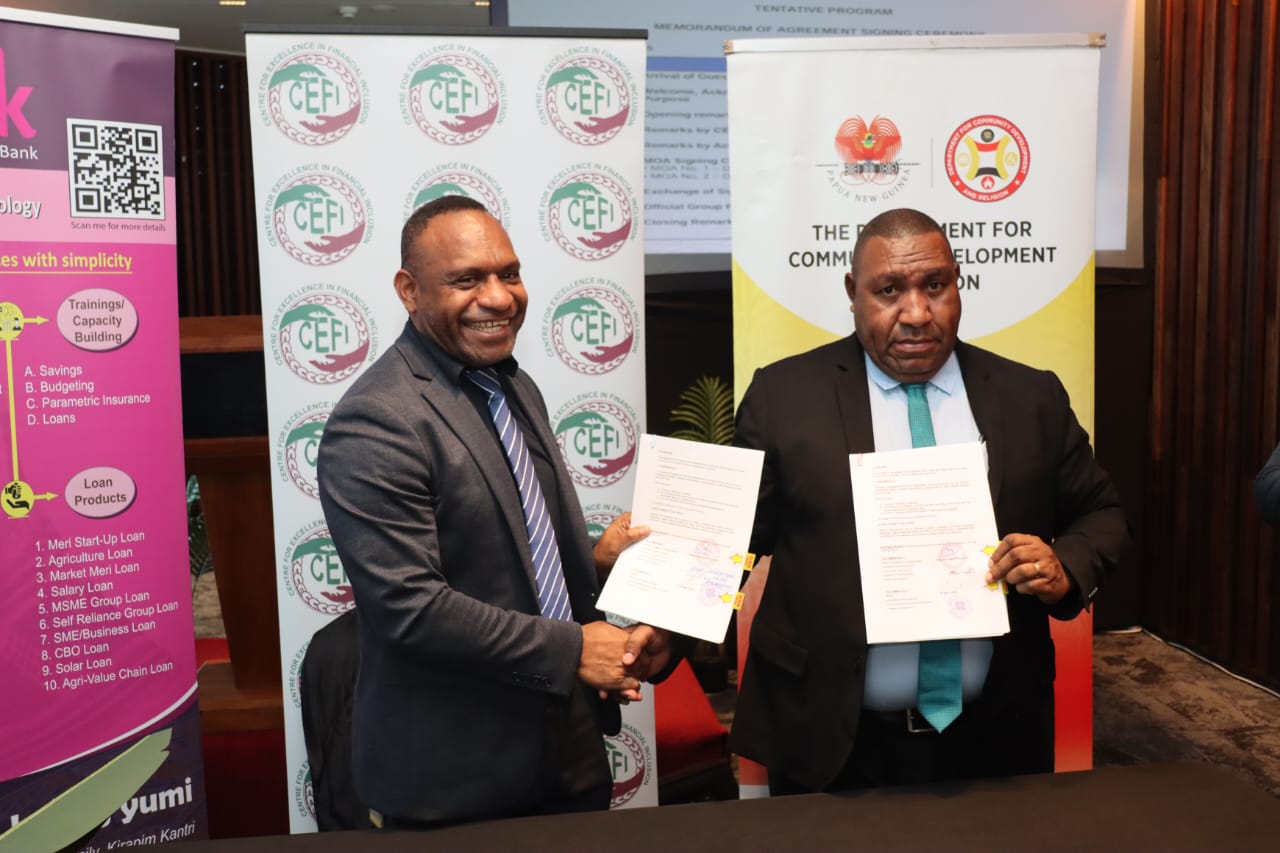
THE Centre for Excellence in Financial Inclusion (CEFI), the Department for Community Development and Religion (DFCDR), and Women’s Micro Bank (WMB) have reaffirmed their commitment to expanding financial inclusion and economic empowerment across Papua New Guinea through the signing of two Memoranda of Agreement (MoA).
DFCDR signed the MOA with CEFI and WMB yesterday (Thursday 02nd July 2026) at APEC. Haus Port Moresby.
The agreements formalise partnerships between DFCDR and CEFI, and DFCDR and Women’s Micro Bank, creating a coordinated approach to delivering financial literacy training, improving access to financial services and supporting women, youth, persons with disabilities and vulnerable communities throughout the country.
Speaking during the signing ceremony, CEFI Acting Executive Director Mr Peter Samuel said the strengthened partnership demonstrates a shared commitment to creating lasting opportunities for Papua New Guineans through financial inclusion.
Mr Samuel explained that CEFI was established to complement the Bank of Papua New Guinea’s broader vision of extending financial services beyond the formal banking sector and ensuring more Papua New Guineans can participate in the country’s financial system.
“Financial inclusion is about changing mindsets. We want people to develop a healthy relationship with money by encouraging saving before spending, building financial resilience and creating opportunities for long-term investment,” he said.
Mr Samuel highlighted the significant progress achieved under Papua New Guinea’s National Financial Inclusion Strategy, noting that the number of bank accounts has grown from approximately 800,000 to almost five million nationwide.
Financial service access points, including bank branches, ATMs and agents, have also increased to more than 20,000, while almost two million people are now using internet and mobile banking services.
He said these achievements were only possible through strong partnerships with organisations such as DFCDR, whose extensive presence throughout the country enables financial literacy programmes to reach communities at the grassroots level.
“The Department has become one of our strongest partners because it provides the critical last-mile connection to communities across Papua New Guinea. Together, we are creating opportunities that improve lives through financial education and inclusion,” Mr Samuel said.
DFCDR Secretary Mr Jerry Ubase described the signing as a significant milestone that aligns with the Government’s commitment to empowering communities through education, entrepreneurship and economic participation.
He said the partnership would enable CEFI to deliver financial literacy training through the Department’s nationwide network, while Women’s Micro Bank would provide accessible banking services and financial products to participants who complete the training.
“Our objective is to ensure that financial literacy reaches women, girls, boys and young people throughout Papua New Guinea. Financial education gives people the confidence and knowledge to start businesses, generate income and create employment within their own communities,” Mr Ubase said.
He said the initiative also supports the Government’s Medium Term Development Plan IV target of creating one million jobs by helping individuals establish sustainable small businesses rather than relying solely on formal employment opportunities.
Mr Ubase noted that many women operating in the informal sector continue to face barriers in accessing banking services.
Through the partnership, Women’s Micro Bank will help more women safely save their income, access financial services
and obtain small business loans to grow their enterprises.
“We want to empower our people economically while also addressing many of the social challenges facing our communities. Strong partnerships like this allow us to deliver practical solutions that improve people’s livelihoods,” he said.
Women’s Micro Bank Chief Executive Officer Mr Gunanidhi Das welcomed the agreement, describing it as an important step towards ensuring financial services become accessible to every Papua New Guinean, particularly those living in rural and underserved communities.
“We believe that opening a bank account should not be a privilege reserved for people in urban centres. It should be the birthright of every Papua New Guinean, and access to credit should be available to every aspiring entrepreneur,” Mr Das said.
He commended CEFI for its Training of Trainers programme, which has helped build a nationwide network of qualified financial literacy trainers, including 26 Women’s Micro Bank staff members who now deliver financial education throughout the country.
Mr Das said financial literacy provides communities with the knowledge to manage money effectively, while Women’s Micro Bank ensures they have immediate access to practical financial services such as savings accounts and affordable loan products.
He revealed that since launching its specialised SME lending programme earlier this year, the bank has approved nearly 1,500 loans for women and families, many of whom had never previously owned a bank account. The bank is also partnering with markets, churches, community organisations and training institutions to deliver banking services directly to informal sector participants.
“Training creates knowledge, but people also need access to financial products so they can put that knowledge into practice. That is where our partnership with CEFI and the Department becomes so important,” he said.
Under the agreements, the Department for Community Development and Religion will provide K800,000 to support CEFI’s financial literacy Training of Trainers and retail training programmes. A further K200,000 has been allocated to Women’s Micro Bank as seed funding to support new account openings and provide loans, particularly for women, vulnerable groups and persons with disabilities.
The strengthened collaboration reflects the shared commitment of all three organisations to expanding financial inclusion, promoting entrepreneurship and improving economic opportunities for communities throughout Papua New Guinea.