


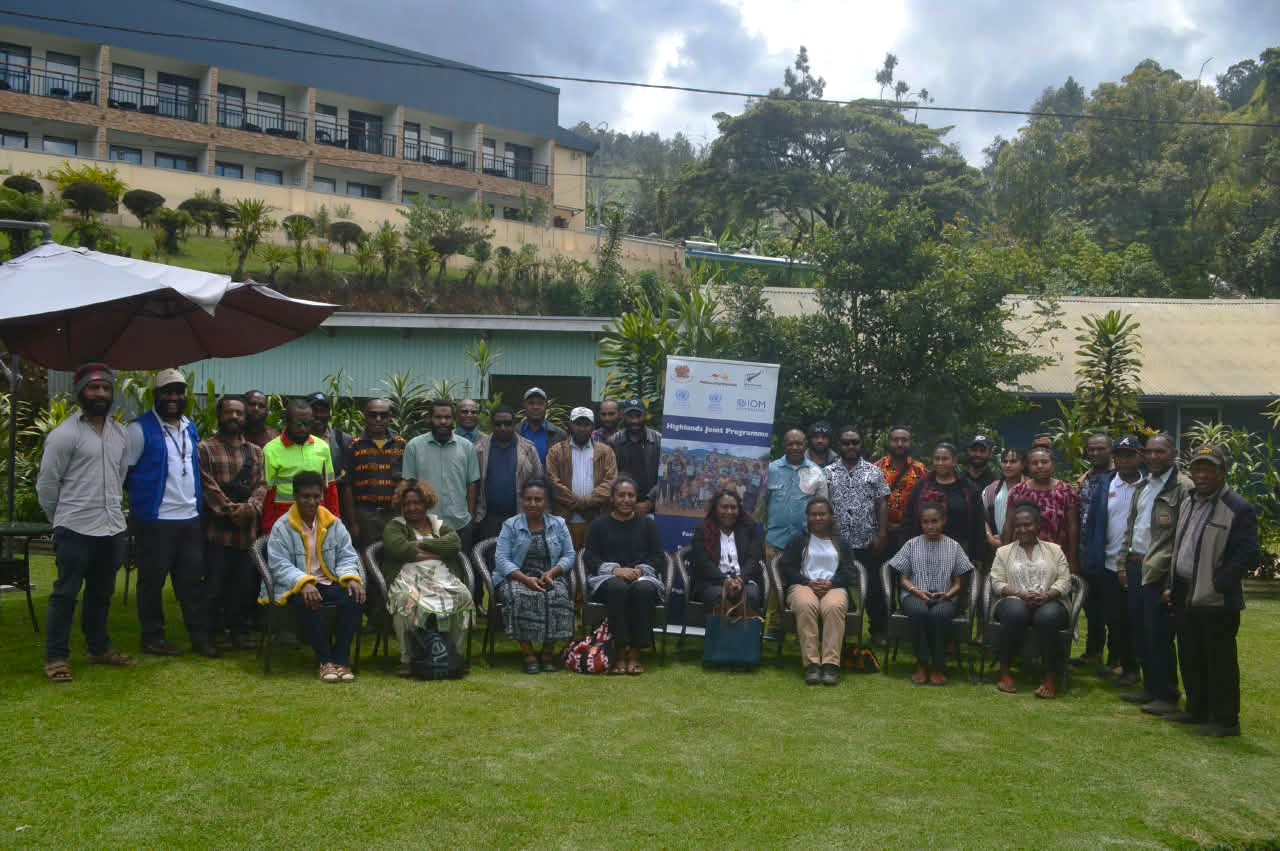
The International Organization for Migration (IOM), in partnership with the Enga Provincial Government (EPG), has conducted a one-day El Niño Assessment Enumerators Training in Wabag to strengthen local capacity for disaster assessments and improve the collection of reliable information from communities affected by El Niño-related conditions across Enga Province.
The training was officially opened by Enga Provincial Deputy Administrator, Mr Kenneth Andrew, who represented the Enga Provincial Government.
In his opening remarks, Mr Andrew acknowledged IOM as a longstanding development and humanitarian partner of the Provincial Government and welcomed the training as a timely initiative, particularly as the government, through its Provincial Disaster Office, is working to engage enumerators to support El Niño assessments across the province.
He said the training presented an important opportunity for government officers, graduates and local volunteers to develop practical skills and become familiar with the assessment tools, methodologies and data collection techniques provided by IOM.
Mr. Andrew emphasized that collecting accurate primary data from affected communities would enable the Provincial Government to better understand the situation on the ground and make informed decisions when planning appropriate interventions and responding to the impacts of El Niño.
The training brought together participants from across Enga Province, including cadets under the Enga Provincial Government Graduate Development Program (GDP), provincial government officials, community-based organizations (CBOs), civil society organizations (CSOs), local non-governmental organizations (NGOs), and representatives from all six districts. District and sub-district officials, including representatives from Local-Level Governments (LLGs), also participated.
The diverse representation was intended to strengthen coordination between provincial and district administrations, local authorities, community stakeholders and trained enumerators ahead of the planned ward-level assessments.
Speaking during the training, IOM Senior Project Associate in Enga, Tony Tambi Jr, said the one-day training on the Roll-out of El Niño Multi-Sectoral Ward Assessments and Capacity Building on Assessment Tools for LLGs, Local Authorities and Enumerators in Enga Province was designed to equip government officers and local organizations with the knowledge and practical skills required to collect primary data from affected communities.
Tambi Jr explained that El Niño-related dry conditions, water shortages, reduced agricultural production, food insecurity and other climate-related impacts could affect communities differently across wards and districts.
“Timely and reliable information is essential to understand the extent of these impacts, identify priority needs, determine vulnerable populations and inform coordinated, evidence-based responses,” he said.
He further highlighted the importance of collecting accurate and verifiable information directly from affected communities to ensure that assessment findings reflect the actual challenges people are experiencing.
The training covered the objectives and scope of the El Niño Multi-Sectoral Ward Assessments, assessment methodologies, questionnaires and sectoral indicators, interview techniques, community consultations and the use of mobile data collection applications.
Participants were also introduced to data quality assurance, verification, informed consent, confidentiality, safeguarding and field deployment procedures. Practical exercises enabled participants to familiarize themselves with the digital assessment tools, including completing and submitting sample questionnaires.
The training forms part of IOM’s support to facilitate the roll-out of El Niño Multi-Sectoral Ward Assessments across affected areas of the Highlands region, working closely with provincial and district administrations, LLGs, ward authorities and trained enumerators.
Following the training, the next steps will include confirming the affected target wards, finalizing enumerator teams and supervisors, agreeing on field deployment schedules, and coordinating transport, communication and other operational arrangements.
The trained enumerators will support the collection of structured ward-level information, which will undergo data quality checks and verification before being consolidated into assessment findings and reports.
The information gathered is expected to help the Enga Provincial Government, IOM and relevant stakeholders better understand the scale and distribution of El Niño impacts, identify priority community needs and inform coordinated preparedness, response and recovery planning.
The partnership reflects the importance of strengthening local government and community capacities to ensure that disaster assessments are informed by reliable evidence and the experiences of people directly affected by climate-related hazards.