


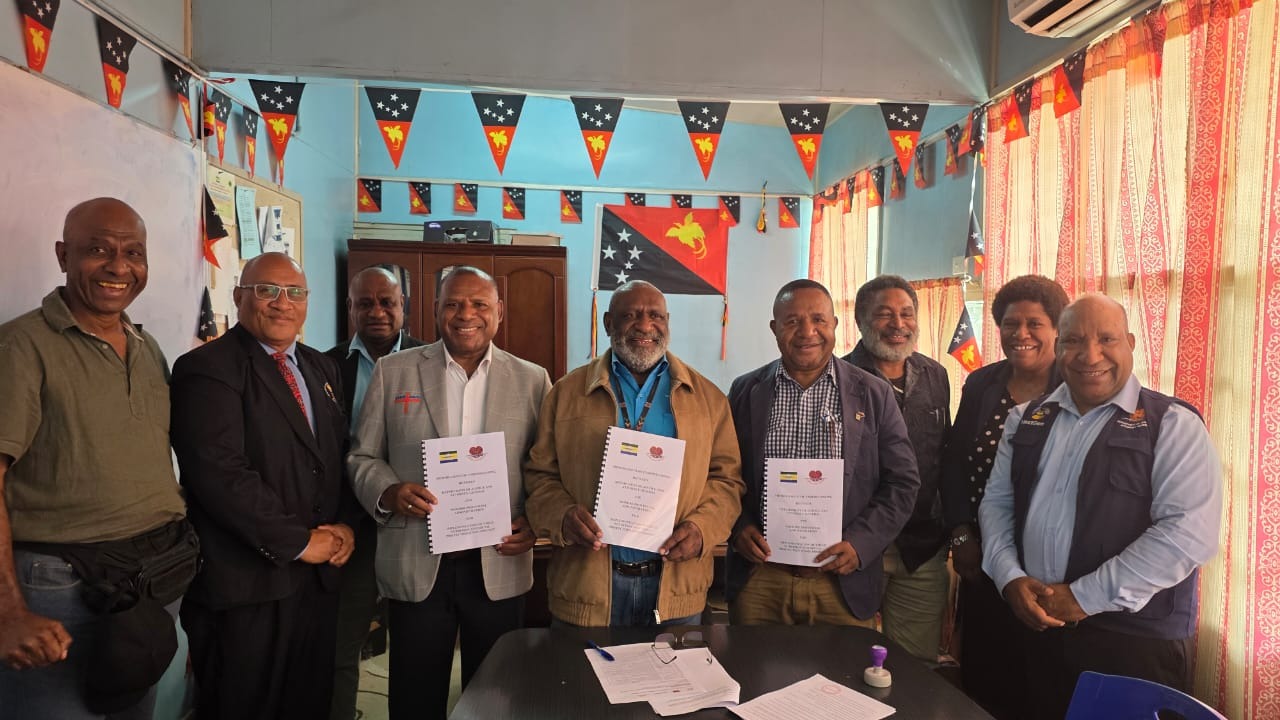
THE strengthened multisectoral collaboration and convergence between the CNSP Project and the Department of Agriculture and Livestock (DAL) on food and nutrition has led to the establishment of a strategic partnership with the Morobe Provincial Administration through a Memorandum of Understanding signing last week Wednesday in Lae, Morobe Province.
This milestone positions Morobe as the fifth participating province and establishes a national demonstration model for integrated service delivery, bringing together nutrition, agriculture, food security, livelihoods, community development and social protection under a coordinated whole-of-government approach.
The historic agreement was formally signed at the Morobe Provincial Administration Headquarters in Lae by Secretary for the Department of Justice and Attorney General and Chairman of the CNSP Project Steering Committee, Dr Eric Kwa, and Morobe Provincial Administrator, Mr Max Bruten.
The partnership demonstrates a strong commitment by both the CNSP Project and the Morobe Provincial Administration to work together to improve nutrition, strengthen social protection systems, and reduce child stunting through coordinated, whole-of-government action.
Speaking following the signing ceremony, Dr Eric Kwa said the agreement represents more than a formal partnership—it reflects a shared commitment to investing in Papua New Guinea’s future by ensuring children receive the nutrition, care and opportunities they need during their critical first 1,000 days of life.
“Reducing child stunting requires coordinated action across government sectors and strong partnerships with provincial administrations.
This MoU signing reinforces our collective commitment to improving the lives of children and families in Morobe Province while contributing to Papua New Guinea’s long-term human capital development.”
The Memorandum of Understanding establishes the framework for collaboration between the Department of Justice and Attorney General, the National Department of Health, the Department for Community Development and Religion, and the Morobe Provincial Administration to coordinate implementation of the Child Nutrition and Social Protection (CNSP) Project.
Under the agreed implementation plan, theinitial rollout will prioritise Nawaeb District, Markham District, and Mumeng LLG in Bulolo District. Drawing on lessons and experience from these initial implementation areas, the Project will progressively expand into TewaiSiassi District and other parts of Morobe Province in subsequent phases.
The agreement aligns implementation of the CNSP Project with the Government’s MediumTerm Development Plan IV (MTDP IV) by integrating nutrition interventions across multiple priority sectors including health, education, agriculture, social protection, governance, youth development, gender equality, climate resilience and information technology.
Under the agreement, the Morobe Provincial Administration will chair the Provincial Project Coordination Committee, ensuring provincial leadership and ownership of implementation while working closely with national implementing agencies to deliver nutritionsensitive services to vulnerable households Papua New Guinea continues to face one of the highest child stunting rates globally, with almost one in every two children under five affected. The CNSP Project is a multi-sectoral Government of Papua New Guinea initiative designed to improve utilisation of priority nutrition interventions, strengthen household purchasing power during the first 1,000 days of life, promote positive behaviour change, and enhance coordination of nutrition-related services across sectors.
The Project is implemented by the Government of Papua New Guinea through the collaboration of the Department of Justice and Attorney General, the National Department of Health and the Department for Community Development and Religion, with support from the World Bank and Australian Department of Foreign Affairs & Trade.
This official signing further reinforces the Government’s commitment to building healthier communities, improving child development outcomes, and ensuring every Papua New Guinean child has the opportunity to reach their full potential. The momentous partnership is expected to strengthen provincial coordination, support food distribution, improve service delivery, and contribute meaningfully towards reducing child stunting—one province at a time.
I want to enquire on how will I as a CHW seek assistance for collaboration with your organisation to run an awareness programme at our community Aidpost and primary school in wampit village Wampar LLG Huon Gulf district