


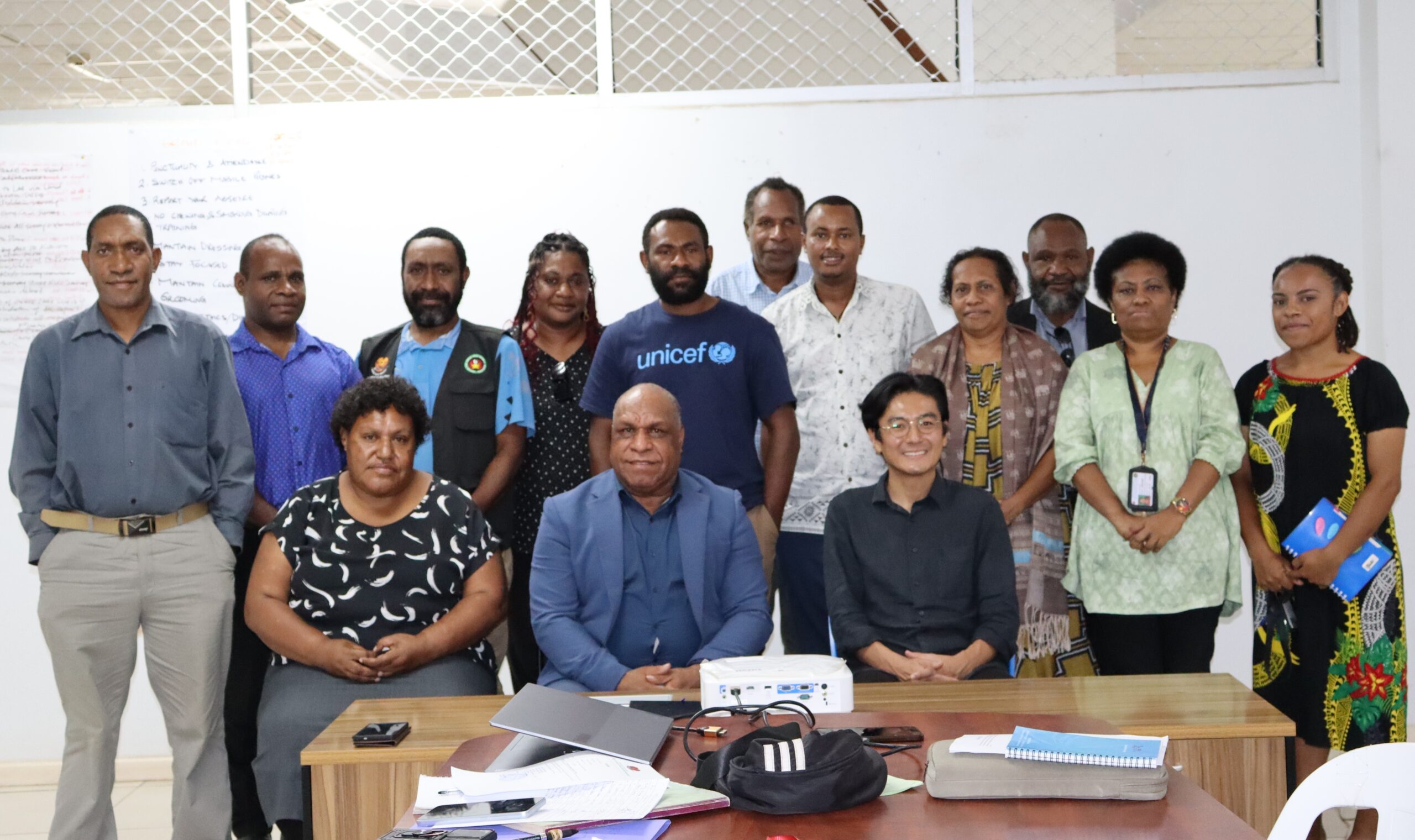
SENIOR officers from the National Office for Child and Family Services and the United Nations International Children’s Emergency Fund met last Friday (April, 24) and held joint discussions on a number of key initiatives to advance child protection in the country.
The bipartisan discussions were held at the National Office for Child and Family Services (NOCFS) office in Waigani, National Capital District.
The child protection programs that were deliberated on included; advancing the Ending Violence Against Children (EVAC) roadmap, creating an Out-of-Home Care Centre (OHCC) national standards guideline, creating a Child Protection Case Management (CPCM) standard operating procedure, institutionalizing Positive Parenting for Child Development (P4CD) and creating a Community-Based Child Protection (CBCP) system.
NOCFS chief executive officer Mr Jerry Wap, when welcoming the United Nations International Children’s Emergency Fund (UNICEF) team, said his office values the partnership it has with UNICEF and is committed to expanding and strengthening this relationship.
“Our programs are very well aligned with that of UNICEF. Most of our programs are existing ones but we want to add more value to this partnership,” Mr Wap stated.
Mr Wap explained that in order for these and other child protection programs to work effectively in the country, there has to be proper institutions and systems in place to make it workable and sustainable.
He said the Lukautim Pikinini Act (LPA) provides for the creation of six fundamental institutions that are vehicles to drive all child protection programs in the country.
These six are the: National Child and Family Services Council (NCFSC), NOCFS, Provincial Child and Family Services Councils (PCFSC), District Child and Family Services Committees (DCFSC), Child Protection Trust Fund (CPTF) and the Family Court.
Mr Wap said the NCFSC and the NOCFS have already being established and work is now afoot to create the PCFSC and the DCFSC.
“In order to make EVAC work, these fundamental institutions in the country must work first. The provinces must have the councils fully established and operational,” Mr Wap said.
“When we establish these six institutions, then we will really establish child protection in this country. Furthermore, we will also end violence against children,” he said.
“This is because these are institutions established by law. All other programs that we do in this country in the name of child protection must hanger on these six fundamental institutions,” Mr Wap said.
Meanwhile, Mr Yuichiro Yamamoto, UNICEF’s in-country child protection specialist, said UNICEF is in Papua New Guinea (PNG) to provide technical and financial support in the child protection space.
Mr Yamamoto said it was crucial for PNG to implement its key child protection programs so that it honors its international obligations to the global child protection movement and can report positively on international forums about what it has done.
He added that for the EVAC roadmap, it was better to keep the process simple and allow for quicker implementation as it was obvious that violence committed against children and families were widespread in PNG.
The UNICEF officers who attended the meeting included Mr Yamamoto, Mr Yeshiwas Shona (P4CD consultant), Ms Bernadette Haro (child protection consultant) and Mr Ishmael John (child protection officer).
The meeting ended cordially with a number of understandings reached and tentative dates schedules for further discussions on the programs.