


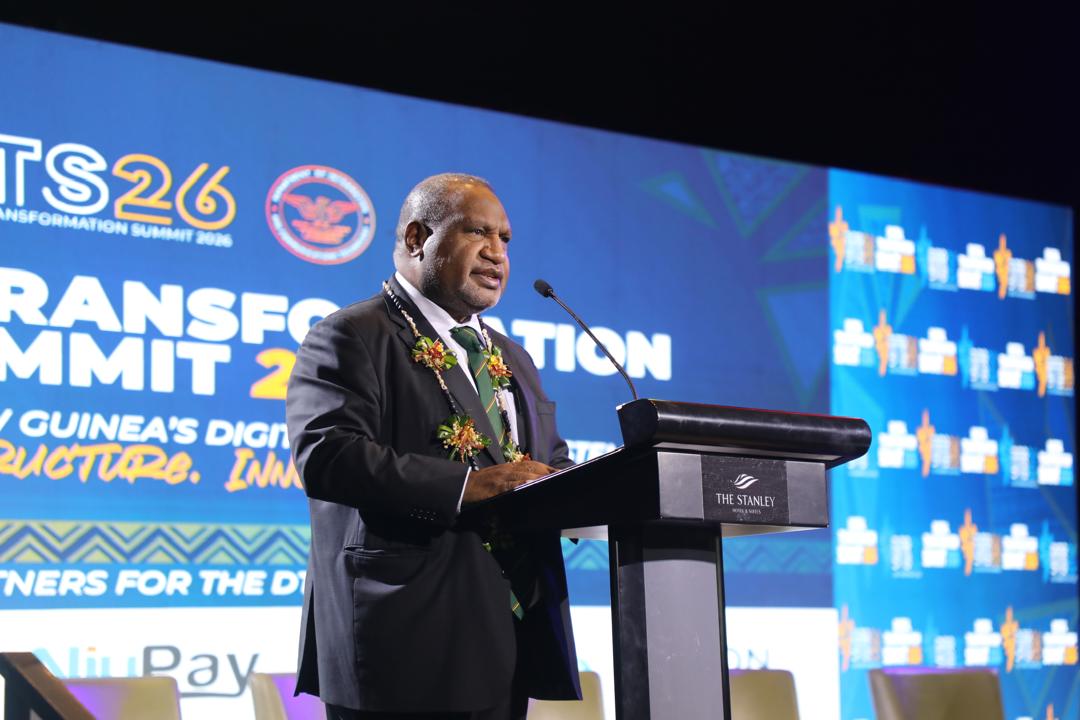
PRIME Minister Hon. James Marape has called on Pacific Island nations to adopt a united approach to digital transformation, artificial intelligence (AI) and cyber security, saying the region must work together to ensure technology drives development while protecting national and regional security.
Addressing delegates at the opening of the Digital Transformation Summit 2026 and Pacific Cyber Week 2026 in Port Moresby, Prime Minister Marape said the conference came at a pivotal time as digital technology rapidly reshapes economies, governments and societies around the world.
He welcomed delegates from throughout Papua New Guinea, the Pacific region and the wider international community, extending a special welcome to Pacific ICT Ministers and senior government officials attending the event.
“I welcome you all to Papua New Guinea. This is an important conversation and an important meeting, not just for Papua New Guinea, but for all of us in the Pacific,” Prime Minister Marape said.
“The vastness of our region, separated by thousands of kilometres of ocean, can now be bridged through ICT infrastructure, digital platforms and communication highways that connect us in real time.”
Prime Minister Marape said one of the lasting lessons of the COVID-19 pandemic was the indispensable role played by digital technology in keeping economies and societies functioning.
“If there was one positive lesson from COVID-19, it was the importance of ICT as a driver of healthcare, education, commerce, government services and social connectivity. This is why this summit is not a wasted conversation—it is exactly the right conversation for our time.”
The Prime Minister reflected on Papua New Guinea’s own digital journey, recalling that more than a decade ago, while serving as Education Minister and later Finance Minister, government was already exploring digital education and electronic financial systems.
“Looking back, it is remarkable how quickly this landscape has changed. Today, artificial intelligence is transforming almost every aspect of ICT and is becoming the dominant global conversation.”
Prime Minister Marape said the issue had featured prominently during his participation at the World Economic Forum and the World Governments Summit in Dubai, where discussions centred on the rapid growth of AI and digital technologies.
“Artificial Intelligence has leapfrogged many of the traditional ICT discussions. It is now shaping economies, governments and societies across the globe. The Pacific cannot afford to be left behind.”
He said the Pacific Islands collectively occupy the largest sovereign ocean space on Earth and are strategically positioned between Asia and the Americas, making regional cooperation in digital policy increasingly important.
“We sit between some of the world’s largest economies and populations. Whether through submarine cables,
satellites or other digital infrastructure, connectivity across the Pacific will only continue to grow.”
“For that reason, our policy frameworks must also grow together. We need common approaches that promote digital connectivity while ensuring security, safety, resilience and trust.”
Prime Minister Marape encouraged delegates to look beyond their individual national interests and develop policy recommendations that would benefit the wider Pacific family.
“I encourage everyone here to think beyond Papua New Guinea and consider the needs of our Pacific neighbours. Our digital infrastructure will increasingly be interconnected, so our policies should also complement one another.”
Speaking on Papua New Guinea’s digital progress, the Prime Minister said broadband coverage had expanded significantly during his Government’s term.
“In 2020, broadband coverage reached about 40 per cent of our country. Today that has grown to around 80 per cent, representing major progress in connecting our people.”
He said Papua New Guinea continued to invest heavily in national backbone infrastructure, including fibreoptic connectivity linked to major power transmission projects extending from Lae into the Highlands.
Prime Minister Marape also highlighted the country’s unique geographical and demographic challenges.
“Papua New Guinea is not simply a nation of a few islands. We are one of the world’s largest island nations, with rugged mountains, remote communities, more than 800 languages and one of the most geographically challenging environments anywhere.”
“Despite these challenges, we are steadily building the infrastructure needed to connect every province and bring government services closer to our people.”
However, he warned that increased connectivity also brings increased risks.
“As digital connectivity expands, cyber threats also increase. We are already seeing growing attacks on our financial systems, taxation systems and other critical digital infrastructure.”
“Our responsibility is to ensure that ICT is used to improve commerce, education, healthcare and public services while protecting our citizens and institutions from cybercrime and malicious activity.”
Prime Minister Marape revealed that the Government is now working to elevate ICT into a central government agency to reflect its growing strategic importance to national development.
“ICT is no longer a side conversation within government. It is becoming central to how we deliver services, grow our economy, strengthen governance and protect our national interests.”
He said Papua New Guinea’s experience could contribute meaningfully to regional discussions as Pacific nations work together to strengthen digital resilience.
Looking ahead, Prime Minister Marape predicted that digital technologies would dominate global economic activity throughout the coming decade.
“Based on current trends, ICT could account for as much as 60 to 70 per cent of the global economy during the 2030s. Neither Papua New Guinea nor the Pacific can afford to miss this transformation.”
He also noted that many of today’s global security challenges—including cyber warfare, cybercrime and digital interference—are increasingly being driven through technology, making cyber resilience a critical national and regional priority.
“The digital age presents enormous opportunities, but it also demands greater responsibility. We must build secure systems that protect our people while enabling innovation and economic growth.”
Concluding his address, Prime Minister Marape urged participants to make full use of the summit to share knowledge, strengthen partnerships and develop practical solutions for the Pacific.
He also shared a traditional piece of wisdom from his Highlands upbringing, reminding delegates that success comes to those who are willing to listen, learn and apply knowledge.
“I look forward to the outcomes of this summit. Let us work together to ensure that digital transformation benefits every citizen of Papua New Guinea and every member of our Pacific family.”