


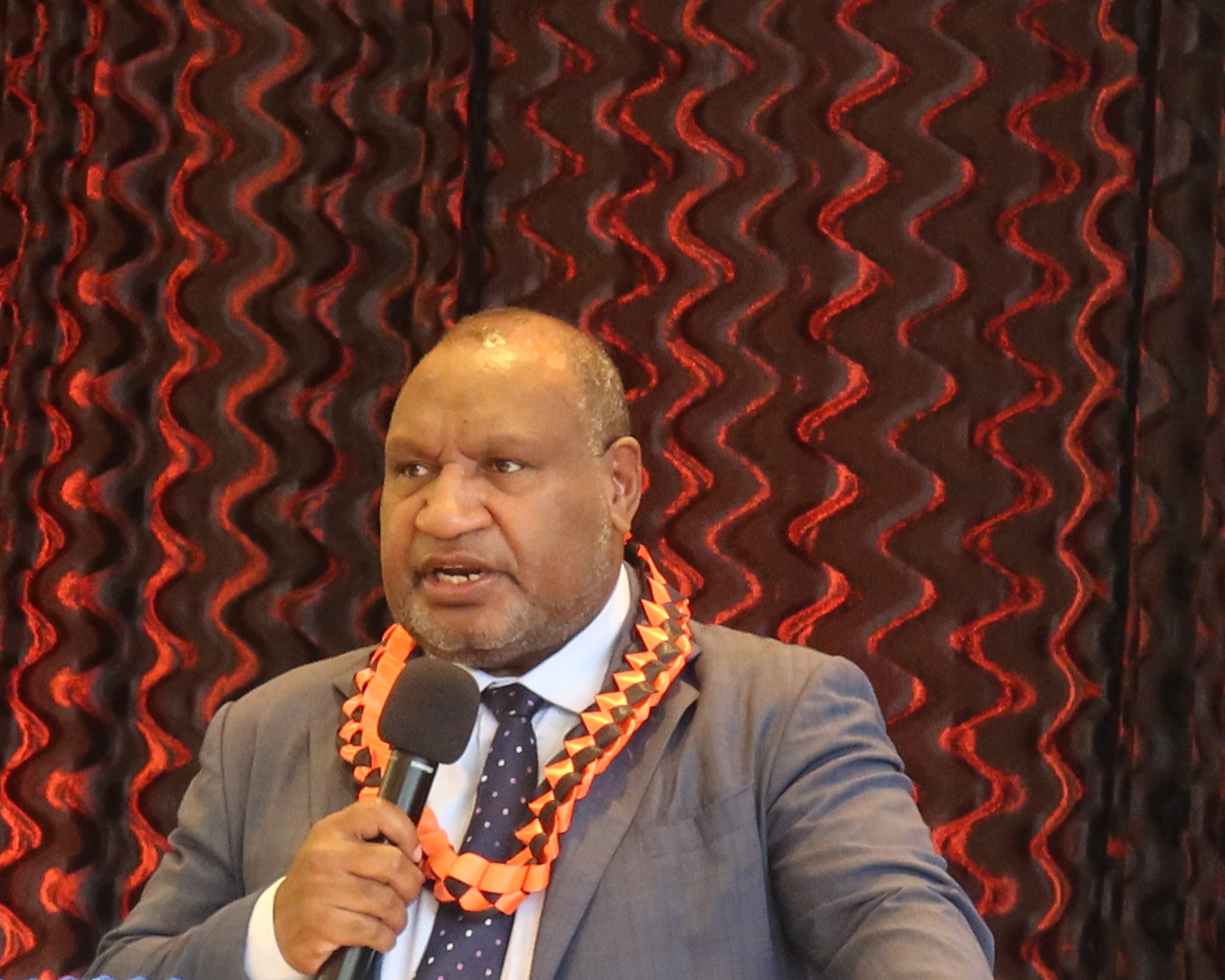
PRIME Minister Hon. James Marape today challenged Papua New Guinea’s public servants to embrace digital transformation, strengthen accountability and eliminate inefficiency as he officially launched the Public Service Payroll Office in Port Moresby.
Speaking at the launch, Prime Minister Marape said the establishment of the Public Service Payroll Office under the Department of Personnel Management (DPM) formed part of the Government’s broader Reset PNG agenda aimed at preparing the country for the next 49 years leading to the centenary of Independence.
The Prime Minister said the Government had spent the last several years reviewing the country’s strengths and weaknesses and identified weaknesses in public administration that needed to be addressed through structural reforms, stronger governance and the use of modern technology.
“We have taken stock of where we are as a nation. While we have made significant progress in delivering services and building our country, we must also acknowledge the weaknesses that remain within our public service systems.
“Today is not simply about relocating the payroll function. It is about ensuring that when this responsibilitynreturns to the
Department of Personnel Management, the weaknesses of the past do not return with it.
“As we reset our nation, we must eliminate corruption, nepotism, complacency and inefficiency from ournpublic service.”
Prime Minister Marape said advances in Information and Communications Technology (ICT) and Artificial Intelligence (AI) now provided Papua New Guinea with the opportunity to remove many of the human weaknesses that had historically affected payroll administration and public sector management.
“In the past, payroll systems relied heavily on manual processes. Today, ICT allows us to eliminate many opportunities for corruption, favouritism and manipulation.
“Technology does not favour relatives, friends or political connections. Proper digital systems promote transparency, accountability and efficiency.”
The Prime Minister noted that approximately 140,000 public servants—representing only about 1.4 per cent of Papua New Guinea’s population—were entrusted with delivering services to the remaining citizens while consuming a significant share of the national budget.
“Every fortnight the Government spends well over K280 million paying public servants. That investment must deliver
value to our people.
“I have no difficulty paying our public servants properly if they are performing efficiently and delivering services to our country.”
Prime Minister Marape outlined several major reform priorities that the Government expects to implement immediately.
These include enforcing the principle of one person, one position, removing duplicate appointments, filling vacant positions, and ensuring every public servant is issued with a Digital ID by 31 December 2026.
He said Digital IDs would create an electronic record of every public servant’s transactions and strengthen payroll integrity while reducing opportunities for fraud and ghost employees.
“Every public servant must have a digital identity. It creates accountability and allows Government to better manage performance and public resources.”
The Prime Minister also directed that recruitment processes increasingly move online, with ICT and AI used to improve merit-based selection.
“Applications should be lodged online. Technology should assist us in identifying the best-qualified candidates based on merit.
“We must eliminate the ‘wantok system’ from recruitment and allow competence, qualifications and performance to determine appointments.”
Prime Minister Marape further instructed all Government departments and agencies to strengthen performance management by ensuring every public servant operates under clearly defined Key Performance Indicators (KPIs) linked to departmental priorities, the Medium-Term Development Plan, Vision 2050 and ultimately the National Constitution.
“Every public servant must know exactly what they are employed to deliver.
“Performance must determine career progression. Those who perform should be rewarded. Those who consistently fail to perform should not remain in the system.”
The Prime Minister also called for a comprehensive review of the Public Service General Orders, describing many provisions as outdated and no longer suited to a modern public administration.
He encouraged all department heads, provincial administrators and agency leaders to embrace ICT-driven management systems to improve service delivery across national departments, provincial administrations and district offices.
Prime Minister Marape commended Minister for Public Service Hon. Joe Sungi, Department of Personnel Management Secretary Taies Sansan, and officers involved in establishing the Public Service Payroll Office.
He said the reforms represented another important milestone in building a professional, efficient and accountable public service capable of supporting Papua New Guinea’s long-term development.
“Our task is to fine-tune the public service so it operates at the right frequency to carry Papua New Guinean successfully through the next 49 years and beyond.
“It is not the Prime Minister alone who will transform this country. It is every faithful public servant working with integrity, professionalism and commitment to serve our people.
“Together, we can build a stronger public service and a stronger Papua New Guinea.”