


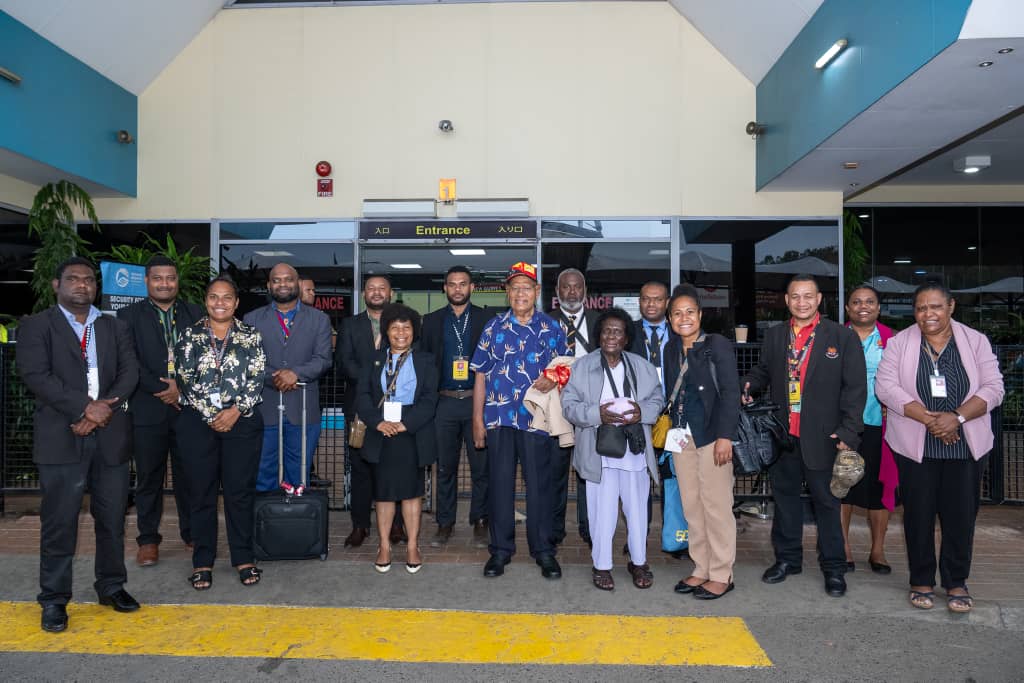
The Department of Prime Minister & National Executive Council (PMNEC) has extended its full support to two of Papua New Guinea’s founding leaders, Dr. John Momis and Sir John Kaputin, during their participation in the Nation’s 50th Independence Anniversary Celebrations.
Dr. John Momis and Sir John Kaputin are two of the three surviving members of the historic Constitutional Planning Committee (CPC). The other surviving member of the CPC is former long-serving Lae MP and senior state minister Anthony Ila.
In 1972, Dr. Momis served as the de facto chairman of the CPC, which was tasked with writing and drafting Papua New Guinea’s homegrown National Constitution, a process that spanned from 1972 to 1975.
The CPC’s visionary recommendations included the entrenchment of provincial governments within the Constitution, laying the foundation for Papua New Guinea’s decentralized system of governance. Beyond his role of nation-building, Dr. Momis became a leading advocate for decentralized governance, serving as Governor of Bougainville and later playing a central role in negotiating the Bougainville Peace Agreement in 2001.
Today Dr. Momis is widely recognized as the Father of the Constitution and the Father of Decentralization.
Sir John Kaputin was also a key architect of Papua New
Guinea’s National Constitution and a trailblazer in the nation’s political and economic history. In the 1960s, he rose to prominence as a leader of the Mataungan Association, a grassroots movement in East New Britain that championed land ownership rights and self-determination during the pre-independence era.
Over the course of his distinguished career, Sir John served in several senior ministerial roles, including as Minister for Finance in 1980, where he was instrumental in crafting legislation that established the National Provident Fund, which later evolved into NASFUND—now one of the country’s most important superannuation institutions. In 1993, as Minister for Foreign Affairs, he led a high-level delegation to the United States for the APEC Ministerial Meeting, where he successfully lobbied for Papua New Guinea’s admission into APEC, securing the nation’s place in regional and global economic forums.
Together, Dr. John Momis and Sir John Kaputin embody the living legacy of Papua New Guinea’s constitutional history and nation-building journey. Their contributions—from drafting the National Constitution to championing decentralization, peace, economic reform, and international diplomacy—stand as milestones in the country’s progress.
As part of its arrangements, the Department provided liaison officers and drivers to accompany and support Dr. Momis and Mrs. Momis as well as Sir Kaputin and Mrs. Kaputin throughout their stay in Port Moresby. This gesture ensured that the Senior Statesmen were accorded the dignity, care, and respect befitting their pivotal role in shaping Papua New Guinea’s path to independence and beyond.
On Friday morning last week, the team gathered at Jacksons Domestic Airport to farewell Dr Momis and Mrs. Momis. The moment symbolized the nation’s collective gratitude to its living founding fathers and mothers.
Chief Secretary to Government Mr. Ivan Pomaleu said, “To truly demonstrate our appreciation of where we have come from, we must appreciate those who made it happen. Those gone, but more so those who are at the twilight of their time. This is the PNG way.”
Representatives of the Department’s liaison team also gathered early on Saturday morning to farewell Sir Kaputin and Mrs. Kaputin at the Jackson’s International Terminal, ensuring that both leaders were accorded the same respect and recognition. These gestures reflect the Government’s commitment to honoring those who dedicated their lives to shaping Papua New Guinea’s independence, democracy, and identity. As the nation celebrates 50 years of sovereignty, it is moments such as these that reaffirm the importance of remembering and respecting the leaders whose vision and sacrifice made independence possible.