


AUSTRALIA is supporting Papua New Guinea’s transition toward climate-resilient development, with Morobe Province taking a significant step forward through the validation of its Climate-Resilient Green Growth (CRGG) Strategy.
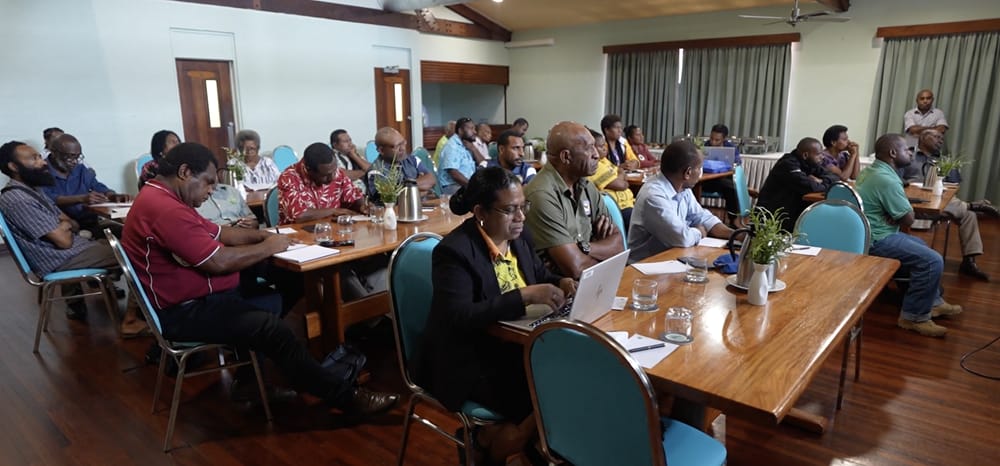
A two-day CRGG Strategy Validation Workshop was recently held in Lae under the Australia-funded Climate Finance Initiative for Resilience and a Sustainable Transition (Climate FIRST) project. The workshop reinforced Australia’s ongoing partnership with PNG in strengthening climate change adaptation and resilience.
Convened by the Climate Change and Development Authority (CCDA) in partnership with the Global Green Growth Institute (GGGI), the workshop brought together provincial leaders, national government agencies, development partners and private sector representatives to validate Morobe’s CRGG Strategy and identify priority investments for sustainable development.
Participants endorsed a range of climate-resilient interventions across the agriculture, transport and water sectors. They also identified a pipeline of projects, including
renewable energy initiatives, climate-proof infrastructure, and improved waste and water management systems, that will be developed into bankable investments by 2027.
Morobe Provincial Administration Provincial Planner Gordon Aking described the strategy as a platform for coordinating resources and investments to address climate change.
“Developing a CRGG plan for Morobe Province is like setting up a platform for sharing resources to deliver climate resilient projects in the province. This is where we want to identify priority investments for managing climate change impacts and plan to deliver them,” Mr Aking said.
Deputy Provincial Administrator Robin Kiki praised the efforts of the provincial team in advancing the strategy.
“It has been an inspiring journey for us to promote climate-resilient green growth in the province and I’m fully grateful to have such a dedicated and proactive team that had worked hard on developing the Morobe CRGG strategy,” Mr Kiki said.
The Morobe workshop builds on momentum generated in Eastern Highlands Province, where stakeholders recently endorsed the Eastern Highlands CRGG Strategy 2026–2032. The endorsement positioned Eastern Highlands among the first provinces in PNG to integrate climate resilience and green growth into subnational planning and budgeting processes.
Together, these provincial milestones demonstrate growing momentum for locally led climate action across Papua New
Guinea. They highlight the importance of empowering provinces to identify development priorities, strengthen investment pipelines and improve access to climate finance.
GGGI Country Representative for PNG, Solomon Islands and Vanuatu, Muhammad Ali Shaik, said Morobe had made remarkable progress since the initiative began.
“Climate resilient mainstreaming was a new concept when we started last year and in these two years, Morobe has made strong progress as the province had worked hard in bringing citizens forward, building understanding and creating real momentum,” he said.
Department of National Planning and Monitoring Assistant Secretary for Aid Effectiveness, Regional and UN Branch, Alex Ginet, acknowledged Australia’s contribution to climate resilience efforts in PNG.
“I acknowledge the Australian Government for the Climate FIRST and the support that they provide to the government. I am happy that we are in the validation process that GGGI is providing,” Mr Ginet said.
The Climate FIRST project is a flagship climate resilience program supported by Australia and implemented by GGGI PNG. The initiative aims to strengthen Papua New Guinea’s access to climate finance and support sustainable, climate-resilient development across the country.
As Morobe and Eastern Highlands continue to advance their CRGG strategies, PNG is strengthening a coordinated national approach to climate resilience, helping communities better prepare for the impacts of climate change while promoting sustainable economic growth.