


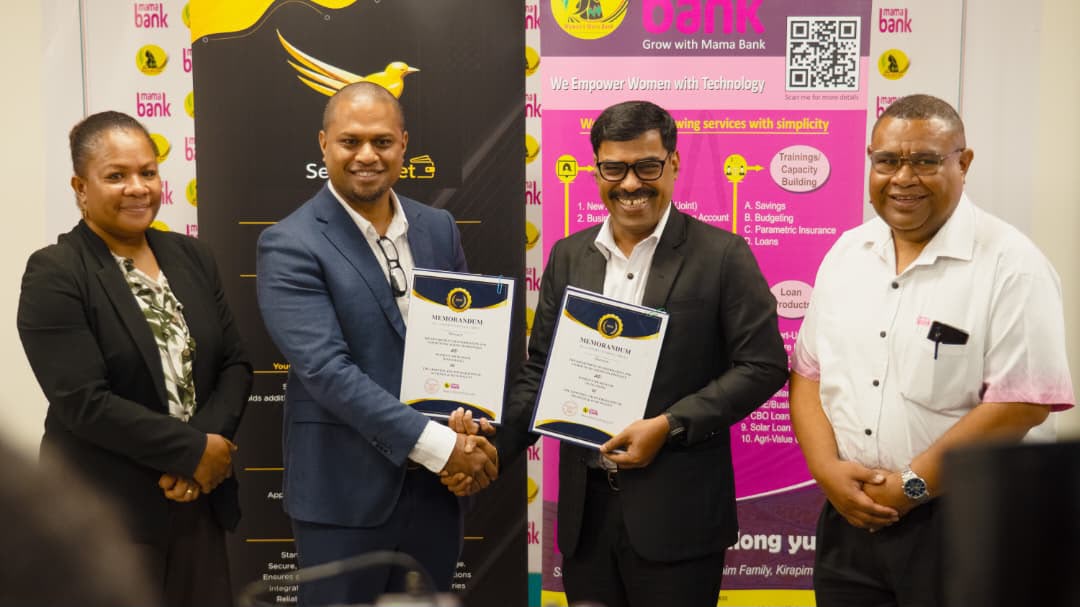
MORE Papua New Guineans, particularly women and people in rural communities, will soon be able to open bank accounts without visiting a bank branch following a partnership between Women’s Micro Bank (Mama Bank) and the Department of Information and Communications Technology (DICT).
The two institutions signed a Memorandum of Understanding (MoU) on Monday, November 23, 2026, in Port Moresby to integrate the Government’s digital identification system, SevisPass, into Mama Bank’s banking services.
The partnership will allow customers to use their SevisPass digital identity, stored in the national SevisWallet application, to verify their identity when opening new accounts and accessing existing banking services.
Through electronic Know Your Customer (eKYC) verification, customers will be able to complete identity checks digitally, reducing paperwork, travel costs and the need to visit bank branches.
The system is expected to enable people in rural communities to verify their identities and open bank accounts in less than 10 minutes using their mobile phones.
Mama Bank Chief Executive Officer Gunanidhi Das said the partnership would help the bank reach people in the informal and rural sectors who often struggle to access financial services because they lack formal identification documents.
“We are looking at the informal sector and rural sector, where people need very small loans of K300, K500 or K1,000 but may not have the credentials to show who they are,” Mr Das said.
He said Mama Bank would help customers open accounts, provide financial literacy training and offer small loans to enable them to build their financial capacity and eventually qualify for larger loans as small and medium enterprise (SME) operators.
Das said the partnership would also reduce the high costs associated with reaching rural communities, allowing the bank to pass savings on to customers through more affordable services and lower interest rates.
Mama Bank aims to extend the benefits of the initiative to customers across all 22 provinces.
He said women who previously had no access to formal banking had demonstrated a strong willingness to save, with almost 50 per cent in savings mobilised from customers who had never held a bank account before.
Secretary for DICT Steven Matainaho said the partnership was an important step towards improving financial inclusion by bringing digital services closer to people in underserved communities.
“This is really about financial inclusion, reaching out to the frontline and getting services into rural spaces where those who traditionally cannot access services because of documentation and difficulties verifying who they are can now have that opportunity,” Mr Matainaho said.
Under the arrangement, DICT will provide technical assistance and training to help Mama Bank integrate SevisPass into its banking systems.
The two institutions will also establish a Technical Working Group to coordinate implementation, identify activities and monitor progress.
The agreement provides for the protection of confidential information and compliance with relevant data protection and privacy laws and policies.
SevisPass is a government-issued digital identity that allows Papua New Guineans to verify their identities through the SevisWallet application when accessing participating government and private sector services.
The system is also intended to support access to other services, including national identification and driver’s licence information, reducing the need for customers to repeatedly submit physical documents when applying for financial services such as small loans.
Mr Das said Mama Bank would activate the SevisPass channel on its banking platform soon.
The partnership is expected to create new opportunities for women, small business operators and people in the informal economy to access savings accounts, microfinance and other financial services.
Mama Bank is Papua New Guinea’s first women-owned licensed microfinance institution. It provides savings accounts, small business loans and financial literacy training, with a particular focus on women and the informal sector.
The MoU will remain in force for three years from the date of signing.