


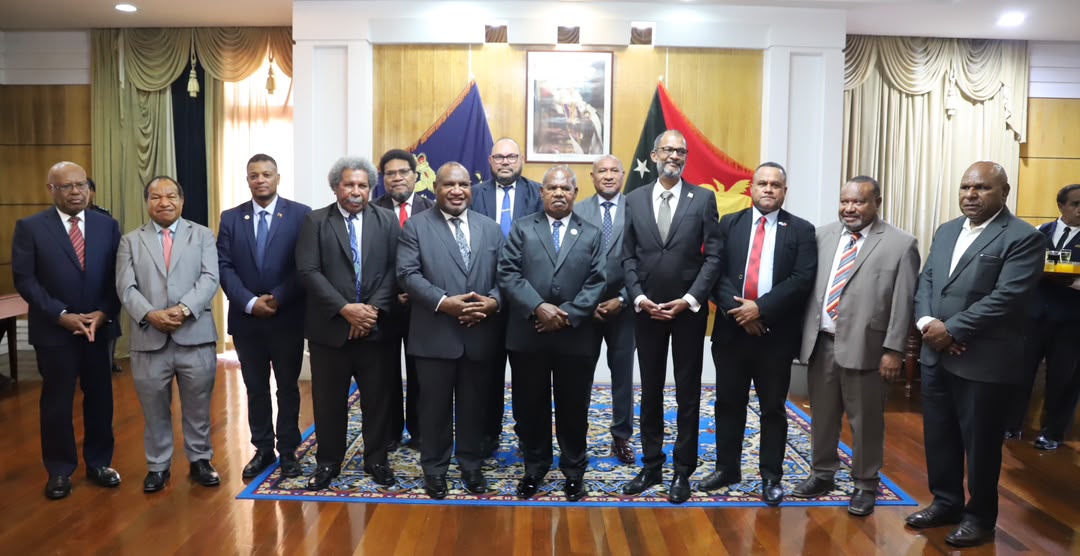
PRIME Minister James Marape has welcomed the signing of the Papua LNG Fiscal Stability Agreement at Government House today, describing it as a major milestone towards securing the project’s Final Investment Decision (FID) and unlocking billions of kina in investment for Papua New Guinea.
Prime Minister Marape said the signing, together with amendments to existing PNG LNG and Papua LNG fiscal arrangements, provided greater certainty for international investors while strengthening Papua New Guinea’s long-term economic benefits.
“This is a milestone moment, not just for Papua LNG, but for our country and our economy as we step into the next 50 years,” he said.
“We want to grow our economy to a scale and size that can sustain more than 12 million people, with our population growing at around three per cent every year.”
The Prime Minister said Papua LNG, involving approximately 6.6 trillion cubic feet of gas, would be the country’s second major LNG development after PNG LNG.
He commended ExxonMobil for assuming operatorship of Papua LNG and thanked TotalEnergies, Santos and other project partners for their continuing commitment.
He also acknowledged ExxonMobil Chairman and Chief Executive Officer Darren Woods, TotalEnergies Chairman and Chief Executive Officer Patrick Pouyanné, Petroleum Minister Hon. Jimmy Maladina, State Negotiating Team Chairman Dairi Vele and all those involved in the negotiations.
ExxonMobil PNG Limited Chairman and Managing Director Dinesh Sivasamboo confirmed that the project partners were working towards achieving FID before the end of 2026, with the Government targeting 15 December.
“The Fiscal Stability Agreement is a key milestone that concludes all the commercial agreements that we have structured,” Mr Sivasamboo said.
“What it does is give confidence to all stakeholders — government, investors and landowners — that the fiscal terms are protected.”
He said the agreement provided the necessary confidence to move towards FID and subsequently into construction.
“We are on track to do that. We are working very hard with all stakeholders to ensure that happens,” he said.
Mr Sivasamboo thanked Prime Minister Marape, Cabinet ministers, provincial leaders, landowners and the joint-venture partners for their cooperation in reaching the agreement.
He said the negotiations had not always been easy, but had produced an outcome that protected the interests of the different stakeholders.
PNG’s economic interests protected Prime Minister Marape assured Papua New Guineans that the Government had not compromised the country’s interests in negotiating revised fiscal arrangements.
He said the original Papua LNG agreement, signed on 10 April 2019, provided for an estimated 51 per cent overall State take, while the revised arrangements were designed to deliver improved returns.
According to the Prime Minister, Government modelling indicated that Papua New Guinea’s overall benefits would remain at or above 51 per cent under a lower oil-price scenario of around US$65 per barrel, with the potential to approach or exceed the Government’s 55 per cent policy target at higher sustained prices.
He said the Government had carefully considered the combined returns from taxation, equity, royalties, development levies and wider economic activity.
Prime Minister Marape also rejected claims that the revised depreciation arrangements would cost the country more than K20 billion in revenue, explaining that the changes involved bringing forward cost recovery that would otherwise occur later in the project’s production life.
He said amendments to the 2008 PNG LNG fiscal arrangements would also provide improved calculations of royalties and development levies for eligible landowners and provincial governments.
Prime Minister Marape said Papua LNG was part of a broader strategy to maintain LNG production and investment for future generations.
He outlined the existing PNG LNG resource base of approximately 10.5 trillion cubic feet, Papua LNG’s 6.6 trillion cubic feet and the proposed P’nyang development’s 4.6 trillion cubic feet.
The Government also envisaged subsequent developments involving Muruk and other gas resources.
Prime Minister Marape said the objective was to prevent a decline in national LNG production as existing fields matured, with combined developments potentially increasing annual output to around 12 million tonnes after 2033 and further expansion possible in subsequent years.
“This is not just about looking at one or two years, or what the next budget will receive. This is about intergenerational development,” he said.
“We are thinking about the big picture — growing the garden for our country so our children can liveon.”
Mr Sivasamboo supported this long-term vision, saying a coordinated sequence of projects could sustain construction and investment activity for the next eight to 12 years.
He said Papua New Guinea’s proximity to major Asian energy markets, including China, Japan and South Korea, strengthened its position as a competitive LNG supplier.
“Papua New Guinea is strategically well positioned for the LNG demand market,” he said.
Prime Minister Marape said the Government would continue working closely with ExxonMobil, TotalEnergies, Santos, other partners, provincial governments and landowners to achieve FID and commence construction.
“This is about securing the future of our country, growing our economy and ensuring that generations of Papua New Guineans benefit from the resources we have today,” he said.