


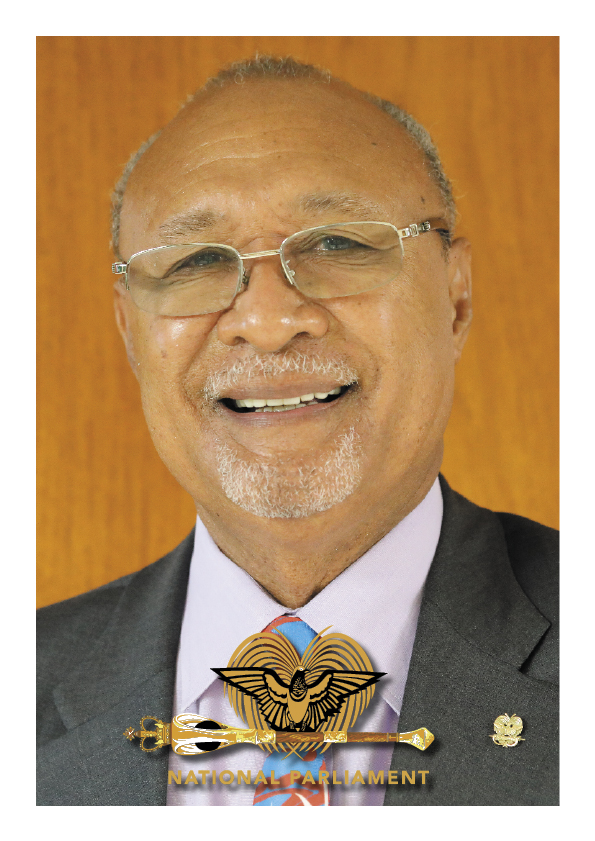
Senior statesman and Abau MP Sir Puka Temu has called for a structured national dialogue on reforming PNG’s parliamentary system, emphasizing the need for early preparation for institutional changes ahead of the 2035 60th Independence anniversary.
Sir Puka cited yesterday’s Post-Courier editorial, which questioned the relevance of governors’ roles.
His remarks also come ahead of the Constitutional and Law Reform Commission report scheduled to be debated in Parliament next Tuesday — a moment he believes presents a genuine opportunity to reflect on the future direction of the nation’s governance framework.
“This debate must not be treated as routine business,” Sir Puka said.
“It should be the starting point of a serious national discussion about whether our current system is delivering stability, accountability, and effective service delivery.”
His main concern is the provincial governance model, especially the dual role of provincial governors in the National Parliament and provincial administration.
Sir Puka questioned whether this arrangement continues to serve the intended purpose.
“The question must be asked — what exactly is the role and function of Governors in our system today? Are they lawmakers at the national level, or administrators at the provincial level? And if they are both, is that creating clarity or confusion?”
His comments come as political and administrative tensions continue to unfold in New Ireland Province, exposing weaknesses in provincial leadership arrangements and raising broader questions about accountability and constitutional design.
Sir Puka said such developments highlight the need to reassess whether the existing structure under the Organic Law on Provincial Governments and Local-level Governments remains fit for purpose.
“When governance instability emerges at the provincial level, it disrupts service delivery, weakens investor confidence, and ultimately impacts ordinary citizens.
“These are systemic issues, not isolated personalities,” Sir Puka added.
Among the reform options he proposes for open debate is the possible restructuring of provincial governance, including a transition toward stronger State-style governments with clearer lines of authority and fiscal responsibility.
He has also suggested that Parliament consider the introduction of a bicameral system.
Under this model, the current National Parliament would act as a lower house representing districts and electorates. A second chamber, possibly composed of governors or regional reps, could serve as a Senate-style body for reviewing constitutional amendments, major policy reforms, and the national budget.
“This would strengthen checks and balances and may provide a more defined role for provincial leadership at the national level,” he said.
Executive leadership reform is also being raised as part of the broader conversation.
Sir Puka believes PNG should debate whether to retain the Westminster system or consider a model in which the Prime Minister is elected directly by the people.
Another alternative would be a Presidential system with fixed terms and clearer separation of powers.
One proposal under discussion is a system where the Government caucus and Opposition caucus each nominate a candidate, with the final decision determined by a national vote — ensuring political clarity and enhanced legitimacy.
Any move toward a directly elected Prime Minister or President, he said, must include a strict two-term limit to safeguard democratic renewal and prevent prolonged
concentration of power.
Sir Puka has also indicated that, as part of long-term constitutional evolution, PNG could consider transitioning formally into a republic — a step he describes as reflecting national maturity rather than a departure from historical relationships.
He emphasized that none of these ideas is a predetermined conclusion. Rather, they are proposals intended for national consultation and bipartisan debate, particularly in light of the CLRC report now before Parliament.
“As we work toward our 60th Independence anniversary, we must ask ourselves whether our institutions are evolving with the times,” he said.
“Next Tuesday’s debate on the CLRC report should mark the beginning of that national reflection.
“The future of our democracy should not be shaped by crisis. It should be shaped by foresight,” Sir Puka said.