


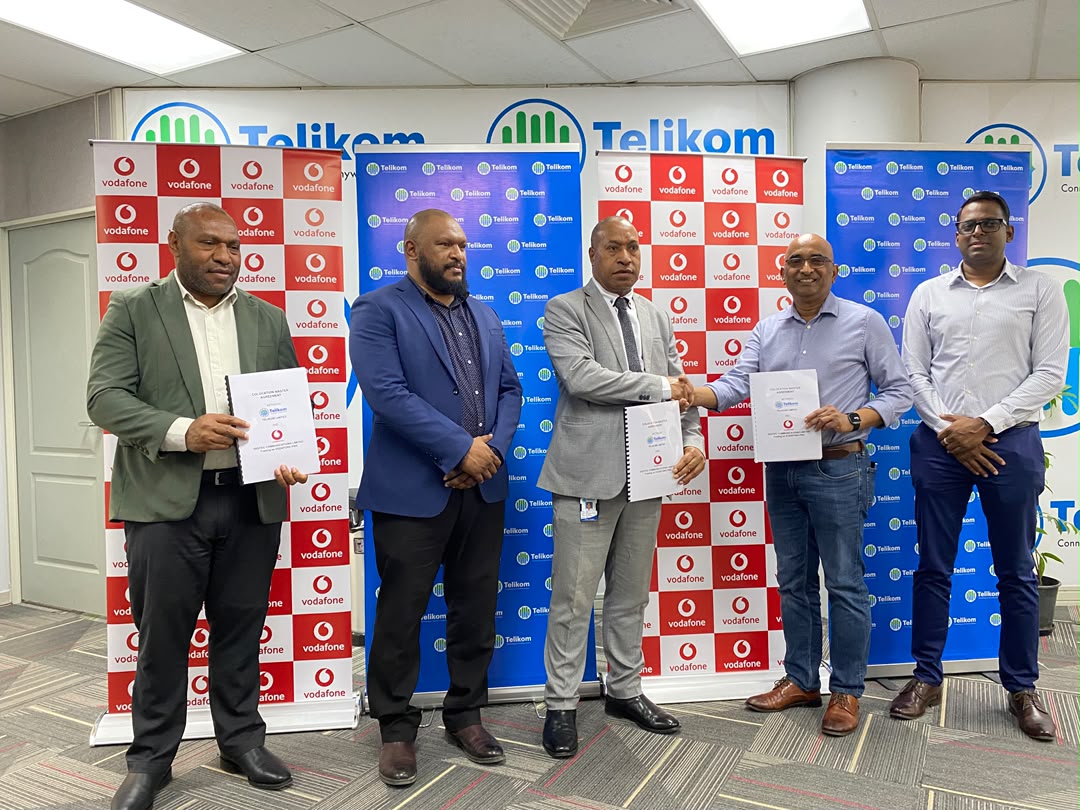
Papua New Guinea’s telecommunications sector has taken a major step towards improved connectivity, lower costs and wider network coverage following the signing of a landmark Co-Location and Network-Sharing Agreement between Telikom PNG and Vodafone PNG.
The agreement will allow the two competing telecommunications operators to share infrastructure, including towers, fibre and other network assets, reducing unnecessary duplication and helping accelerate the expansion of telecommunications services across the country.
Telikom PNG Chief Executive Officer Mr Amos Tepi described the agreement as a “historic first” for PNG’s telecommunications industry, saying it demonstrated that competitors could cooperate in areas that directly benefited the country and consumers.
“Today is a good day for Papua New Guinea’s telecommunications sector,” Mr Tepi said.
He said the agreement marked an important milestone for the industry and would enable both companies to make better use of existing infrastructure while reducing the cost and time required to expand their networks.
Mr Tepi said cooperation between competing operators did not weaken competition but could instead create a stronger telecommunications sector and deliver better services to customers.
A significant component of the agreement is the decision by Telikom and Vodafone to move towards a “bill and keep” arrangement for interconnection.
Under the arrangement, subscribers communicating between the two networks will no longer be burdened by interconnection costs currently associated with calls and other communications between networks.
Mr Tepi thanked Vodafone PNG for agreeing to the arrangement, saying it demonstrated the genuine spirit of partnership behind the wider network-sharing agreement.
The move is expected to make communication between Telikom and Vodafone subscribers more affordable and encourage greater traffic between the two networks.
The agreement builds on an interconnection arrangement signed by Telikom and Vodafone in 2022, which enabled subscribers of the two networks to call and text each other.
Mr Tepi said that earlier cooperation demonstrated that collaboration between competitors could provide a foundation for stronger competition and better services.
At the centre of the new agreement is infrastructure sharing.
Rather than both companies independently constructing towers and other telecommunications facilities in the same or nearby locations, the operators will be able to make greater use of infrastructure that has already been established.
Mr Tepi said sharing existing infrastructure would allow the companies to “get there faster” and extend coverage more efficiently.
He acknowledged the significant challenges of connecting Papua New Guinea, particularly given its mountainous terrain, islands and remote communities.
“Papua New Guinea is not an easy country to connect,” he said.
Mr Tepi stressed that no single telecommunications operator could address the country’s connectivity challenges alone.
The network-sharing agreement therefore provides an opportunity for the two companies to combine resources and extend services to areas where telecommunications access remains limited.
The agreement is expected to support faster infrastructure rollout and improve network coverage and reliability across Papua New Guinea.
For ordinary Papua New Guineans, the expected benefits include stronger network signals, more reliable connections and improved access to telecommunications and digital services.
It will also help reduce duplication of infrastructure and allow investment to be redirected towards communities that currently have limited or no reliable connectivity.
Mr Tepi also acknowledged the National Information and Communications Technology Authority (NICTA) and the Government for promoting infrastructure sharing as part of efforts to increase network penetration and digital access.
He said the Telikom-Vodafone agreement represented an important step towards making that vision a reality.
The expected benefits include faster deployment of infrastructure, reduced duplication, lower costs and wider access to telecommunications services.
Mr Tepi said the agreement was also consistent with Telikom PNG’s broader transformation into a technology driven company supporting Papua New Guinea’s growing digital economy.
He pointed to Telikom’s work with the Department of Information and Communications Technology on digital public infrastructure and initiatives aimed at extending connectivity to wards and communities.
“Using every partnership available to us to close PNG’s connectivity gap,” Mr Tepi said.
He said Telikom would continue to pursue technology-driven partnerships that could support digital transformation and enable more Papua New Guineans to participate in the digital economy.
Implementation of the network-sharing agreement will be carried out in phases, with technical teams from both companies assessing the sites and infrastructure involved.
The teams will determine how existing infrastructure can be shared and integrated under the agreement.
Mr Tepi acknowledged the engineers, legal teams and negotiators from both companies who worked to turn the concept into a formal agreement.
He said the process required patience, goodwill and a willingness by both companies to work together.
The Telikom-Vodafone agreement could establish a new model for telecommunications competition in Papua New Guinea.
The two companies will continue to compete for customers, products and services while cooperating in areas where infrastructure sharing can produce greater benefits for consumers and the country.
Mr Tepi said the agreement demonstrated what modern telecommunications could look like in PNG—strong competition combined with cooperation where necessary to ensure people in every province could access reliable connectivity.
The landmark agreement comes as Papua New Guinea accelerates efforts to expand digital connectivity and ensure communities outside major urban centres are not left behind.
For consumers, the partnership could ultimately mean lower costs, faster network expansion, improved coverage and greater access to digital services.
The Telikom-Vodafone agreement therefore goes beyond a commercial arrangement between two competing companies, it represents a significant step towards a more connected Papua New Guinea.