


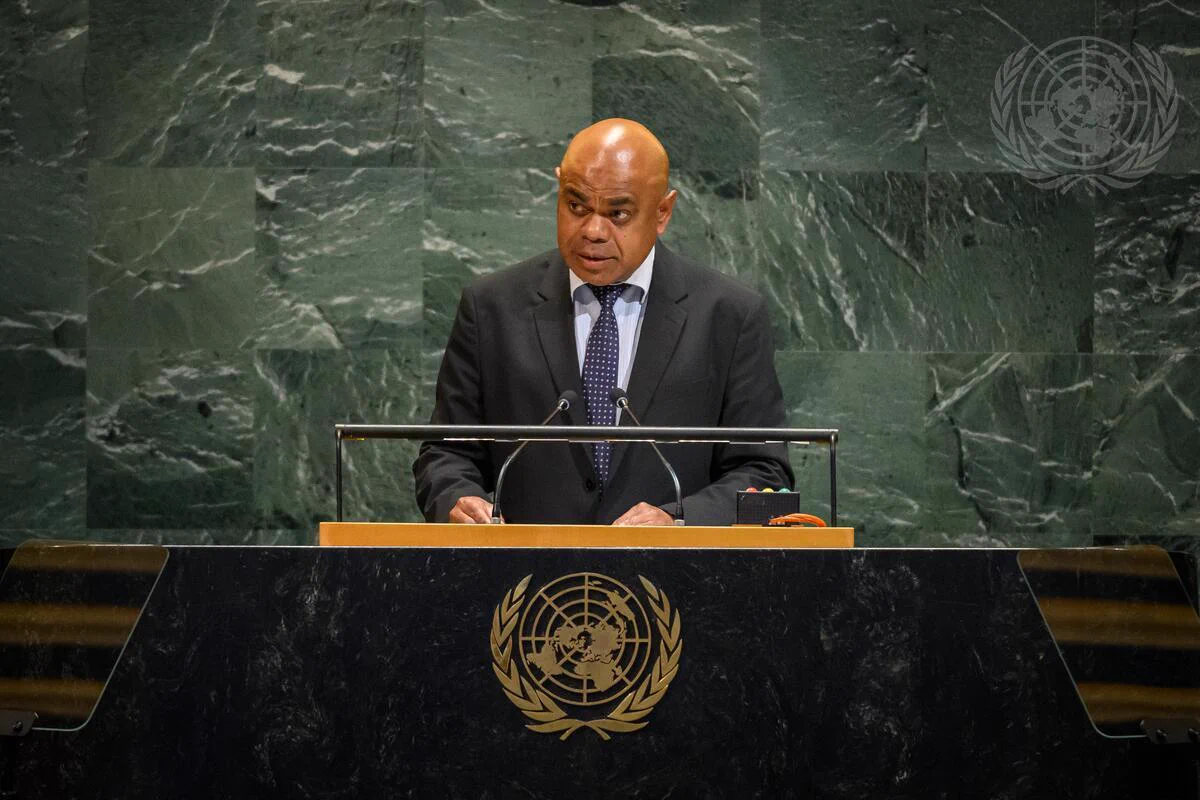
NEW YORK, (PACNEWS)- Vanuatu has raised concerns over alleged human rights violations in West Papua, called for the decolonisation of Kanaky New Caledonia and urged France to accept the jurisdiction of the International Court of Justice (ICJ) over the disputed Matthew and Hunter Islands.
Vanuatu’s Permanent Representative to the United Nations, Odo Tevi, raised the three issues in his address to the United Nations General Assembly in New York.
Tevi said peace and security could not be separated from human rights and called for renewed international attention to the situation of indigenous Papuans in West Papua.
“Vanuatu remains deeply concerned about reports of serious human rights violations affecting indigenous Papuans in West Papua,” Tevi said.
He said United Nations special procedures had raised concerns over indigenous rights, displacement, cultural rights, environmental impacts and the treatment of human rights defenders in Papua.
“The call from the Pacific Forum leaders for the UN Human Rights Commissioner visit to West Papua remains unheeded and needs to be action,” he said.
Tevi also reaffirmed Vanuatu’s support for the decolonisation of Kanaky New Caledonia, which remains on the UN list of Non-Self-Governing Territories.
“We reiterate the inalienable right of the indigenous Kanak people to self-determination and call for a peaceful, inclusive, transparent and credible process consistent with the Charter of the United Nations and relevant General Assembly resolutions,” he said.
Tevi said Vanuatu remained concerned about persistent socio-economic disparities affecting Kanaks, including inequalities in employment, education, income and access to economic opportunities.
He said the disparities were long-standing structural imbalances that constrained the full and equitable enjoyment of economic, social and cultural rights by indigenous Kanaks despite New Caledonia’s natural resources and economic potential.
“Addressing these disparities is essential to fostering social cohesion and advancing a just, inclusive and sustainable decolonisation process,” Tevi said.
Vanuatu called for the full implementation of relevant UN resolutions on New Caledonia and continued engagement among all stakeholders, including France as the administering power and representatives of the people.
Tevi also reaffirmed the role of the UN Special Committee on Decolonisation and the Fourth Committee in advancing self-determination.
He said the rights, aspirations and interests of the Kanak people must remain at the centre of the decolonisation process.
Turning to Vanuatu’s territorial dispute with France, Tevi said the Vanuatu Government had initiated proceedings against France before the International Court of Justice (ICJ)at the end of August.
The case concerns sovereignty over Umaenupne and Umaeneg islands, known in English as Matthew and Hunter Islands, as well as maritime boundaries between Vanuatu and New Caledonia.
“These islands are an integral part of Vanuatu’s territory,” Tevi said.
He said Vanuatu’s position was grounded in customary governance, long-standing historical connections and indigenous ownership, which he said formed part of the country’s responsibility as ancestral custodians.
Tevi acknowledged France’s support for the international rules-based order and its backing for international judicial institutions.
He also recognised France’s cooperation with Vanuatu on global climate action, including support for initiatives before the ICJ.
“We greatly value this partnership and France leadership on issues of international importance.
“It is in the same spirit of mutual respect and commitment to international law that we respectfully invite France to consent to the jurisdiction of the court,” Tevi said…. PACNEWS